AI-powered conversational booking assistant
To close that gap, an AI-powered conversational assistant was built directly into the platform, letting users ask questions in their own words and get accurate, real-time answers without contacting support.
Web and Mobile app (Android + iOS)
Language services / Booking management
Key challenges and how we solved them
What was the client’s key challenge
The real challenge was not query volume, but the shape of the questions. Analysis of incoming support tickets showed that roughly 70% were freeform data-lookup questions whose answers already existed in the platform.
The support team was acting as a translation layer between natural language and a structured system. Adding more filters or dashboards would not have closed that gap, the form factor itself was the bottleneck.
Manual support dependency reduced
Self-service enabled
Users can independently access booking status, assignments, and schedules without raising tickets, sending emails, or calling support.
What was our approach
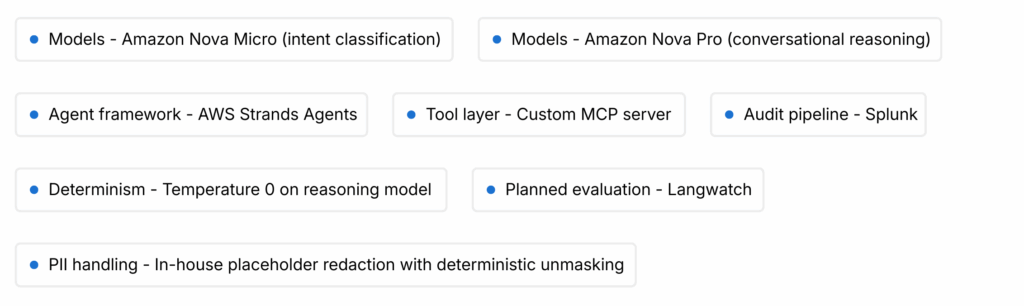
Team Mallow built a conversational assistant on a deterministic agent architecture: the LLM is allowed to understand, but not to act. A lightweight model classifies intent and gates every request. A larger reasoning model selects which tool to call, but never touches the database directly.
All data access flows through a dedicated MCP server fronting the existing booking APIs, and a custom redaction layer replaces PII with opaque placeholders before any data reaches the LLM. The result is fluent natural-language replies with strict, auditable boundaries.
Key functionalities delivered in the project
01
Conversational booking access
Users ask questions in their own words and get accurate booking answers, without learning a syntax, navigating menus, or filing a support ticket.
02
Real-time booking visibility
Every response is built from live backend data fetched at the moment of the query, ensuring status, assignment, and schedule details are current.
03
Self-service booking retrieval
Users independently access booking timelines, appointment details, and schedules for specific dates, days, or ranges, removing the dependency on support channels.
04
Flexible query handling
The assistant interprets the same intent across many phrasings, whether date based, status based, or assignment based, and asks for clarification or guidance when input is unclear.
05
Always-on availability
The assistant is accessible 24/7 for authenticated users, providing uninterrupted access to booking information well beyond standard support working hours.
06
Secure role-based access
Role-based authorisation is enforced at the backend, so the assistant can only return data the requesting user is already entitled to see.
07
Enterprise-grade security & compliance
PII is masked with placeholders before reaching the LLM, every interaction is logged with no raw personal data, and guardrails enforce scope on every query.
Ready to bring your product to life?
Technologies and capabilities to build and scale
Technology stack of the overall application

AI chatbot specific technology stack
Services offered
Business analysis
Analysed real support tickets, defined intent taxonomy, mapped booking query patterns, and documented edge cases and system behaviours.
UI/UX design
Designed intuitive conversational interfaces and platform touchpoints with iterative client reviews and structured validation cycles.
Frontend development
Built responsive web and mobile interfaces, integrating the conversational assistant seamlessly into the existing booking platform.
Backend development
Built scalable backend services and APIs to handle query routing, tool orchestration, PII redaction, and audit logging securely.
DevOps
Configured AWS infrastructure, deployment pipelines, monitoring, and observability to ensure scalability, reliability, and performance at production load.
Integrations
Integrated booking APIs, authentication, the MCP tool server, and Bedrock model access to enable secure, real-time interactions.
AI and chatbot development
Designed and implemented the conversational assistant using Amazon Nova models, AWS Strands Agents, and a custom MCP tool layer.
Quality assurance
Conducted end-to-end testing of conversational flows, tool-call accuracy, edge cases, and PII redaction to ensure reliable behaviour.
How we approached and executed the project
Designed around distinct user roles and their pain points
Booking user
Core need
Instantly access booking status, assignments, and schedules without contacting the support team.
Biggest pain
No self-service access to live booking data forces dependence on support channels.
On-demand usage, self-service driven
Support team
Core need
Cut repetitive query volume and focus on complex, high-value support cases efficiently.
Biggest pain
Routine booking questions consume the time needed for escalations and critical requests.
Continuous workload, operations-focused
What impact did team Mallow deliver?
- Self-service access to booking information through a conversational interface
- Reduced support dependency on routine, repetitive booking queries
- Faster, more accessible booking information for end users
- Real-time visibility into booking status, assignments, and schedules
- Auditable AI interaction layer with PII protection by design
- Foundation for future capabilities like booking creation and modification

Explore more on what really goes into shaping our client's successful outcomes?
No two journeys here follow the same path. Each story captures a different starting point, set of constraints, and path to execution. As you explore our portfolio, you’ll see how priorities shifted, what trade-offs were made, and how decisions evolved in response to real-world challenges. It gives you a more complete view of what actually shapes outcomes, beyond just what gets built.