AI agents are quickly moving from experimental technology to operational infrastructure.
Businesses are no longer exploring AI only for chatbots or internal productivity experiments. They are beginning to evaluate how AI systems can coordinate workflows, interact with enterprise tools, automate decision-making, and reduce operational overhead across departments.
That shift has created a new challenge.
Finding an AI development partner is now easy. Finding one that can actually build reliable, scalable, enterprise-grade AI agents is considerably harder.
The market is crowded with vendors showcasing chatbot demos, AI wrappers, and automation prototypes. But production AI systems require something very different. They demand orchestration engineering, infrastructure maturity, governance planning, workflow understanding, and long-term operational thinking.
For businesses evaluating AI adoption seriously, vendor selection is becoming one of the most important decisions in the implementation journey.
Why choosing the right AI agent development partner matters
Many organizations still underestimate how different AI agent projects are from traditional software development initiatives.
In conventional applications, workflows are largely deterministic. Inputs follow expected paths, outputs are predictable, and system behavior can usually be controlled with explicit business logic.
AI systems behave differently.
Large language models operate probabilistically. Outputs can vary. Context influences behavior. Workflow paths may evolve dynamically depending on inputs, retrieved data, or reasoning quality.
That introduces an entirely new category of engineering complexity.
A proof-of-concept might appear impressive during a demo and still fail once exposed to –
- fragmented enterprise systems
- inconsistent internal data
- high operational volume
- edge-case workflows
- compliance constraints
- unpredictable user behavior
This is one of the biggest reasons many AI initiatives stall after early experimentation.
According to research published through McKinsey AI Insights, organizations are increasingly discovering that operational integration and governance are far more difficult than initial AI prototyping.
The challenge is rarely “getting AI to work.”
The challenge is building systems around AI that continue working reliably at scale. Technical teams planning enterprise deployments can also explore how organizations move from early AI prototypes into scalable production-ready systems.
That distinction is what separates mature AI engineering partners from vendors that are simply reacting to market demand.
What an AI agent development partner should actually bring to the table
One of the biggest misconceptions in the market is that AI agent development primarily revolves around selecting a model and writing prompts.
In reality, prompts are usually the smallest part of the implementation effort.
Enterprise AI systems involve a much broader engineering ecosystem that includes –
- workflow orchestration
- memory handling
- infrastructure scaling
- observability
- API integrations
- security controls
- governance frameworks
- deployment pipelines
A capable AI partner should approach the engagement as a systems engineering initiative rather than a standalone AI experiment.
Workflow understanding matters more than AI buzzwords
Strong AI implementations usually begin with workflow analysis, not model selection.
A mature partner should spend time understanding –
- where operational bottlenecks exist
- which processes are repetitive
- where human decision-making slows execution
- what systems currently interact within the workflow
- where automation boundaries should exist
This becomes especially important because not every process is suitable for AI-driven automation.
For example, automating internal knowledge retrieval may provide immediate value with relatively low operational risk. Fully autonomous financial approval workflows, however, introduce a very different level of governance complexity.
An experienced AI partner should understand that distinction early.
Architecture and orchestration are critical
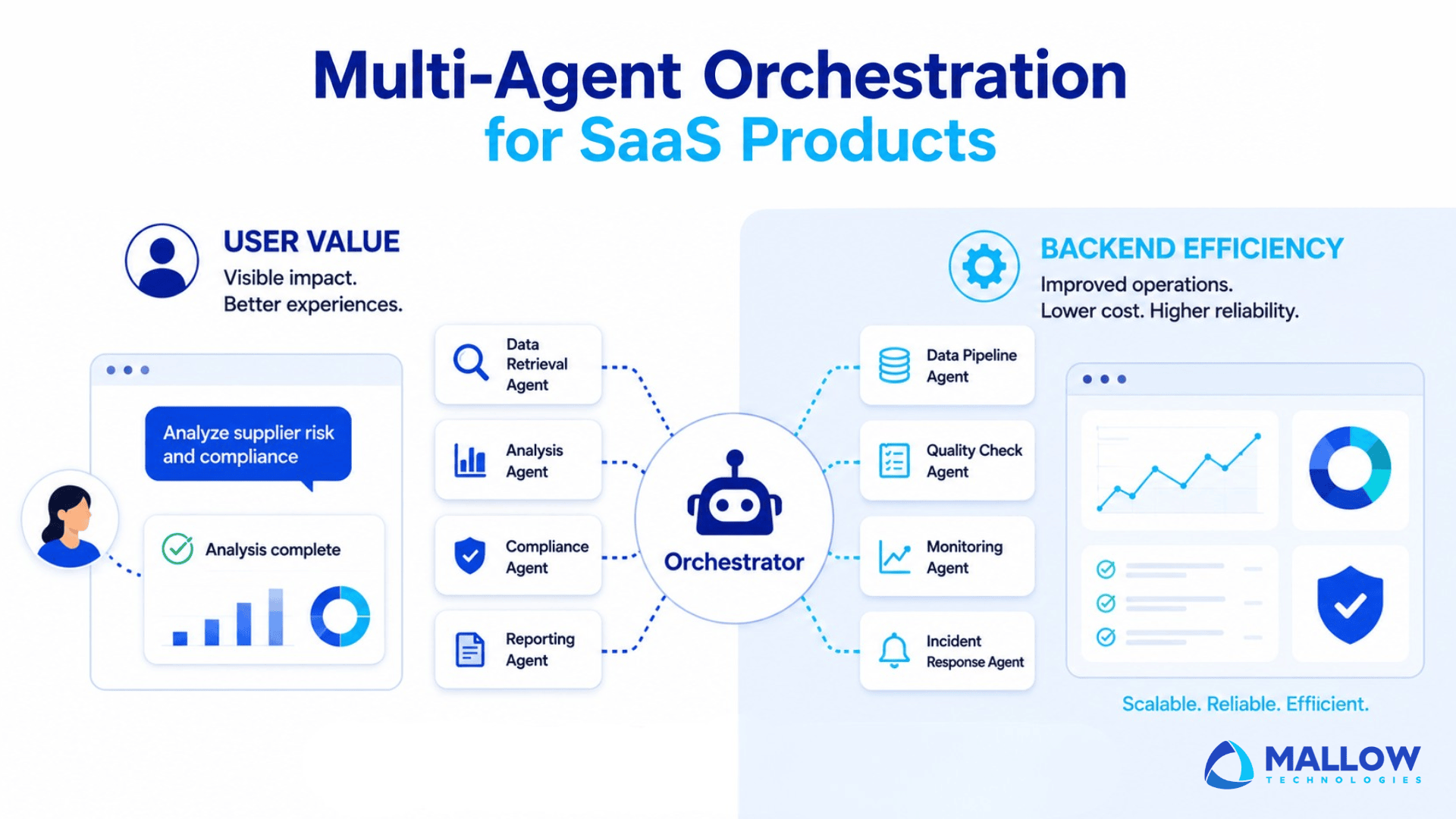
The AI model itself is only one component inside a much larger operational system.
Most enterprise AI agents require –
- orchestration layers
- vector databases
- retrieval systems
- workflow engines
- memory systems
- API coordination
- monitoring pipelines
Without proper orchestration, even advanced models become unreliable inside real-world workflows.
Frameworks such as LangChain Documentation and modern orchestration platforms have accelerated development capabilities, but implementation quality still depends heavily on engineering maturity.
This is why businesses should evaluate architecture thinking, not just interface demonstrations.
How to evaluate real AI engineering expertise
One of the most difficult parts of vendor evaluation today is separating actual AI engineering capability from AI-themed marketing.
Nearly every software vendor now claims to offer AI services. But there is a major difference between –
- integrating an API into a chatbot interface
and - engineering production-grade AI workflows inside enterprise environments
That difference becomes visible very quickly once technical discussions move beyond demos.
Look beyond surface-level demonstrations
Many AI vendors focus heavily on polished demonstrations.
The problem is that demos rarely reveal –
- workflow reliability
- orchestration maturity
- infrastructure scalability
- observability planning
- governance handling
- operational resilience
A chatbot answering questions correctly in a controlled environment does not necessarily indicate production readiness.
Instead of focusing only on outputs, businesses should evaluate how vendors discuss –
- workflow failures
- model inaccuracies
- retry handling
- monitoring systems
- escalation logic
- human approvals
Those conversations reveal actual engineering depth.
Ask about production deployment experience
A vendor that has only built prototypes will usually speak differently from one that has managed enterprise deployments.
Production AI systems introduce operational realities such as –
- inference latency
- scaling costs
- concurrency limits
- infrastructure optimization
- monitoring requirements
- workflow recovery mechanisms
Experienced AI partners tend to discuss these operational details naturally because they have already encountered them in live environments.
Cloud ecosystems from providers like AWS AI Services, Google Cloud AI Documentation, and Microsoft AI Documentation have significantly improved enterprise AI deployment capabilities, but successful implementations still require strong infrastructure expertise.
Why reliability engineering is becoming more important than prompt engineering
A surprising number of AI discussions still revolve around prompts.
But in enterprise systems, prompt quality is only one piece of the reliability equation.
Businesses evaluating AI partners should pay closer attention to how vendors handle operational uncertainty. Teams implementing execution-oriented AI systems can also explore how businesses design workflows that allow AI systems to safely take actions inside production environments.
For example –
- What happens if the model produces an incorrect response?
- How does the workflow recover from failures?
- Can outputs be validated before execution?
- Are there escalation paths for high-risk scenarios?
- How are hallucinations monitored over time?
These questions matter because AI agents frequently operate inside workflows connected to –
- customer systems
- operational data
- internal tools
- compliance processes
- financial systems
A single incorrect action may have downstream operational consequences.
This is why mature AI systems increasingly rely on –
- human-in-the-loop workflows
- validation pipelines
- confidence scoring
- retrieval systems
- fallback handling
- permission boundaries
A capable development partner should already be discussing these considerations before implementation begins.
Security and governance should never be an afterthought
One of the clearest warning signs during vendor evaluation is when security discussions are either superficial or completely absent.
Enterprise AI systems introduce new security concerns that many traditional software teams are still learning to manage.
This includes risks involving –
- prompt injection
- sensitive data exposure
- insecure tool integrations
- excessive model permissions
- workflow manipulation
- unmonitored data access
The OWASP LLM Security Project has already identified emerging security categories specific to large language model applications, and these concerns are becoming increasingly relevant in enterprise deployments.
A mature AI partner should be able to explain –
- how data is isolated
- how permissions are enforced
- how audit logs are maintained
- how workflow actions are monitored
- how model interactions are secured
If security only appears late in the conversation, that is usually a red flag.
Enterprise integration experience often determines project success
Many AI projects fail not because the model underperforms, but because the surrounding enterprise environment is far more complicated than expected.
AI agents rarely operate independently.
They typically need to interact with –
- CRMs
- ERP systems
- internal APIs
- ticketing platforms
- analytics systems
- cloud infrastructure
- authentication layers
This creates integration complexity that is often underestimated during early planning.
A technically mature partner should already understand –
- enterprise authentication models
- API orchestration
- middleware architecture
- event-driven systems
- workflow synchronization
- data consistency challenges
Businesses should evaluate whether the vendor has genuine enterprise systems experience, not just AI experimentation experience.
That distinction becomes critical once workflows scale operationally.
Questions businesses should ask before choosing an AI agent development partner
The quality of vendor conversations often improves significantly when businesses move beyond generic capability discussions.
Instead of asking only what technologies a vendor uses, it is more valuable to understand how they think operationally.
A few questions tend to reveal technical maturity quickly –
How do you handle AI workflow failures?
Every production AI system eventually encounters failure conditions.
Strong partners usually discuss –
- retries
- workflow recovery
- escalation handling
- fallback logic
- human intervention mechanisms
Weak partners often avoid discussing failures entirely.
How do you measure AI reliability?
Reliability in AI systems is more difficult to measure than traditional application uptime.
A capable vendor should discuss –
- evaluation frameworks
- workflow success metrics
- hallucination monitoring
- output validation
- operational observability
How will the AI agent integrate into existing workflows?
This question often reveals whether the vendor truly understands enterprise operations.
Production AI systems need to coexist with –
- legacy software
- internal processes
- governance rules
- operational dependencies
Integration thinking matters significantly more than isolated AI capabilities.
What is your approach to governance and security?
Security maturity should appear early in the conversation, not after architecture discussions are complete.
Vendors should already have structured approaches for –
- access control
- auditability
- encryption
- monitoring
- compliance handling

Explore how AI agents can
integrate into your business systems
Build AI agents aligned with your workflows, integrations,
and business goals to improve efficiency, scalability,
and operational reliability.
Red flags businesses should watch for during vendor evaluation
Certain patterns appear repeatedly in immature AI engagements.
Overpromising fully autonomous AI systems
Completely autonomous enterprise AI workflows are still relatively rare.
Most successful implementations today involve carefully controlled automation boundaries with human oversight mechanisms in place.
Vendors promising fully autonomous operations without discussing governance usually lack operational maturity.
Excessive focus on models instead of systems
Strong AI engineering conversations tend to focus heavily on –
- workflows
- orchestration
- reliability
- monitoring
- integrations
- operational scalability
Weak conversations usually revolve only around –
- model names
- prompt quality
- chatbot interfaces
- hype-driven terminology
No clear discussion around long-term operations
Enterprise AI systems are not static deployments.
They require ongoing –
- monitoring
- optimization
- infrastructure management
- workflow tuning
- governance updates
A partner that only discusses initial delivery but not operational sustainability may struggle once the system moves into production.
Why specialized AI expertise alone is not enough
Interestingly, some businesses now overcorrect in the opposite direction by focusing exclusively on AI specialization.
AI expertise matters, but enterprise AI projects still depend heavily on broader engineering capabilities.
Production AI systems require –
- backend engineering
- DevOps
- cloud infrastructure
- observability tooling
- API architecture
- deployment automation
- security engineering
This is why the strongest AI partners are often companies that combine –
- AI engineering maturity
with - full-stack software delivery expertise
Businesses should evaluate whether the vendor can support the entire operational lifecycle instead of only the AI layer itself.
Evaluating cost expectations realistically
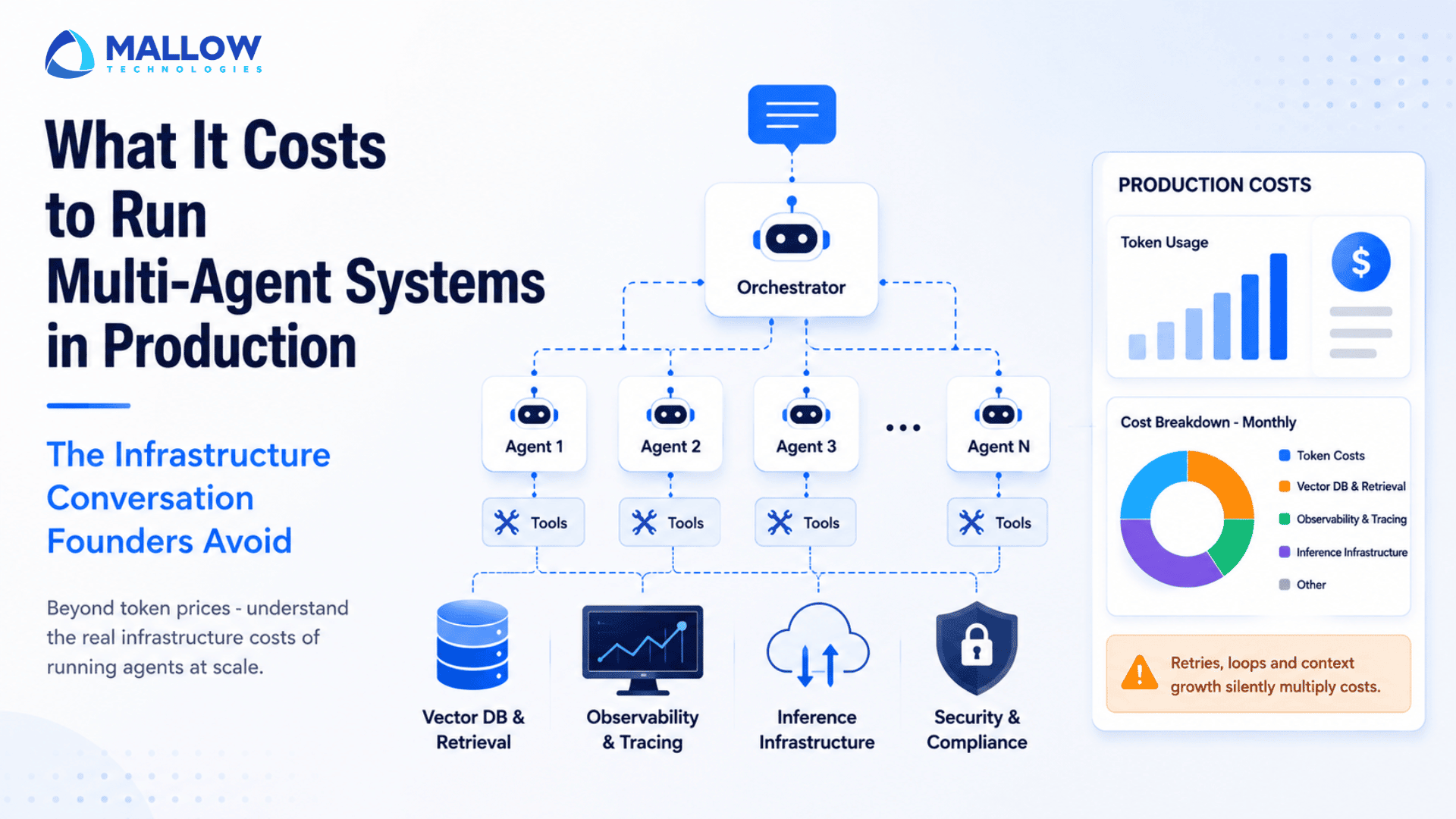
One of the biggest misconceptions around AI implementation is that successful prototypes automatically translate into inexpensive production systems.
Production-grade AI agents often require significantly more investment in –
- orchestration
- governance
- integrations
- infrastructure scaling
- monitoring
- security controls
There is also a substantial difference between –
- a proof-of-concept
and - a production workflow handling live operational data
Infrastructure costs can also evolve quickly depending on –
- inference volume
- concurrency
- workflow complexity
- model selection
- retrieval architecture
A mature AI partner should discuss these tradeoffs transparently instead of minimizing them during early sales conversations.
How Mallow approaches enterprise AI agent development
At Mallow, we approach AI agent development as a long-term operational engineering initiative rather than a short-term experimentation exercise.
Our focus is not simply on integrating AI models into applications. We work with businesses to design scalable AI systems that align with real operational workflows, infrastructure requirements, and governance expectations.
That includes –
- workflow discovery
- AI orchestration design
- enterprise integrations
- cloud-native deployment architecture
- observability planning
- infrastructure optimization
- governance implementation
Because enterprise AI systems operate inside critical business environments, reliability and maintainability become just as important as capability demonstrations.
From workflow automation to multi-system orchestration and scalable deployment engineering, our teams help organizations move from isolated AI experimentation toward production-ready AI operations that deliver measurable business impact.
If your business is evaluating AI adoption opportunities, choosing the right implementation partner early can significantly influence long-term scalability, operational reliability, and return on investment. Connect with our AI engineering team to explore the right approach for your business.
Your queries, our answers
Businesses should evaluate technical expertise, workflow orchestration capability, enterprise integration experience, governance maturity, cloud infrastructure knowledge, and production deployment experience.
AI agent systems involve workflow orchestration, memory handling, integrations, monitoring, governance controls, and operational reliability engineering beyond simple conversational interfaces.
Strong AI engineering partners typically demonstrate experience with production deployments, reliability engineering, enterprise integrations, observability systems, and workflow scalability rather than only chatbot demonstrations.
Common red flags include overpromising autonomous AI capabilities, ignoring governance discussions, lacking enterprise integration experience, and focusing heavily on AI hype instead of operational architecture.
The strongest AI implementation partners often combine specialized AI expertise with broader software engineering, cloud infrastructure, DevOps, and enterprise integration capabilities.
What happens after you fill-up the form?
Request a consultation
By completely filling out the form, you'll be able to book a meeting at a time that suits you. After booking the meeting, you'll receive two emails - a booking confirmation email and an email from the member of our team you'll be meeting that will help you prepare for the call.
Speak with our experts
During the consultation, we will listen to your questions and challenges, and provide personalised guidance and actionable recommendations to address your specific needs.

Author
SathishPrabhu
Sathish is an accomplished Project Manager at Mallow, leveraging his exceptional business analysis skills to drive success. With over 8 years of experience in the field, he brings a wealth of expertise to his role, consistently delivering outstanding results. Known for his meticulous attention to detail and strategic thinking, Sathish has successfully spearheaded numerous projects, ensuring timely completion and exceeding client expectations. Outside of work, he cherishes his time with family, often seen embarking on exciting travels together.