Every SaaS founder in our network is having some version of the same conversation right now. Someone on the team has pitched adding AI agents to the product. The board has asked about the AI roadmap. A competitor just shipped an “AI-powered” workflow. And now you are trying to figure out what any of this actually means for your backlog and your budget.
Most founders searching for AI agent development services are asking the second question when they should still be on the first. The second question is “which agency should we hire?” The first question is “do we actually understand what we are commissioning?”
That gap is where the majority of AI agent projects go wrong. Not because the model underperformed. Not because the agency was incompetent. Because the people who approved the project did not have a clear enough picture of what production AI agents actually require, and the people building it did not push back hard enough to find out.
This article is a working guide for SaaS founders who are somewhere between “we know we want AI agents” and “we have a team ready to build.” It is not a sales pitch for AI. It is a framework for thinking clearly about whether you have the right problem, the right architecture, and the right partner before a single line of code is written.
What AI agents actually are, and why the definition matters more than you think
The phrase “AI agent” is doing a lot of work in the industry right now, and it is covering for a wide range of things that behave very differently in production.
Here is the distinction that matters. An AI feature is self-contained. You pass it an input, it returns an output. A sentiment classifier. A smart search ranking model. An AI-generated email summary. These are valuable, and they are relatively predictable to build and operate.
An AI agent is fundamentally different because it introduces autonomous decision-making across multiple steps. An agent receives a goal, not just an input. It decides what information to gather, which tools to call, in what order, evaluates whether each step produced a useful result, and adapts if something did not go as expected. It is not generating a response. It is executing a plan.
The distinction that actually changes your engineering decisions
The difference between a feature and an agent is not semantic. It has direct consequences for how you architect the system, what your infrastructure needs to handle, and what “done” even means.
An AI feature has deterministic failure modes. You know when it is wrong because the output is wrong. An AI agent can fail silently. It might call the right tool with the wrong inputs. It might misinterpret a successful tool response and proceed down the wrong path. It might produce a confident-sounding final output that is factually wrong because one intermediate step returned ambiguous data.
This is why evaluation is the hardest part of AI agent development, and why most teams underestimate it. Teams planning larger operational transformation initiatives can also explore our article on how businesses are moving beyond rule-based automation into agentic AI workflows. You cannot just test whether the output looks right. You have to test whether every step in the chain behaved correctly, under varied conditions, including conditions you did not anticipate when you wrote the spec.
Why SaaS products are built for AI agents
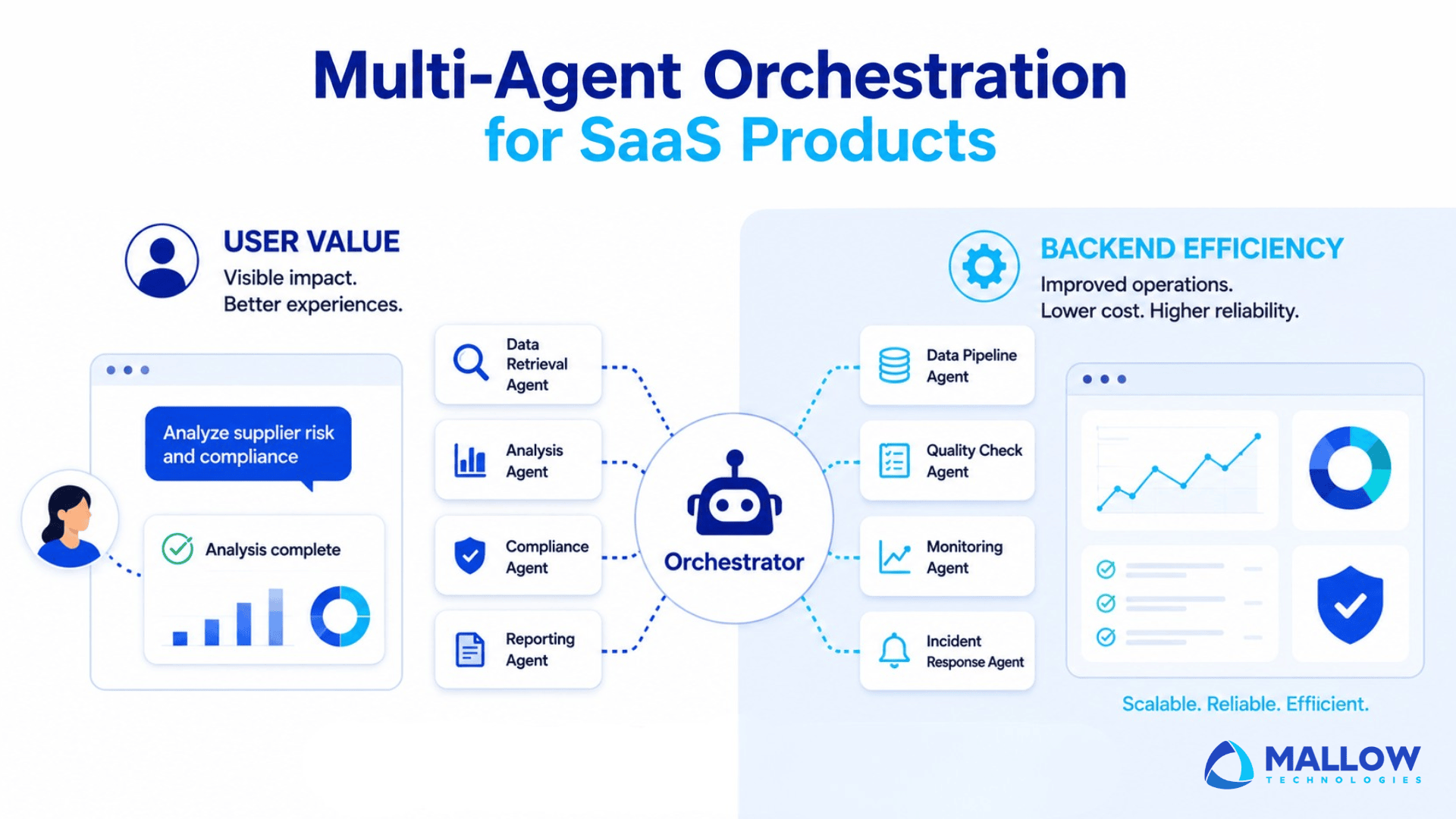
AI agents are not useful in isolation. They need three things to function well: a clear goal to pursue, tools they can invoke to take action, and data they can reason over to make decisions. SaaS products already have all three. Your product stores structured user data. It has a defined set of actions it can perform on a user’s behalf. Your APIs are the exact surface that an agent’s tool layer needs. And your users arrive with goals they want to accomplish, which is precisely what agents are designed to help with.
This is why AI agents embedded in SaaS products tend to produce meaningfully better outcomes than agents built as standalone tools. The environment is rich, the context is specific, and the tools are pre-defined by the product’s existing functionality.
The product implication is also significant. According to McKinsey’s 2025 research on AI in enterprise software, only 16 percent of SaaS companies have successfully commercialised AI capabilities, while those that have are seeing materially stronger revenue signals. Products that embed AI into core user workflows rather than treating it as an adjacent feature are consistently the ones extracting measurable business value. Agents that operate inside your product’s core workflows are stickier than AI features bolted on at the edges.
The production reality no one in the sales pitch mentions
Here is what development agencies should tell you upfront, and often do not.
- Latency compounds with every step. A single LLM call to a capable model takes between 600 milliseconds and 2.5 seconds depending on prompt size and load. If your agent chains five steps together, you are looking at 3 to 12 seconds of wall clock time before the user sees anything. For a synchronous user-facing feature, that is not viable. Your infrastructure needs to be designed for async execution from day one, not retrofitted when users start complaining.
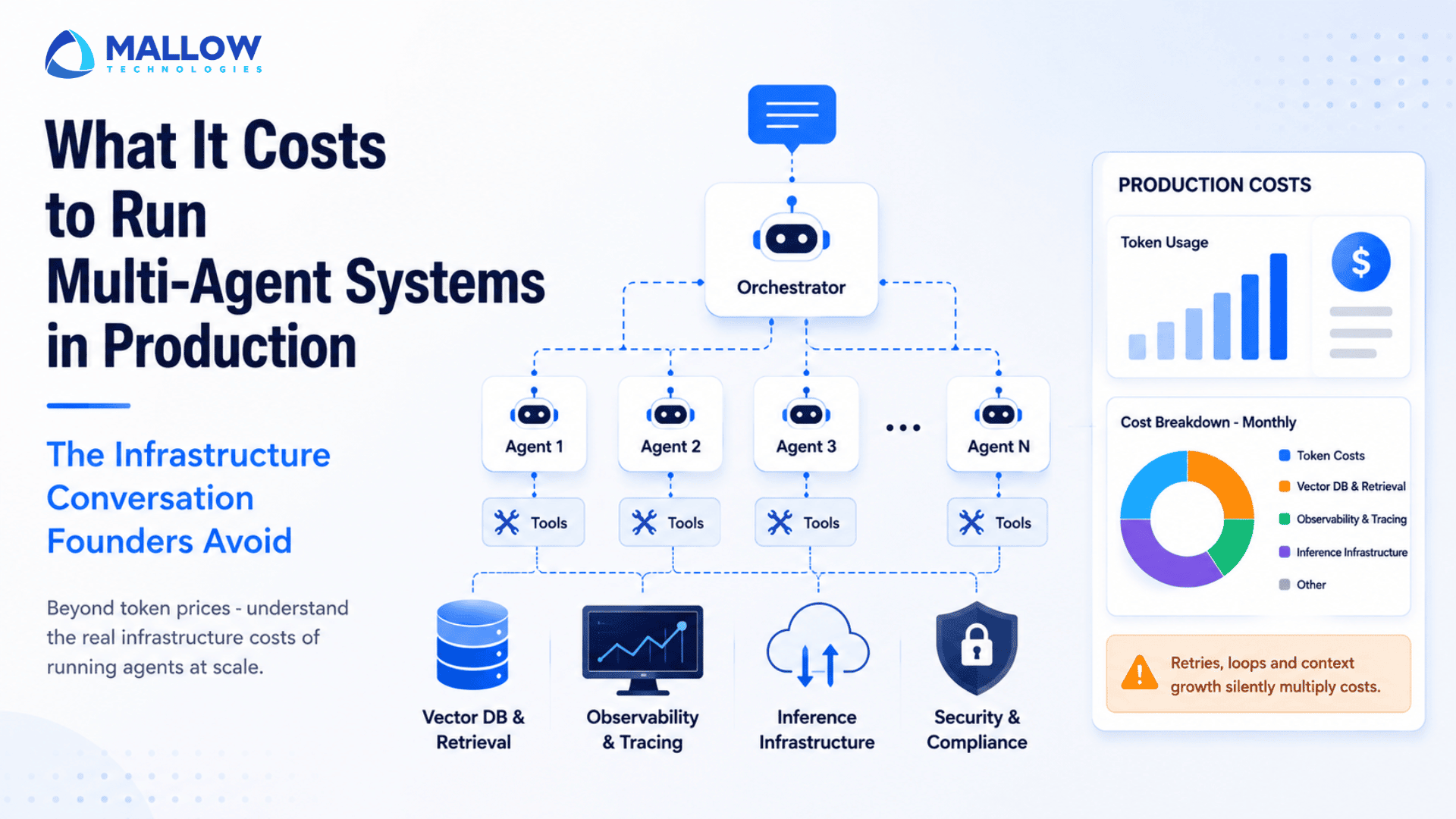
- Token costs are a business decision, not a technical one. Every agent invocation has a cost in tokens. A five-step agent with 2,000 input tokens and roughly 750 output tokens per step consumes approximately 10,000 input tokens and 3,750 output tokens per user interaction. Based on current GPT-4o pricing of $2.50 per million input tokens and $10.00 per million output tokens, that works out to approximately four to seven cents per invocation depending on output verbosity. At 50,000 monthly agent invocations, you are looking at $2,000 to $3,500 per month in inference costs alone, before any infrastructure overhead. This is why model selection is a business decision, not just a technical one. Routing decisions and input classification can run on significantly smaller, cheaper models without meaningful quality degradation. A senior AI engineer should be designing this cost architecture deliberately, not leaving it as a default.
- Prompt regression is a real operational risk. Model providers update their models. When they do, your carefully crafted prompts can behave differently. An agent that passed your evaluation suite on one model version may produce subtly wrong outputs after an update. Catching this requires ongoing evaluation infrastructure, not a one-time test suite you run at launch. This operational cost is rarely included in agency proposals and frequently comes as a surprise.
- The context window ceiling. Agents that accumulate context over long conversations eventually hit a ceiling where the model’s attention starts to degrade on information from earlier in the chain. This is a memory architecture problem, not a model problem. Teams still deciding between retrieval architecture and model fine-tuning approaches can also explore our article explaining where retrieval systems create stronger production outcomes. Short-term memory in the active context window, long-term memory in an external vector store, and structured memory via direct database lookups each serve different purposes. A production agent needs a deliberate strategy across all three. Skipping this produces an agent that works well for the first two minutes of a user session and becomes unreliable after five.
Use cases worth pursuing right now for your business
Not every AI agent idea has good production economics. These are the use cases where the value-to-complexity ratio tends to justify the investment.
- Intelligent onboarding that adapts in real time. A linear wizard cannot recover gracefully when a user deviates from the expected path. An agent can ask follow-up questions, interpret non-standard answers, and configure the product accordingly. The value is significant: onboarding completion rates and time-to-value improvements are directly measurable.
- High-volume document and data processing. For SaaS products that ingest invoices, contracts, support tickets, or user-submitted content, a well-designed agent pipeline handles edge cases that rule-based classifiers cannot. The failure mode is also well-contained: the agent processes a document, a human reviews the output, and incorrect processing is caught before it becomes a downstream problem.
- Proactive anomaly detection and alerting. An agent with access to usage data can identify leading indicators of churn, billing exceptions, or security anomalies before they become incidents. This is a use case where async architecture shines. The agent does not need to respond in real time. It runs on a schedule, evaluates what it finds, and acts only when it identifies something worth acting on.
- Automated multi-step research and reporting. Generating contextualised reports for individual customers at scale is the kind of task that is simultaneously high value for the customer and expensive in human analyst time. An agent that can reason over product data, structure the findings into a templated report, and flag edge cases for human review closes that gap meaningfully.
Build in-house vs hire an AI agent development service
This is the real decision most founders are making when they search for AI agent development services. Here is an honest breakdown.
Building in-house makes sense if your engineering team already has senior production experience with LLM-based systems, your main roadmap can absorb a 12 to 20 week R&D period with uncertain output, and you have the infrastructure to support non-deterministic failure modes from day one. If all of those are true, the knowledge retention and architectural control of in-house development is genuinely valuable.
Most Seed to Series B SaaS teams do not have all of those conditions at once. Strong product engineers who have never shipped an agent to production will underestimate the evaluation and observability requirements. The R&D risk eats capacity that was budgeted for the features your paying customers are waiting for.
An AI agent development agency is the right call when you need a production-ready system within a defined timeline, when your team has no prior AI agent production experience to draw on, when the architectural stakes of getting it wrong are high enough that you want a team that has already made those mistakes, or when you want the project to run in parallel to your core roadmap without cannibalising engineering capacity.
The qualification criteria for a serious agency are specific. Before timelines or deliverables are discussed, a competent team will want to understand your data model, your API surface, your infrastructure, and your current deployment process. They will have opinions about where your architecture is agent-ready and where it needs hardening first. If a team skips straight to scope and budget before asking those questions, that is a signal worth taking seriously.
What AI agent development services should actually include
Any engagement that does not include all of the following is under-scoped, regardless of what the proposal says.
- Architecture design before build. The discovery phase should produce a technical design document that maps your existing product to the agent’s toolset, specifies the memory architecture, identifies latency risks, and defines the evaluation approach. This document is the engagement’s foundation. Without it, scope creep is inevitable.
- Deliberate model selection. The default of “we will use GPT-4o for everything” is a cost and performance risk. A well-scoped project identifies which steps need high reasoning capability, which steps can run on faster and cheaper models, and what the cost model looks like at your expected usage volume. The OpenAI API pricing page is a useful reference for understanding how quickly inference costs scale across model tiers.
- Tool definition and contract design. Every action the agent can take needs to be defined as a callable tool with explicit input and output contracts, error handling, and timeout behaviour. This work requires both backend engineering skill and a thorough understanding of where API calls fail in production under load.
- Orchestration layer implementation. This is where frameworks like LangChain or LangGraph come in. The orchestration layer manages how your agent plans, selects tools, handles errors, and loops on outputs. LangGraph is particularly well suited to multi-step agentic workflows where state needs to be tracked explicitly across steps. This is the most complex part of the build and the part most likely to create production problems if it is not designed carefully from the start.
- Evaluation pipeline as a first-class deliverable. The evaluation framework should be built alongside the agent, not after. It should cover step-level accuracy, chain-level coherence, and failure mode coverage including the conditions the happy path does not anticipate.
- Observability and monitoring. Production AI agents need logging that standard application monitoring tools are not designed for. You need visibility into reasoning traces, token usage, tool call latency, and failure distribution at each step of the chain. Without this, debugging a misbehaving production agent is essentially guesswork.
If you want to see how we scope and structure AI agent engagements before writing a single line of code, our case studies walk through the approach in detail.
What usually goes wrong during AI agent projects
These are the patterns that appear repeatedly, and they are worth knowing before you start.
- Scope is defined too loosely. “Build us an AI agent that handles customer onboarding” is not a spec. The more precisely you can define the agent’s goal, the tools it should have access to, the data it should read, and the actions it should be able to take, the more predictable the build will be.
- The proof of concept passes a demo but fails in production. It is surprisingly easy to build something that works on twenty carefully chosen test cases and breaks on the twenty-first real user interaction. This is not a flaw in AI agents as a concept. It is a sign that the evaluation process was not rigorous enough during development.
- Infrastructure is underestimated. AI agents introduce latency that standard SaaS infrastructure is not optimised for. A single agent invocation might chain five or six LLM calls with tool calls in between. If your infrastructure is not designed to handle this gracefully, the user experience degrades fast.
- Memory is an afterthought. Stateless agents are only useful in a narrow set of contexts. Most SaaS use cases require some form of persistent memory. Designing memory architecture late in a project is painful and expensive.
- The team tries to use a single model for everything. Different steps in an agent workflow have different requirements. Routing decisions can use a small, fast, cheap model. Complex reasoning steps might need a more capable one. Mixing these deliberately is a cost optimisation strategy that many teams skip until they see the inference bill.
How to evaluate your development partner
Choosing an AI agent development agency is a different decision from hiring a standard software vendor. The failure modes are less obvious, the technical vocabulary is easy to fake, and a confident-sounding proposal can mask a team that has never shipped an agent past a demo environment. The questions below are designed to surface the difference quickly.
Ask for a specific production failure, not a success story
Most agencies will lead with what went well. That tells you almost nothing. Ask them directly – describe an AI agent they have shipped to production users, and then ask what broke in production that did not break in development. How did they know something was wrong? How did they diagnose the cause? What did they change?
A team with genuine production experience will answer this without hesitation. They will have a specific story. It might involve an edge case in tool input formatting that only appeared at scale, a timeout failure on a third-party API that caused the whole chain to fail silently, or a memory retrieval issue that produced confident but factually wrong outputs for a subset of users. The specifics do not matter as much as the fact that they exist.
A team that struggles to answer this question has likely not shipped an agent to real users under real conditions. Agencies that pivot to talking about their process or their framework choices when asked about failures are signalling that their production experience is thinner than the proposal suggests.
Follow-up worth asking – How long did it take to diagnose the issue once it appeared in production? The answer tells you a great deal about the quality of their observability setup.
Dig into their evaluation methodology
AI agents are non-deterministic. The same input can produce different outputs across runs, across model updates, and across changes in the external tools the agent calls. Any team that tests an agent the same way they test deterministic software does not understand what they are building.
Ask them to describe their evaluation pipeline. What does their test suite cover? How do they handle the fact that there is no single correct output for most agent tasks? Do they evaluate at the step level (did each tool receive the right inputs and return useful outputs?) or only at the chain level (did the final output look reasonable?)? How do they catch prompt regression after a model provider pushes an update?
A team with a mature evaluation approach will talk about things like golden dataset construction, LLM-as-judge evaluation patterns, step-level trace logging, and regression testing against prior outputs when a new model version is deployed. They will treat evaluation as an engineering discipline, not a QA afterthought.
A team that describes their evaluation as “we run it through a set of test cases and check that it looks right” is building to demo quality, not production quality. That gap will cost you significantly once real users are involved.
Follow-up worth asking – How do you handle evaluation when the agent’s task involves open-ended generation, where there is no single right answer? This question quickly separates teams that have thought seriously about this from those who have not.
Test their model selection reasoning
A team that defaults to GPT-4o for every step in an agent chain is either not thinking about cost architecture or not confident enough in their understanding of the model landscape to make deliberate choices. Neither is a good sign.
Ask them to walk you through how they would select models for your specific use case. What factors drive that decision? How do they think about the trade-off between capability and cost at different steps in the chain? Do they use smaller, faster models for routing and classification steps while reserving more capable models for complex reasoning steps? Have they worked with open-weight models and do they have an opinion on when they are the right choice?
A team with genuine depth here will think about model selection the way a senior engineer thinks about infrastructure choices: as a set of deliberate trade-offs with measurable consequences for performance, cost, and reliability. They will ask you about your latency requirements, your expected usage volume, and your tolerance for occasional output quality variance before making any recommendation.
A team that says “we use the latest OpenAI model” and moves on has not built the cost architecture thinking into their process. At scale, that gap becomes your problem, not theirs.
Follow-up worth asking – Can you show me an example of how you documented model selection decisions for a past client, and what the inference cost projection looked like before and after optimisation?
Ask what monitoring looks like on day thirty-one
Launch day monitoring is table stakes. Any reasonable team will have logging in place at go-live. The more revealing question is what the monitoring picture looks like six weeks after launch, when the initial attention has faded and the agent is running as a background system.
Ask them what their observability setup looks like for a production agent. Can they see reasoning traces at the step level, not just final outputs? Do they have alerting on tool call failure rates, token usage anomalies, and latency spikes within individual chain steps? How do they distinguish between a model behaving unexpectedly and a tool returning bad data? What does their incident response process look like when an agent starts producing wrong outputs for a subset of users?
A team with strong production experience will have specific answers to all of these. They will have tooling opinions, whether that is LangSmith for tracing, custom logging pipelines, or third-party observability platforms. They will be able to describe a specific incident where their monitoring caught something before a user reported it.
A team that describes monitoring as “we check the logs if something gets flagged” is not equipped to maintain a production agent reliably. AI agents fail in ways that standard application monitoring was not designed to catch. If the team does not have AI-specific observability built into their process, post-launch maintenance will be reactive and expensive.
Follow-up worth asking – How do you handle a situation where the agent’s outputs have silently degraded in quality but no hard errors are being thrown? This question cuts to the heart of whether they have thought seriously about non-deterministic failure modes.
Assess the depth of their integration experience
An AI agent does not exist in isolation. It integrates with your product’s data layer, your API surface, your background job infrastructure, and your real-time delivery layer. A team that understands orchestration frameworks but has only ever integrated agents with a narrow set of technologies will find ways to make your product fit their patterns rather than designing the integration correctly for your architecture.
Ask them specifically about their integration experience with your stack. How have they connected agent orchestration layers to existing backend applications? What is their approach to designing the API contracts that the agent’s tool layer calls? How do they handle situations where your existing APIs are not structured in a way that maps cleanly to agent tool definitions? Do they assess your existing codebase before scoping the work, or do they scope first and discover architecture problems later?
The best teams will want a technical discovery session before they produce any proposal. They will ask to see your data model, your API documentation, and your deployment setup. They will flag potential integration issues early rather than absorbing them as scope creep later.
A team that produces a detailed proposal and a fixed timeline without first understanding your architecture is making assumptions that will eventually become your problem. The more complex your existing product, the more expensive those assumptions tend to be.
Follow-up worth asking – Have you ever walked away from a project after a discovery session because the client’s architecture was not ready for what they wanted to build? A team that can answer yes to this with a real example is demonstrating the kind of technical honesty that protects you from a poorly scoped engagement.
One final check before you decide
After all of the above, ask yourself one practical question: did this team ask you harder questions than you asked them?
A serious AI agent development team will want to understand your user workflows, your data quality, your API reliability, your tolerance for latency, and your plans for managing inference costs at scale before they are comfortable committing to a scope. If the conversation was mostly one-directional, with them presenting and you listening, that asymmetry is worth paying attention to.
The teams most likely to deliver a production-grade AI agent are the ones who are most cautious about committing to one before they understand the full picture. Teams planning larger orchestration architectures can also explore our article explaining when multiple coordinated agents become more effective than relying on a single workflow.
What AI agent development typically costs
Based on industry data from Clutch.co’s analysis of AI development engagements, senior AI engineers at specialist agencies typically bill between $100 and $200 per hour depending on depth of specialisation and geography. A well-scoped MVP engagement, covering discovery, architecture, build, evaluation pipeline, and initial production monitoring, generally runs eight to sixteen weeks of active engineering time.
The more useful frame for founders is understanding what drives cost, because scope variation within AI agent projects is significant. Complexity of tool integrations, the number of agent steps requiring individual evaluation coverage, the sophistication of the memory architecture, and the depth of observability infrastructure you need all affect the final number substantially. A focused first agent with three to four well-defined tools and a clear success criterion costs materially less than a multi-agent system with cross-agent communication and complex state management.
The cost that most founders do not budget for upfront is ongoing inference cost and evaluation maintenance. As noted earlier, inference costs are real and scale directly with usage volume. Prompt regression monitoring and evaluation suite maintenance require engineering time on an ongoing basis. These are not large costs in isolation, but they are operating costs that should be modelled before the build, not discovered after launch.
How your existing SaaS stack fits into an AI agent architecture
This is a question we hear from SaaS founders regularly, and the answer is more reassuring than most expect regardless of what your product is built on.
Whether your backend runs on Ruby on Rails, Laravel, Python, or another framework, the integration pattern for AI agents follows the same foundational logic. The orchestration layer is kept separate from your core application. Your product exposes a set of clean internal API endpoints that the agent’s tool layer can call. The orchestration service, typically built using LangChain or LangGraph, communicates with your product through those API contracts. This is a clean boundary that keeps your existing application stable while the agent layer evolves independently.
The async architecture challenge is also solved similarly across stacks. Your existing background job infrastructure handles the multi-step agent chains that would otherwise block the request-response cycle. Your real-time layer, whether that is WebSockets, server-sent events, or a streaming API, handles surfacing intermediate results to users so that the full chain time does not translate directly into perceived latency.
According to the Stack Overflow Developer Survey 2025, 84 percent of developers now use or plan to use AI tools as part of their development process, up from 76 percent the previous year, and 52 percent of developers report that AI agents have positively affected their productivity. The pattern emerging across teams is incremental integration into existing workflows, not wholesale rebuilds, which is consistent with how production AI agent work actually gets done.
The critical variable is not which framework you are on. It is whether your existing codebase has clean API contracts, clear data ownership, and a reasonably documented deployment process. Those three factors determine how quickly an AI agent layer can be introduced without accumulating new technical debt. A team that understands both AI orchestration patterns and your specific stack can assess that readiness in a short technical discovery session before a single line of new code is written.
Ready to build? Start with the architecture conversation
Shipping AI agents on top of a product that has messy API contracts, unclear data ownership, or brittle infrastructure is a fast path to a different kind of problem.
Our engineering team works with SaaS founders across the full product lifecycle. Before you commission any AI agent work, it is worth an hour understanding where your current architecture is agent-ready and where it needs work first.
If you are evaluating AI agent implementation for your SaaS product, talk to our experts to assess your existing architecture, integration readiness, and long-term scalability before development begins.
Your queries, our answers
AI agent development services cover the design, build, and deployment of autonomous AI systems that can pursue goals, make decisions, use tools, and take actions without requiring a human to manage each step. For SaaS products, this typically means building agents that can interact with your product's data, APIs, and user workflows in a goal-directed way.
A chatbot generates responses to inputs. An AI agent can plan, execute multi-step tasks, use external tools, evaluate its own outputs, and adapt to unexpected situations. The underlying models might be similar, but the architecture and intended behaviour are fundamentally different.
Costs vary based on scope and complexity. Senior AI engineers at specialist agencies typically bill between $100 and $200 per hour based on Clutch.co industry data. A focused MVP engagement covering discovery, architecture, build, and evaluation generally runs eight to sixteen weeks. Ongoing inference costs scale with usage volume and should be modelled before the build, not after launch.
Yes. Regardless of your backend technology, the standard integration approach involves exposing clean internal API endpoints as agent tools, keeping the orchestration layer separate from your core application, and handling async execution through your existing job queue infrastructure. This is an extension pattern, not a rebuild.
For a well-scoped first agent on a reasonably structured SaaS codebase, expect eight to sixteen weeks from architecture design to production-ready deployment. This assumes a dedicated development team and a clearly defined brief going into the engagement.
Ask for specific examples of AI agents they have run in production, not demos. Ask how they handle evaluation for non-deterministic outputs. Ask how they monitor agents once deployed. Ask about their model selection process and whether they have experience integrating with your existing stack.
It depends on your team's current capabilities. If you have senior engineers with LLM and production AI experience, in-house is viable. If your team has strong product engineering skills but no prior AI agent production experience, an agency gives you a faster path to production with lower risk of expensive architectural mistakes.
LangChain and LangGraph are the most widely used orchestration frameworks for production AI agents. For model integrations, the OpenAI API is the most common foundation, though open-weight models are increasingly viable for specific use cases depending on latency and cost requirements.
What happens after you fill-up the form?
Request a consultation
By completely filling out the form, you'll be able to book a meeting at a time that suits you. After booking the meeting, you'll receive two emails - a booking confirmation email and an email from the member of our team you'll be meeting that will help you prepare for the call.
Speak with our experts
During the consultation, we will listen to your questions and challenges, and provide personalised guidance and actionable recommendations to address your specific needs.

Author
SathishPrabhu
Sathish is an accomplished Project Manager at Mallow, leveraging his exceptional business analysis skills to drive success. With over 8 years of experience in the field, he brings a wealth of expertise to his role, consistently delivering outstanding results. Known for his meticulous attention to detail and strategic thinking, Sathish has successfully spearheaded numerous projects, ensuring timely completion and exceeding client expectations. Outside of work, he cherishes his time with family, often seen embarking on exciting travels together.