You are two weeks from shipping the AI feature. The model is trained. The endpoint is deployed. The product manager has written the release notes. And then someone asks: “has anyone actually checked whether the rollback plan is documented?”
That question, asked two weeks before launch, is manageable. Asked two days after launch when the model starts producing outputs nobody expected, it is a crisis.
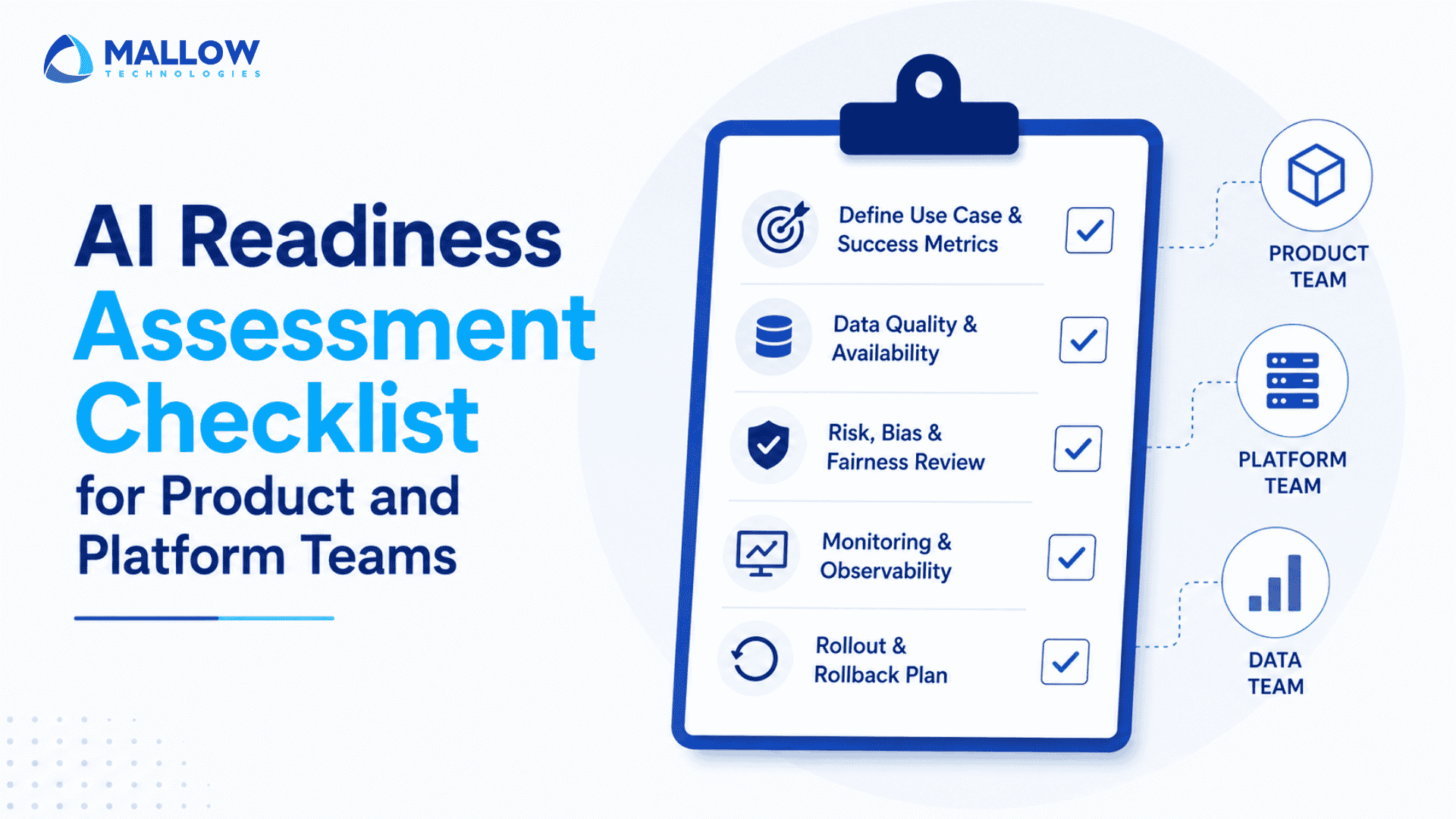
This article gives you the structured checklist to make sure that conversation happens before shipping, not after. Separate checklists for product teams and platform teams, a shared list of items both must confirm together, and a direct look at the five items that most teams skip under deadline pressure.
Why product and platform teams need separate checklists
Most AI readiness frameworks treat the pre-launch checklist as a single document. That works for teams where product and platform are the same person. For any team where those functions are separate, a single list creates ambiguity about who owns what.
The product team owns the business side of the AI feature: what the model is predicting, what the success metric is, what stakeholders have agreed to, and what the product does when the model is wrong. The platform team owns the technical side: how the data flows, how the model is served, how predictions are logged, and how the system behaves when the model degrades.
These are different lists with different owners. The confusion created by treating them as one is one reason AI features slip through pre-launch review with critical gaps intact.
According to the NIST AI Risk Management Framework, which defines standards for responsible AI deployment across industries and sectors, clear role separation in AI governance, defining who is accountable for business decisions versus technical decisions, is a core requirement for AI systems that need to be auditable and improvable over time.
The product team AI readiness checklist

Use case is specific and measurable. The feature is not “use AI to improve customer experience.” It is “predict which accounts are likely to churn in the next 30 days with at least 75% precision so the customer success team can intervene before renewal.” The specificity is what makes the checklist possible. Without it, none of the other items can be evaluated.
Success metric defined before build. The number that determines whether the AI feature is working needs to be agreed before any model training begins. Defining it after training creates the temptation to choose a metric that makes the model look better than it is.
Edge cases and failure modes documented. When the model is wrong, what happens? Who is notified? What does the user see? What is the fallback behaviour? These questions need answers before launch, not during the incident.
Stakeholder alignment confirmed. The business owner who will act on model outputs has explicitly committed to doing so. A model that produces a churn probability nobody looks at delivers zero value. The commitment to act needs to be explicit, not assumed.
Rollback plan in place. If the model is removed from production, because it is underperforming, because of a data issue, or because of a business decision, what does the product revert to? This needs a documented answer before launch.
Labelling criteria agreed with the data team. Product and data teams have agreed on what a positive training example looks like. What does “churned” mean? What does “converted” mean? When teams disagree on this, the model learns the wrong definition.
User-facing output format specified. If model outputs are shown to users, a risk score, a recommendation, a probability, the format, wording, confidence threshold, and display logic are defined. A 0.73 churn probability shown directly to a sales rep is not useful. How it is translated into a human-readable signal is a product decision.
Bias and fairness review scheduled. For any model that affects users differently based on who they are, a structured fairness review is planned before launch. This is not optional for regulated sectors and is increasingly expected as standard practice.
Performance baseline established. The current state of the product without the AI feature is measured. This is the comparison point that will tell you whether the feature is actually working after launch.
Monitoring owner assigned. A named person on the product team is responsible for reviewing model performance reports after launch. Without a named owner, the reports get generated and nobody reads them.
Launch criteria documented. The minimum accuracy, precision, or recall the model must hit before it is switched on in production. If the model does not meet this threshold in staging evaluation, the launch does not happen.
Feedback loop designed. A mechanism exists to capture whether model predictions are being acted on and whether those actions produced the expected result. This is the data that makes the next model version better.
The platform team AI readiness checklist

Data pipeline validated end to end. Raw data flows from source to model input without manual intervention, undocumented transformations, or silent failures. The pipeline has been run with production-representative data and the outputs have been verified.
Model serving infrastructure in place. A REST endpoint or batch scoring job exists, has been deployed to the target environment, and has been load tested at expected inference volume. Latency is within the SLA the product feature requires.
Prediction logging active. Every model prediction is logged with its input features, output value, timestamp, and model version identifier. This log is the source of truth for debugging, auditing, and retraining.
Model registry configured. A versioned registry tracks which model version is currently in production and provides a mechanism to roll back to any prior version without a manual redeployment. The registry is integrated with the deployment pipeline.
Drift monitoring set up. Automated alerts are configured to fire when input data distribution or prediction output distribution shifts beyond a defined threshold. The alert goes to a named owner and includes enough context to diagnose the issue.
Rollback procedure tested in staging. The process for reverting from the current model version to a previous one has been executed in a non-production environment and the result has been verified. An untested rollback procedure is not a rollback procedure.
Latency and throughput benchmarked. Inference latency under peak load is measured. The p95 and p99 latency are within the SLA. If the model is in the critical path of a user-facing request, this is a launch blocker.
Feature store or data contract in place. The features fed to the model in production are identical to the features used during training. Training-serving skew is one of the most common causes of model underperformance in production and is almost always preventable.
Model versioning CI/CD integrated. New model versions move through the deployment pipeline with the same quality gates, automated tests, evaluation thresholds, staged rollout, as application code. Ad hoc model deployments are not acceptable for production AI systems.
Alerting and on-call ownership defined. When the model behaves unexpectedly in production, there is a named person or team responsible for the initial response. The escalation path is documented and the on-call rotation includes model-related alerts.
Data schema validation active. The pipeline validates incoming data against the expected schema before it reaches the model inference layer. Malformed, missing, or out-of-distribution inputs are flagged or rejected rather than silently passed to the model.
Retraining trigger and schedule defined. The condition that triggers a model retrain is documented. This may be time-based (retrain every 30 days), performance-based (retrain when accuracy drops below a threshold), or drift-based (retrain when the monitoring alert fires). At least one trigger is automated.
Where the two checklists intersect

Five items require confirmation from both teams, not just one. These are the items most likely to fall through the gap when product and platform are working in separate tracks without a formal handoff.
Rollback plan defined and tested. Product owns the user behaviour when the model is absent. Platform owns the technical execution of the rollback. Both need to have reviewed and agreed on the plan before launch.
Success metric agreed. Product defines the metric. Platform instruments the logging and infrastructure that makes the metric measurable in production. If these two are not aligned on the definition and the measurement approach, the post-launch review will produce numbers nobody agrees on.
Monitoring owner named. There are two types of monitoring alert for an AI feature – a business alert (the model is producing outputs that are not being acted on or are producing wrong outcomes) and an infrastructure alert (the model serving layer is unhealthy). These have different owners and different thresholds. Both need to be named before launch.
Data schema validated. Product defines what inputs are valid from a business logic perspective. Platform enforces schema validation in the pipeline. Without this joint review, the pipeline may accept data that is technically valid but business-logically wrong.
Launch criteria documented. Product sets the minimum performance floor the model must reach for the feature to be valuable. Platform confirms the serving layer can evaluate the model against that criterion in the staging environment before the launch decision is made.
The 5 most commonly skipped items and why they matter

Rollback plan. Teams assume rollback is obvious. It rarely is. The assumption is that the previous version of the code is still deployed and can be re-enabled. The reality is that the database schema may have changed, the dependent services may have been updated, and the previous model artefact may not be in the registry. Defining the rollback plan before launch takes thirty minutes. Figuring it out during an incident takes hours.
Prediction logging. Teams deploy the model and skip logging because it is not user-facing and nobody notices it is missing until something goes wrong. Without prediction logs, there is no way to diagnose errors, no data to retrain on, and no audit trail for regulated use cases. Adding logging after the fact requires a deployment and creates a gap in the historical record.
Drift monitoring. Teams configure the model and move on to the next feature. Drift monitoring is scheduled for a future sprint and never gets there. The model silently degrades over weeks or months. Nobody notices until a business metric drops and someone has to trace it back to a model that has been producing wrong predictions for two months.
Retraining trigger. Teams build the model to work on the current data distribution and do not define what happens when that distribution changes. Customer behaviour shifts. Seasonal patterns emerge. Without an automated retraining trigger, the model ages out of relevance and the team that built it has long since moved on to other work.
Bias and fairness review. This is treated as a nice-to-have that gets pushed to after launch. For any model that differentiates between users, churn probability, credit risk, content moderation, a bias issue discovered post-launch creates support tickets, potential press exposure, and in regulated sectors, legal risk. The review is faster and cheaper to run before launch than to remediate after it.
How to use these checklists in practice
The most effective way to use these checklists is to assign ownership explicitly before the build begins, not before the launch. Each item in the product checklist should have a named product team owner. Each item in the platform checklist should have a named platform team owner. The intersection items should have named owners from both teams.
Two weeks before launch, both teams run through their lists independently and mark each item as confirmed or open. The open items become the launch-blocking list. Items that cannot be confirmed before launch are either resolved or consciously accepted as post-launch technical debt with a documented plan.
According to Google’s documentation on machine learning system design, specifically the technical debt paper published by the Google Brain team on hidden costs in production ML, the cost of resolving a gap in the pre-launch checklist grows significantly once the system is in production. Prediction logging gaps are twenty times more expensive to fix post-launch than pre-launch because they require retroactive data reconstruction and pipeline changes to a live system.
The checklist is not a bureaucratic exercise. It is the fastest path to a production AI feature that behaves predictably and can be improved.
If you are working through either of these checklists and need help closing specific gaps, feel free to connect with us. Our team can help you evaluate readiness gaps, improve launch confidence, and build a more reliable AI deployment process.
Your queries, our answers
A standard software launch checklist covers things like load testing, deployment verification, and monitoring setup. An AI-specific checklist adds items that are unique to ML systems - training-serving skew validation, model drift monitoring, prediction logging, retraining triggers, and bias review. These items do not appear on standard engineering checklists and are the gaps that cause AI features to behave differently in production than they did in testing.
If you have to prioritise, the five items that will cause the most pain if skipped are - rollback plan, prediction logging, drift monitoring, success metric agreed, and data pipeline validated end to end. These five cover the failure modes that are both most common and most expensive to fix after launch. Everything else is important but these five are launch blockers.
For the first deployment of any AI feature, run the full checklist. For subsequent model versions that are incremental updates, run the platform checklist and the intersection items. For major model changes or new use cases, run the full checklist again.
For most teams, the engineering lead or technical product manager is the right person to own the process of running through the checklists and tracking open items. The individual checklist items should have named owners from the product and platform teams respectively. The goal is not a single person signing off on everything, it is clear ownership for every item.
The item should be documented as an accepted risk with a named owner and a committed timeline for resolution. Some items, like a retraining trigger in an automated CI/CD pipeline, may reasonably be delivered in the sprint after initial launch. The key is that the gap is explicit, owned, and has a plan, rather than unnoticed or assumed to be someone else's responsibility.
What happens after you fill-up the form?
Request a consultation
By completely filling out the form, you'll be able to book a meeting at a time that suits you. After booking the meeting, you'll receive two emails - a booking confirmation email and an email from the member of our team you'll be meeting that will help you prepare for the call.
Speak with our experts
During the consultation, we will listen to your questions and challenges, and provide personalised guidance and actionable recommendations to address your specific needs.

Author
SathishPrabhu
Sathish is an accomplished Project Manager at Mallow, leveraging his exceptional business analysis skills to drive success. With over 8 years of experience in the field, he brings a wealth of expertise to his role, consistently delivering outstanding results. Known for his meticulous attention to detail and strategic thinking, Sathish has successfully spearheaded numerous projects, ensuring timely completion and exceeding client expectations. Outside of work, he cherishes his time with family, often seen embarking on exciting travels together.