There is a distinction that most SaaS teams building GenAI features do not make early enough, and it costs them significantly when they discover it in production. The distinction is between users trusting your feature and your feature being trustworthy.
A GenAI feature can earn user trust quickly. The outputs sound confident. The interface feels intelligent. Early interactions go well. Users adopt the feature and begin relying on it. Then something goes wrong. The feature produces an incorrect answer presented as fact. It gives inconsistent responses to the same type of query. It fails to acknowledge that it does not know something. The trust that formed quickly collapses, and it collapses harder than trust in a non-AI feature because the failure feels more like deception. The feature seemed knowledgeable. It was not.
Building genuinely trustworthy GenAI features is a product and engineering discipline. This article covers what that discipline requires.
The difference between users trusting your feature and it actually being trustworthy
The IDC Data and AI Impact Report commissioned by SAS in September 2025 surfaced a finding that every SaaS team building AI features should understand – among organisations reporting the least investment in trustworthy AI systems, GenAI is viewed as 200 percent more trustworthy than traditional AI, despite traditional AI being the more established, reliable, and explainable form. Users are assigning trust based on how intelligent a system appears, not on how reliably it performs.
The same research found that only 40 percent of organizations are investing to make their AI systems genuinely trustworthy through governance, explainability, and ethical safeguards. And only 2 percent of respondents selected developing an AI governance framework as a top organizational priority.
The implication for product teams is direct. Initial user trust in a GenAI feature is easy to earn and not a reliable signal that the feature is actually trustworthy. The organizations that are building trustworthy systems rather than just trustworthy-looking ones are seeing the returns – the same IDC research found they are 60 percent more likely to double ROI from their AI projects.
Why trustworthiness is a product and engineering problem, not a communications one

The instinct when a GenAI feature produces an incorrect output is often to manage the communication around it. Add a disclaimer. Update the onboarding. Set user expectations differently. These are not solutions to a trustworthiness problem. They are attempts to manage the gap between perceived and actual trustworthiness, and that gap closes on its own the longer users interact with the feature.
Genuine trustworthiness requires engineering decisions made before and during the build, not communications decisions made after problems appear. It requires measuring hallucination rates against real use of case scenarios, not just benchmark datasets. It requires designing what the feature does when it cannot answer reliably. It requires building confidence calibration, so the system communicates uncertainty rather than stating incorrect information with the same tone it uses for correct information.
Research on LLM confidence calibration has documented a particularly important challenge – AI models often express outputs with higher apparent confidence when hallucinating than when producing accurate responses. According to CMARIX’s May 2026 analysis of AI trust and RAG statistics, this calibration failure makes hallucinations harder for users to detect without systematic verification infrastructure. A feature that does not address this is actively working against the user’s ability to evaluate its outputs.
The five pillars that determine whether real users keep trusting a GenAI feature
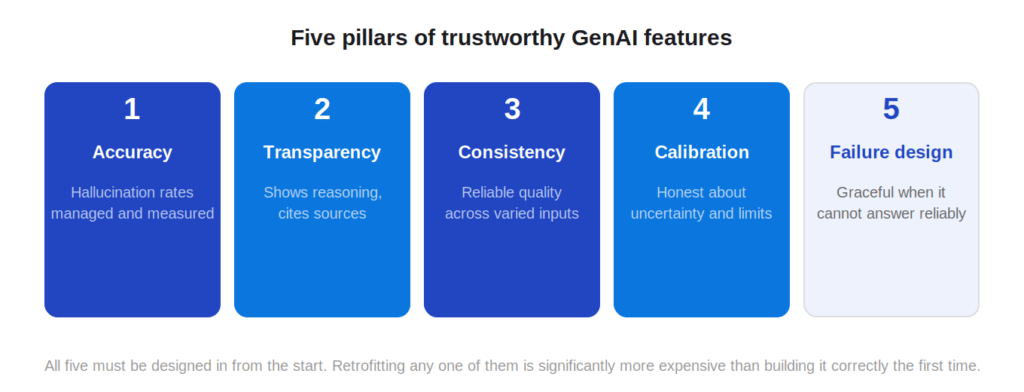
Pillar 1 - Accuracy - Hallucination rates that users can work with
Accuracy in a GenAI context does not mean perfection. No production model is hallucination-free. What it means is that hallucination rates are measured, understood relative to your specific use case, and managed to a level that users can work with without discovering that the feature misled them.
The right hallucination rate threshold is use-case-dependent. A content drafting assistant can tolerate occasional factual errors if users are expected to review and edit the output. A compliance document tool cannot. A customer-facing chatbot answering billing questions has a different tolerance than an internal knowledge retrieval tool. Defining the acceptable threshold for your specific use case, and then measuring against it, is a product decision that most teams avoid making explicitly. The consequence of avoiding it is discovering the threshold implicitly, in production, through user complaints.
Mitigation strategies have measurable impact. According to data compiled by AllAboutAI in December 2025 from Vectara’s Hallucination Evaluation Framework, retrieval-augmented generation reduces hallucination rates by approximately 71 percent compared to ungrounded generation. Structured prompts, output validation, and source-grounded generation each add further reduction. None of these are magic. They are engineering decisions that need to be made before production, not added reactively.
Pillar 2 - Transparency - Showing the reasoning, not just the answer
A GenAI feature that returns an answer without any indication of how it arrived at that answer is asking the user to trust a black box. For low-stakes queries this is acceptable. For any query where the user will act on the output, whether financial, legal, medical, or strategic, it is not.
Transparency at the feature level means showing sources when factual claims are made, acknowledging when an answer is drawn from the model’s training data versus from a verified source, and providing enough reasoning trace that a user can evaluate whether the output is relevant to their specific context. The format varies by use case – a citation for a factual claim, a confidence indicator for a recommendation, a reasoning summary for a complex analysis. The principle is consistent – the user should be able to evaluate the output, not just receive it.
Pillar 3 - Consistency - Reliable quality across every type of input
A feature that works reliably for the 80 percent of queries that resemble the test cases it was evaluated against is not a trustworthy feature. It is a feature with a hidden cliff edge. Users who encounter that cliff in a high-stakes moment and fall off it do not usually give the feature a second chance.
Consistency testing means deliberately evaluating the feature across varied, unexpected, and edge-case inputs, not just the inputs the team anticipated. It means testing for adversarial inputs that might produce harmful or misleading outputs. It means testing for the phrasing variations that real users actually use, which are rarely as clean as the test cases written by the development team.
Inconsistency is one of the trust-eroding patterns most reliably linked to user abandonment of GenAI features. The experience of asking the same question on two different days and receiving outputs of significantly different quality is a trust-ending experience, not a trust-testing one.
Pillar 4 - Confidence calibration - Honest about what the system does not know
Confidence calibration is the property of expressing uncertainty when uncertain and confidence when confident, rather than expressing a uniform confident tone regardless of whether the underlying output is reliable.
Most production LLMs are not well-calibrated by default. They generate text that sounds authoritative regardless of whether the content is accurate. The feature-level response to this is to build explicit uncertainty communication into the output design. When the model cannot retrieve a relevant source, the feature should say so. When a query falls outside the domain the feature was designed for, the feature should acknowledge the boundary rather than attempting an answer it is not equipped to give reliably.
This is a product design decision as much as an engineering one. It requires deliberately defining what the feature should say when it is uncertain, not just what it should say when it is confident.
Pillar 5 - Graceful failure - What happens when it cannot answer well
Every GenAI feature will encounter inputs it cannot handle reliably. The question is whether that failure is designed or accidental. Accidental failure, where the feature attempts an answer it cannot give correctly and produces something wrong or misleading, is the trust-destroying version. Designed failure, where the feature recognises its limit and responds in a way that is honest and still useful, is the trust-preserving version.
Designed failure responses include – acknowledging the limit and offering an alternative path (human escalation, refined search, a different tool), providing a partial answer with explicit uncertainty, or returning a safe default with an explanation of why the full answer is not available. The specific implementation depends on the use case. The principle is that every edge the feature cannot handle should have a tested, intentional response rather than falling into uncontrolled output.
User control as a trust multiplier
One of the most consistent findings in research on user trust in AI systems is that giving users control over AI-generated outputs significantly increases long-term trust, even when they rarely exercise that control. The ability to verify, edit, or override a GenAI output changes the user’s relationship to it from passive recipient to active collaborator.
Practically, this means building verification affordances into AI features – the ability to see the source behind a factual claim, the ability to regenerate an output with different parameters, the ability to flag an output as incorrect. These features cost engineering time. They return it in the form of users who engage with the feature confidently rather than tentatively.
Why use case context changes everything about hallucination risk
The hallucination rates that define whether a GenAI feature is trustworthy for your use case are not the rates published in model benchmarks. Benchmarks measure performance on curated, standardised tasks. Real use cases do not look like curated, standardised tasks.

According to Drainpipe’s February 2026 analysis of production AI hallucination data, enterprise chatbots in live production report hallucination rates of approximately 18 percent in real interactions. For legal AI tools, Stanford Law research cited in industry publications has found hallucination rates between 17 and 33 percent even when retrieval-augmented generation is applied. For medical AI applications without structured mitigation, rates have reached 64 percent in research evaluations.
The top models on standardised factual accuracy benchmarks now perform below 1 percent hallucination rates. The gap between benchmark performance and production performance is not a gap in model capability. It is a gap in the complexity and variability of real-world queries versus the predictable structure of benchmark datasets.
For a SaaS product team, this means that the question “what is the hallucination rate of the model we are using?” is the wrong question. The right question is “what is the hallucination rate of our specific feature, tested against the actual distribution of queries our users will ask?”
What the regulatory environment is adding to the trust equation
The EU AI Act (Regulation EU 2024/1689) introduces transparency obligations for AI systems that interact with users, requiring that users are informed when they are interacting with AI and that systems affecting significant decisions provide explanations of how those decisions were made. These provisions apply progressively, with most requirements for general-purpose AI systems taking effect from August 2026.
For SaaS products serving European users, this is not a distant concern. The transparency design decisions that make a GenAI feature trustworthy to users are the same design decisions that bring it into alignment with the regulatory requirements now taking effect. Building transparency in from the start is both a product quality decision and a compliance preparation decision.
For products serving US markets, the EU AI Act sets the emerging global benchmark rather than the binding requirement. But the direction is consistent – regulators in multiple jurisdictions are moving toward requiring AI transparency as a baseline, not a differentiator.
How to evaluate whether your GenAI feature is ready for real users
Before a GenAI feature reaches production users, five dimensions should be evaluated against measurable criteria. Any dimension that is untested or unknown represents a known trust risk that will surface in production.

Accuracy – What is the measured hallucination rate for this feature against a test set that represents real user queries, not benchmark tasks? Is that rate within the acceptable threshold for this specific use case? What mitigation is applied and has its effectiveness been measured?
Transparency – Does the feature communicate the basis for its outputs? When it draws on retrieved sources, are those sources visible to the user? When it operates from model knowledge, is that clear? Is the reasoning accessible for complex outputs?
Consistency – Has the feature been tested across varied, unexpected, and adversarial inputs? What is the quality variance across different query types? Are there known failure categories where quality drops significantly?
Calibration – Does the feature communicate uncertainty explicitly when uncertain? Is there a defined response for queries outside the feature’s reliable domain? Has that uncertainty communication been user-tested for clarity?
Failure design – Is there a tested, intentional response for every category of query the feature cannot handle reliably? Have these failure paths been tested under real conditions, not just expected ones?
If your team cannot answer all five questions with evidence rather than assumptions, the feature has known trustworthiness gaps that will manifest as user trust failures in production. Closing those gaps before launch is significantly cheaper than closing them after.
Our AI development services are built around exactly these evaluation disciplines. If you want to assess whether your current GenAI feature meets this standard before it reaches real users, talk to our engineering team.
What happens after you fill-up the form?
Request a consultation
By completely filling out the form, you'll be able to book a meeting at a time that suits you. After booking the meeting, you'll receive two emails - a booking confirmation email and an email from the member of our team you'll be meeting that will help you prepare for the call.
Speak with our experts
During the consultation, we will listen to your questions and challenges, and provide personalised guidance and actionable recommendations to address your specific needs.

Author
SathishPrabhu
Sathish is an accomplished Project Manager at Mallow, leveraging his exceptional business analysis skills to drive success. With over 8 years of experience in the field, he brings a wealth of expertise to his role, consistently delivering outstanding results. Known for his meticulous attention to detail and strategic thinking, Sathish has successfully spearheaded numerous projects, ensuring timely completion and exceeding client expectations. Outside of work, he cherishes his time with family, often seen embarking on exciting travels together.