The most common reason multi-agent systems fail in production is not that the underlying models are wrong. It is that the coordination between agents breaks down. Individual agents may perform well in isolation. The architecture connecting them does not hold under real conditions.
The MAST study, presented at NeurIPS 2025, analysed 1,642 execution traces across seven state-of-the-art multi-agent frameworks. Failure rates ranged from 41 percent to 86.7 percent. The largest single failure category was not model error, poor prompting, or broken tool calls. It was coordination breakdown, accounting for 36.9 percent of all failures.
This matters before you write a single line of architecture. The decisions that determine whether coordination works or breaks are made in three phases: planning (how the system decides what to do and who does it), execution (how agents work and stay aligned while doing it), and handoffs (how work moves between agents without losing context or introducing errors). This article covers all three.
Why coordination breaks more systems than intelligence does
Most teams approach multi-agent system design by thinking about the model first. Which LLM should power which agent? What prompts produce the most accurate outputs? These are genuine questions, but they are downstream of a more fundamental one: how does the system coordinate?
A multi-agent system is not just a collection of smart agents. It is a distributed workflow where multiple autonomous processes must share context, pass work between each other, respond to failures, and produce a coherent result. Every one of those coordination requirements is an engineering problem independent of model capability. According to Gartner’s December 2025 analysis of multiagent systems, enterprise inquiries about multi-agent systems surged 1,445 percent from Q1 2024 to Q2 2025. The interest is real. The failure rate data suggests the design rigour has not yet caught up.
Understanding the three phases of coordination is the starting point for changing that. Organizations evaluating agent-based systems can also explore how agentic workflows coordinate reasoning, execution, and decision making across enterprise environments.
Phase one - Planning from goal to task graph
Planning is the phase that most product teams think about least, and that causes the most downstream coordination failures when done poorly. It is where a complex goal gets turned into a structured set of tasks that agents can execute.
Goal decomposition - Turning an objective into discrete tasks
When an orchestrator receives a goal, its first job is to break that goal into discrete, independently executable subtasks. This decomposition is not trivial. A subtask needs to be –
- Specific enough that the assigned agent knows exactly what it is doing
- Bounded enough that it fits within one agent’s context window and capability scope
- Separable enough that it can be executed without needing real-time input from every other agent simultaneously
Poor decomposition is a primary source of downstream coordination failures. If subtasks are defined ambiguously, agents will interpret them differently. If subtasks overlap, agents will duplicate work or conflict. If subtasks are too large, individual agents will produce degraded outputs due to context overload.
Plans in multi-agent systems are typically represented as directed acyclic graphs (DAGs), where the output of one agent becomes the input to another. This structure enables scalable problem-solving but introduces a specific fragility – the workflow depends on smooth communication and accurate handoffs between each node.
Dependency mapping - What must happen before what
Not all subtasks can run simultaneously. Some depend on the output of a prior step. Others are genuinely independent and can run in parallel. Mapping these dependencies correctly determines how efficiently the system executes and how gracefully it handles a step failing partway through.
A dependency map should define –
- Which tasks can start immediately (no upstream dependencies)
- Which tasks must wait for specific outputs from specific prior tasks
- Which tasks are blocked if an upstream task fails and cannot produce a usable output
- What the fallback is at each dependency point
Skipping this step and assuming agents will figure out dependencies dynamically is one of the most reliable ways to introduce silent failures into a multi-agent workflow.
Agent assignment - Matching tasks to the right specialist
Once the task graph is defined, each node gets assigned to an agent with the appropriate capability scope. The principle here is specialisation over generalisation. This is one reason many organizations are moving away from isolated automation tasks toward more structured AI workflow architectures. An agent prompted and tooled specifically for legal clause extraction will consistently outperform a general-purpose agent asked to do everything.
Agent assignment should define –
- Which tools each agent has access to
- What data sources each agent can read from and write to
- What output format the agent is expected to produce (this becomes the handoff contract)
- What the agent should do if it cannot complete its task
The output format specification in agent assignments is particularly important. It is the contract that every downstream agent depends on. When this contract is violated in production, the result is the kind of subtle, hard-to-diagnose failure that the MAST study classifies as inter-agent misalignment.
Here is how the planning phase looks as a system –

Phase two - Execution keeping agents aligned while they work
Once the task graph is defined and agents are assigned, execution begins. The coordination challenges here are different from planning. Planning is a design problem. Execution is a real-time systems problem.
Sequential vs parallel execution
One of the most consequential architecture decisions in a multi-agent system is whether agents execute in sequence or in parallel. This choice is not about preference. It is determined by the dependency map produced in the planning phase.
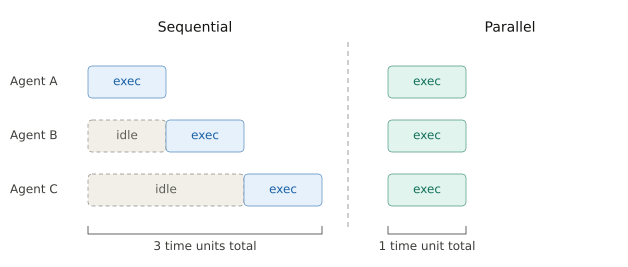
Tasks with upstream dependencies must run sequentially. Tasks with no dependencies on each other can run in parallel. Getting this right has a direct impact on total execution time –
- Sequential execution means the total time equals the sum of all agent execution times. Each agent waits for the previous one to finish before starting.
- Parallel execution means the total time equals the duration of the longest individual task. All independent agents run simultaneously.
For a workflow with three independent research tasks, parallel execution can reduce total execution time to a third of what sequential execution would take. For time-sensitive workflows, this difference is not marginal.
Shared state - The memory layer every agent reads from
While agents are executing, they often need to read information produced by other agents or from the wider workflow context. Without a shared state layer, agents operate in isolation and duplicate work. With a poorly designed shared state layer, agents produce race conditions, read stale data, and create inconsistencies that are extremely difficult to debug.
A production-grade shared state architecture for multi-agent systems typically combines three layers –
- Active context (in the current LLM window): the immediate inputs and the running log of decisions made so far in this workflow
- Short-term shared memory (a fast in-memory or Redis-backed store): data produced by individual agents that other agents may need to read during the same workflow run
- Long-term memory (a vector database or structured database): information persisted across workflow runs, such as learned preferences, prior decisions, or historical outputs
The discipline required here is defining read and write access controls per agent. An agent should be able to read only what it needs and write only to its designated output store. Without these boundaries, shared state becomes a source of unpredictable cross-agent interference.
What happens when an execution step fails
In a single-agent system, a failure produces a clear error. In a multi-agent system, a failure in one step can cascade silently into wrong outputs in downstream steps if recovery logic is not explicitly designed.
Every execution step needs a defined failure mode with three components –
- Detection – How does the system know this step failed? This requires step-level monitoring, not just final-output monitoring.
- Recovery – What happens when failure is detected? Options include retry with a modified prompt, retry with a different tool, route to a fallback agent, or pause and surface the failure to a human.
- Isolation – Does this failure block all downstream steps, or only the steps that depend on this step’s output? Dependency mapping from the planning phase determines this.
Phase three - Handoffs the most fragile moment in any multi-agent system
A handoff is the moment when one agent passes its output to another agent (or back to the orchestrator). It sounds simple. In production, it is the phase where the majority of coordination failures originate.
The three handoff patterns and when each applies
Three distinct handoff patterns appear in production of multi-agent systems. The right pattern depends on the orchestration architecture chosen.
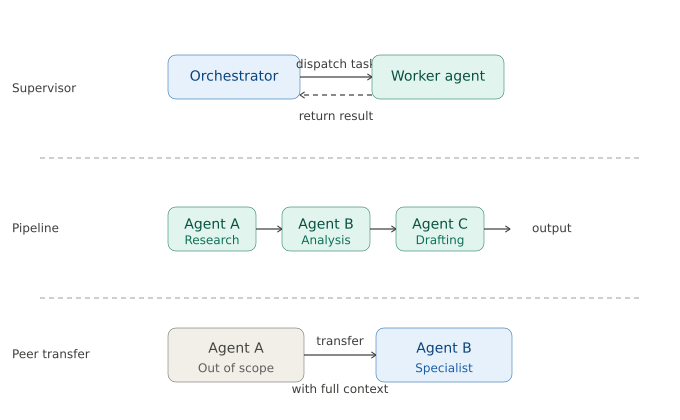
Supervisor handoff is used when a central orchestrator delegates a subtask to a specialist and expects a structured result. The orchestrator maintains overall control. The worker operates within a scoped context. The OpenAI Agents SDK, released in March 2025, formalises this pattern with explicit handoff declarations – each agent declares its handoff targets, and the framework enforces that handoffs follow declared paths. This constraint is precisely what makes the pattern reliable in production.
Pipeline handoff passes output directly from one agent to the next in a linear sequence. Each agent receives the prior agent’s output as its input. There is no central coordinator. The risk here is context degradation across steps – if Agent B misinterprets what Agent A passed, Agent C receives wrong inputs without any agent or orchestrator being aware. Per the LangChain architecture guide, this pattern suits linear workflows where each step genuinely depends on the previous output and the sequence is well-understood.
Peer transfer occurs when an agent determines it cannot handle an incoming task and transfers control to a more appropriate specialist. The key distinction from the supervisor pattern is that the transfer decision happens at the agent level, not at the orchestrator level. This makes it faster for well-defined routing cases but harder to observe and debug when transfers go to unexpected destinations. The Microsoft Azure Architecture Center’s AI agent design patterns guidenotes this pattern requires careful guard conditions to prevent handoff loops, where Agent A transfers to Agent B which transfers back to Agent A.
What every handoff must carry to be reliable
A handoff that loses context is the most expensive failure mode in a multi-agent system. The receiving agent starts with incomplete information, makes decisions based on that incomplete information, and passes the resulting error downstream. By the time the final output surfaces, tracing the original cause can require reconstructing the entire execution trace.
Every handoff in a production system should explicitly carry –
- The task definition – what the receiving agent is expected to do, in precise terms, not inherited assumptions
- Relevant prior context – What the sending agent found, decided, or produced that is relevant to the receiving agent’s task
- Output format specification – What format the receiving agent is expected to return its result in
- Failure instructions – What the receiving agent should do if it cannot complete the task
The most common handoff failure modes
These are the patterns that appear most frequently in production, drawn from the MAST failure taxonomy –
- Format contract violation – the sending agent returns data in a format the receiving agent does not expect. The receiving agent either errors or silently misinterprets the data and proceeds with wrong inputs.
- Context truncation – The handoff carries partial context to stay within token limits. The receiving agent makes decisions based on an incomplete view of the prior steps.
- Ambiguous task scope – The task handed off is defined loosely enough that the receiving agent interprets it differently from the sender’s intent. Both agents behave correctly within their own understanding. The result is wrong.
- Missing failure path – The sending agent fails silently and passes no output or a default value. The receiving agent interprets the default as valid input and continues, producing outputs that appear plausible but are based on nothing.
What the coordination failure data tells you before you build
The MAST study’s finding that coordination breakdowns account for 36.9 percent of all multi-agent failures is the most practically useful data point a builder can have going into architecture design. It means that even with well-chosen models and well-crafted prompts, the majority of production failures will trace back to how agents communicate, not what they individually produce.

The failure rate range of 41 to 86.7 percent across frameworks is the broader context. These numbers reflect research benchmark conditions, and real-world production rates will vary. But they establish a clear baseline: multi-agent systems that are not explicitly designed for coordination of reliability will fail most of the time on complex tasks.
The practical implication is that coordination design is not an optimization step you add after the system works. It is a prerequisite for the system to work at all. Businesses evaluating multi-agent initiatives can also explore the technical and operational criteria used to assess whether an AI development partner is equipped to deliver production-ready systems.
How production teams design for reliable coordination
The teams consistently producing multi-agent systems that work in production apply a set of design disciplines before writing any agent logic. These are not advanced techniques. They are foundational practices that the failure data makes non-negotiable.
- Define explicit output contracts for every agent – Before writing a single prompt, specify the exact format, data types,required fields, and failure outputs for every agent’s output. This contract is the basis for every downstream handoff. When it changes, every downstream agent must be evaluated.
- Test the handoffs before testing the agents – Most teams test each agent individually and then test the full system. The gap between those two tests is where coordination failures live. Test each handoff independently – does the output from Agent A actually work asinput for Agent B?
- Instrument every step, not just the final output – Standard logging captures what the system returned. Agentic observability captures what each agent decided, what eachtool call returned, and what was passed at each handoff. Without step-level visibility, diagnosing a coordination failure in production requires reconstructing execution from incomplete information.
- Design failure paths as carefully as success paths – Every agent needs a definedfailure output. Every handoff needs a defined response to a missing or malformed input. Every orchestrator needs a defined escalation path for when a subtask cannot be recovered.
- Start with the simplest coordination pattern that solves the problem – As both the LangChain architecture guide and the Microsoft AI agent design patterns documentation advise – start centralised and decentralise only when concrete scalability constraints demand it. A simple supervisor pattern that works beats a complex swarm that does not.
Pre-build coordination checklist
Run this before commissioning any multi-agent development work. If any item cannot be answered clearly, treat it as a design gap before the build starts.
- Is the overall goal decomposable into discrete, independently testable subtasks?
- Is the dependency graph between subtasks defined, not assumed?
- Is each agent’s output format specified as an explicit contract, not a description?
- Is shared state access defined per agent (which agents read what, write what)?
- Does each handoff have a defined failure output and downstream response?
- Is step-level observability (not just final output logging) in scope for the initial build?
- Is the escalation path to a human defined for cases where agent recovery fails?
- Is the simplest coordination pattern being used that genuinely solves the task?
If you are planning to build a reliable multi-agent AI system, our team can help you validate the architecture, coordination patterns, and production readiness before development begins. Book a strategy call with our AI experts.
Your queries, our answers
Most production failures happen because agents lose alignment during planning, execution, or handoffs. Even highly capable AI models can fail when tasks are assigned incorrectly, dependencies are unclear, or critical context is lost between agents.
Planning converts a high-level objective into structured, executable tasks. This includes goal decomposition, dependency mapping, and assigning the right agent to the right responsibility so the workflow can operate reliably at scale.
Sequential execution runs tasks step by step, where one agent’s output becomes the next agent’s input. Parallel execution allows multiple agents to work simultaneously on independent tasks, improving speed but increasing coordination complexity.
Handoffs are risky because agents can lose context, misunderstand task status, or receive incomplete information. If the transfer does not include the right data, assumptions, and execution history, downstream failures become more likely.
Teams improve reliability by designing strong orchestration logic, maintaining shared state management, defining clear task ownership, validating dependencies before execution, and implementing structured error recovery during agent handoffs and execution failures.
What happens after you fill-up the form?
Request a consultation
By completely filling out the form, you'll be able to book a meeting at a time that suits you. After booking the meeting, you'll receive two emails - a booking confirmation email and an email from the member of our team you'll be meeting that will help you prepare for the call.
Speak with our experts
During the consultation, we will listen to your questions and challenges, and provide personalised guidance and actionable recommendations to address your specific needs.

Author
Jayaprakash
Jayaprakash is an accomplished technical manager at Mallow, with a passion for software development and a penchant for delivering exceptional results. With several years of experience in the industry, Jayaprakash has honed his skills in leading cross-functional teams, driving technical innovation, and delivering high-quality solutions to clients. As a technical manager, Jayaprakash is known for his exceptional leadership qualities and his ability to inspire and motivate his team members. He excels at fostering a collaborative and innovative work environment, empowering individuals to reach their full potential and achieve collective goals. During his leisure time, he finds joy in cherishing moments with his kids and indulging in Netflix entertainment.