Most SaaS founders who have experimented with AI features hit the same wall. The model is impressive in demos and unreliable in production. It gives generic answers where specific ones are needed. It confidently describes things that are not true about the product. It fails to distinguish between what your product does and what a competitor does. And when you dig into why, the answer is almost always the same: the model does not know anything about your product.
That is not a model quality problem. It is an information access problem. And retrieval augmented generation (RAG) is the structural solution to it.
This article is not a technical tutorial on RAG. It is an explanation of what RAG changes at the product and economics level, why those changes matter for SaaS products specifically, and what a founder or product lead needs to understand before deciding whether RAG belongs in their AI feature roadmap.
Why general-purpose models fail at product-specific tasks
A large language model trained on general internet data knows a great deal about the world. It knows about software categories, common business processes, programming languages, and industry terminology. What it does not know is anything specific to your product: your documentation, your pricing, your customers’ data, your internal workflows, your feature names, or the specific context of any given user’s situation.
When you ask a general-purpose model to answer a question about your product, it does what any intelligent person would do when asked a question they cannot answer from direct knowledge: it draws on what it does know and extrapolates. The result is an answer that sounds plausible but is frequently wrong in the specific ways that matter most. It will describe a feature that does not exist in your product. It will give pricing that belongs to a competitor. It will explain a workflow that applied to a previous version of your product but not the current one.
This is the hallucination problem that most founders encounter first. The common diagnosis is that the model needs to be better, or that the prompting needs to be more precise. Both of those help at the margins. Neither solves the underlying issue – the model cannot give accurate product-specific answers because it has never had access to product-specific information.
The EU AI Act’s requirements for transparency in AI-generated outputs are partly a response to exactly this failure mode at scale. For SaaS products operating in EU markets, the accuracy problem is not just a product quality issue it carries regulatory dimensions in certain use cases.
What RAG actually does
RAG is an architecture pattern that solves the information access problem by separating the question of what the model knows from the question of what information the model can access at query time.
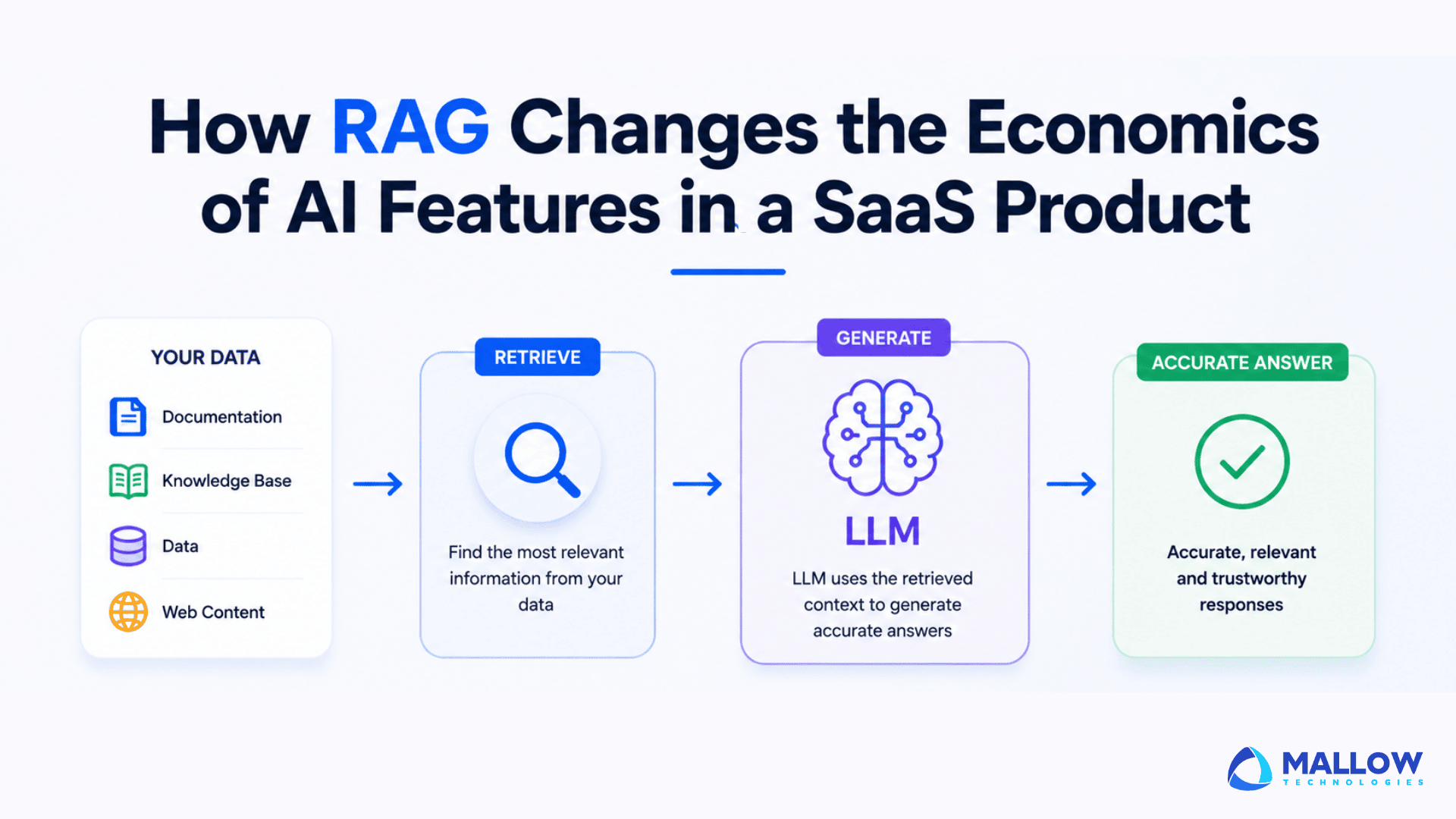
Instead of relying entirely on what was baked into the model during training, a RAG system retrieves relevant documents, data, or records at the moment a query is made, and passes that retrieved content to the model as context for generating the answer. The model’s job shifts from recalling information it was trained on to reasoning over information it has just been given.
In practice, a RAG pipeline has three stages. The first is ingestion – your product’s content documentation, knowledge base articles, pricing pages, customer records, workflow descriptions is processed, chunked, and stored as vector embeddings in a vector database. The second is retrieval – when a user query arrives, the system searches the vector database for the content chunks most semantically similar to the query and retrieves them. The third is generation: the retrieved content is assembled into a context window and passed to the model along with the original query. The model generates an answer grounded in that specific retrieved content rather than in general training data.
The practical result is that the model can answer questions about your specific product, your specific customer’s account, and your specific documentation accurately because the relevant information is in front of it at the time it generates the answer.
If you would like to explore the technical side of RAG in more detail, resources such as the LangChain documentation on retrieval chains and LlamaIndex’s guides on document indexing and retrieval offer practical insights into how RAG pipelines are built and implemented.
The economic shift RAG introduces
The reason RAG matters as a business and product decision, not just a technical one, is what it does to the economics of AI features.
Without RAG, getting a general-purpose model to answer product-specific questions accurately requires one of two approaches – you either fine-tune the model on your product’s data, which is expensive to do and expensive to maintain as your product evolves, or you include extensive context in every prompt, which drives up the token cost of every query and still produces unreliable results because the model has to hold too much information in a limited context window.
RAG changes this cost structure in three specific ways.
The first is accuracy without fine-tuning. Because the relevant information is retrieved and provided at query time, the base model can answer product-specific questions accurately without being retrained on your data. Fine-tuning costs drop out of the equation entirely for most product-specific AI features. The accuracy work shifts from expensive model training to building and maintaining a clean retrieval layer.
The second is freshness without retraining. When your product changes new features, updated pricing, revised documentation a RAG system reflects those changes as soon as the new content is ingested into the vector store. A fine-tuned model requires retraining to incorporate the same update. For a SaaS product that ships continuously, this distinction has significant operational implications. The cost of keeping your AI features accurate with RAG scales with documentation effort, not with GPU compute.
The third is scope without context explosion. A fine-tuned or prompt-stuffed model has a fixed window of knowledge available to it. A RAG system can draw on an arbitrarily large knowledge base because it only retrieves what is relevant to the specific query. A customer asking about a niche edge case in your billing logic gets exactly the relevant documentation retrieved. The query cost is approximately the same as a simple query, because the retrieval is doing the scoping work rather than the context window.
Together, these three changes shift the unit economics of AI features from a model-cost problem to a retrieval-quality problem. The question is no longer “can we afford to fine-tune and maintain a model that knows our product?” It is “how well can we retrieve the right information at query time?” That is a significantly more tractable engineering problem for most SaaS product teams.
Three AI feature categories that change with RAG
Category 1 - Product Q&A and documentation search
Before RAG, product Q&A features were either generic (answering from the base model’s knowledge, which was inaccurate for product specifics) or expensive (fine-tuned models trained on documentation that immediately went stale). With RAG, documentation search becomes a genuinely useful feature rather than a liability. The model answers from the current documentation, retrieved at query time, and the accuracy is bounded by the quality of the documentation rather than by the model’s training data.
Category 2 - Customer support deflection
Support deflection AI chatbots that handle tier-one queries before escalating to a human agent is one of the most commercially valuable AI features in SaaS. Without RAG, support bots give generic answers that frustrate users and increase rather than decrease escalation rates. With RAG, the bot can retrieve the specific policy, the specific account history, and the specific workflow documentation relevant to the user’s query. Deflection rates improve because the answers are actually right.
Category 3 - In-product contextual assistance
The AI assistant features that sit inside a SaaS product helping users understand what a report means, suggesting next steps in a workflow, explaining why a calculation produced a particular result require access to the user’s specific data, not generic knowledge. RAG makes this category buildable. The assistant retrieves the relevant records, the relevant configuration, and the relevant documentation, and the model reasons over that retrieved context to give the user a genuinely useful answer rather than a generic one.
Choosing the right approach - RAG vs fine-tuning
The question of whether to use RAG or fine-tuning is one of the most common strategic decisions for product teams building AI features. The answer depends on what problem you are actually trying to solve.
Fine-tuning changes how the model behaves – its tone, its style, its pattern of reasoning, and its domain-specific vocabulary. It is the right approach when the model needs to consistently produce outputs in a particular format, speak in a particular voice, or apply domain-specific reasoning patterns it did not learn during general training.
RAG changes what the model knows at query time. It is the right approach when the model needs access to information that is specific to your product, your customers, or your data, and where that information changes over time.
For most SaaS AI feature use cases, the primary problem is information access, not model behaviour. RAG is therefore the more appropriate starting point for most teams. Fine-tuning on top of a RAG system makes sense once the retrieval layer is performing well and you have identified specific behavioural patterns the model still gets wrong, such as format consistency, domain terminology, or tone calibration, that retrieval quality improvements cannot address.
A common mistake is to reach for fine-tuning first because it feels like the more thorough solution. It is not more thorough. It is more expensive, harder to maintain, and solves a different problem than the one most SaaS teams actually have.
What a RAG pipeline actually costs to build and run
A RAG pipeline has three cost components: build cost, vector storage and retrieval cost, and the inference cost of the base model.
Build cost covers ingestion pipeline development, the chunking and embedding logic, the retrieval and ranking layer, and integration with your product. For a well-scoped initial implementation handling a single knowledge domain, such as product documentation, a team with relevant experience should be able to build and deploy a production-quality RAG pipeline in four to eight weeks. Scope creep in the ingestion layer is the most common source of overruns.
Vector storage and retrieval costs are relatively modest. Managed vector database services from providers such as Pinecone, Weaviate, or Qdrant charge based on the number of vectors stored and the volume of queries. For most SaaS products at Seed to Series B scale, these costs run well below the cost of the base model inference itself. A knowledge base of ten thousand document chunks with moderate query volume typically costs tens of dollars per month in vector storage, not hundreds.
Base model inference remains the dominant cost driver. RAG reduces inference costs relative to prompt-stuffing approaches because the retrieved context is scoped to what is relevant, rather than including everything that might be relevant in every prompt. But inference costs still scale with query volume, context window size, and the model selected. The economics of model selection, balancing cost per token against capability, is a separate optimisation problem that sits on top of the RAG architecture decisions.
The total operating cost of a well-built RAG system is substantially lower than the equivalent fine-tuned model approach, primarily because there is no ongoing retraining cost. For SaaS products that ship features frequently, that difference is significant.
The failure modes founders miss
Garbage in, garbage out. RAG retrieves from what you give it. If your documentation is incomplete, inconsistent, or out of date, the retrieved content will be incomplete, inconsistent, and out of date. The model will answer accurately based on bad source material. Many teams build technically correct RAG pipelines and get poor results because the knowledge base quality was never addressed. Documentation quality is a prerequisite for RAG quality.
Retrieval precision over recall. A common early mistake is optimising retrieval for recall, returning everything that might be relevant, rather than precision, returning the most relevant chunks. High recall retrieval floods the context window with loosely relevant content and degrades answer quality. The retrieval layer needs to be tuned to return the right content, not the maximum content.
Ignoring the freshness pipeline. The operational advantage of RAG over fine-tuning, that your AI features stay current as your product changes, only holds if you actually update the vector store when your content changes. Many teams build excellent ingestion pipelines for the initial knowledge base and never build the incremental update process. Within months, the retrieval layer is serving stale content and the accuracy advantage begins to erode.
Treating RAG as a complete solution. RAG handles the information access problem. It does not handle the reasoning problem, the tone problem, or the behavioural consistency problem. A RAG system will answer accurately from good source material but still produce answers that are too long, inconsistently formatted, or tonally misaligned with your product. The generation layer still needs prompt engineering and iteration. RAG just ensures there is accurate content to reason over.
Why RAG is becoming the preferred AI architecture for SaaS products
RAG does not make AI features perfect. It makes them grounded. It gives the model access to the specific information it needs to answer product-specific questions accurately, without requiring expensive model retraining every time the product changes.
The economic implication is real. For SaaS products where AI features need to work with your documentation, your customer data, or your specific workflows, RAG changes the build-and-run cost structure from “fine-tune a model and maintain it forever” to “build a retrieval layer and keep your content clean.” The second problem is significantly more tractable for most product teams.
The teams that get this right start narrow: one knowledge domain, tight retrieval, measured quality. They do not try to build a universal knowledge base on day one. They treat documentation quality as a product requirement, not an afterthought. And they build the freshness pipeline before they need it, not after the retrieval layer has gone stale.
If you are evaluating RAG for your SaaS product and need help defining the right architecture, implementation approach, or rollout strategy, talk to us. Our team can help you scope a solution that aligns with your product goals, data requirements, and business objectives.
Your queries, our answers
Products where users frequently ask questions that require access to product-specific information, such as support-heavy products, complex workflow tools, data-rich platforms, documentation-heavy developer tools, and any product where users need contextual guidance specific to their account or configuration. Products where all AI feature queries can be answered from generic knowledge, such as a basic grammar checker, benefit less from RAG.
Through the ingestion pipeline. When source content changes, the relevant chunks are re-embedded and updated in the vector store. For teams with good content pipelines, this can be automated to run on documentation commits or knowledge base updates. The operational question is how quickly the vector store reflects changes in the source content and whether that latency is acceptable for the use case.
A single knowledge domain with a clearly defined scope, such as product documentation or support ticket history, a vector database, an embedding model, a retrieval layer returning the top three to five relevant chunks per query, and a generation step passing those chunks to a base model. Start narrow, measure retrieval quality, and expand scope once the pipeline is performing reliably on the initial domain.
RAG works best with unstructured or semi-structured text content. For structured data, such as tables, database records, or account-specific metrics, the better architecture is typically text-to-SQL or direct API retrieval, where the model generates a query to retrieve the specific records rather than retrieving semantically similar document chunks. Many production RAG systems combine both approaches: vector retrieval for documentation and knowledge content, and structured retrieval for account-specific data.
The primary metrics are retrieval precision (are the retrieved chunks actually relevant to the query?), answer accuracy (is the generated answer correct based on the retrieved content?), and freshness (is the retrieved content current?). Evaluation frameworks such as RAGAS provide structured approaches to measuring RAG pipeline performance across these dimensions, which is considerably more useful than relying on subjective assessment.
Vector databases are the storage and retrieval infrastructure that RAG pipelines depend on. Content is stored as vector embeddings, which are numerical representations of semantic meaning, and the retrieval step finds the embeddings most similar to the query embedding. Vector databases such as Pinecone, Weaviate, and Qdrant are purpose-built for this workload, offering fast approximate nearest-neighbour search at scale that general-purpose databases cannot efficiently replicate.
What happens after you fill-up the form?
Request a consultation
By completely filling out the form, you'll be able to book a meeting at a time that suits you. After booking the meeting, you'll receive two emails - a booking confirmation email and an email from the member of our team you'll be meeting that will help you prepare for the call.
Speak with our experts
During the consultation, we will listen to your questions and challenges, and provide personalised guidance and actionable recommendations to address your specific needs.

Author
SathishPrabhu
Sathish is an accomplished Project Manager at Mallow, leveraging his exceptional business analysis skills to drive success. With over 8 years of experience in the field, he brings a wealth of expertise to his role, consistently delivering outstanding results. Known for his meticulous attention to detail and strategic thinking, Sathish has successfully spearheaded numerous projects, ensuring timely completion and exceeding client expectations. Outside of work, he cherishes his time with family, often seen embarking on exciting travels together.