Most fine-tuning projects produce a version of the same ROI presentation – the model outputs look better, the team is happy, and the loss curves improved during training. Then someone from finance asks what the dollar return is, and the answer is “we estimate it saves about two hours per week per engineer.” That number cannot be audited. It cannot be traced to a measurement. And as TianPan.co’s May 2026 analysis of AI feature ROI states directly: “Finance teams reject AI ROI cases not because they are anti-AI, but because the metrics they receive cannot be audited.”
This article is the framework for producing ROI numbers that can be audited. That means measuring the right things before the project starts, connecting technical improvements to business outcomes, and presenting costs in full rather than showing only the visible compute line.
Why most teams measure the wrong things
The failure pattern in fine-tuning ROI measurement is consistent. Teams measure training metrics (loss, perplexity, BLEU score) and mistake them for business outcomes. Training loss going down is necessary for fine-tuning to have worked. It is not sufficient proof that the business benefited.
According to S&P Global data cited in Larridin’s March 2026 AI ROI analysis, the share of companies abandoning most of their AI projects jumped to 42 percent in 2025 from just 17 percent the year prior, with unclear value cited as a primary reason. The issue is not that fine-tuning does not work. The issue is that teams cannot prove it worked in terms that justify continued investment.
The fix is not a better model or a better prompt. It is a better measurement framework, starting before the training run begins.
The baseline problem that makes ROI unmeasurable
The most common failure in fine-tuning ROI measurement is the absence of a baseline. Teams complete the fine-tuning, evaluate the outputs, conclude they are better, and report improvement. But without a measurement of the same metrics before fine-tuning, there is no improvement to report. There is only a current state.
A credible baseline requires –
- Identical test conditions – The same evaluation set, measured in the same way, before and after fine-tuning. Using different inputs or different reviewers in the before and after comparisons produces a measurement that cannot be attributed to the fine-tuning.
- A documented methodology – What was measured, how, by whom, and when. Without documentation, the baseline cannot be reproduced for the post-deployment comparison.
- Sufficient duration – Three to six months of pre-fine-tuning data eliminates seasonal variation and one-off events that could skew a shorter baseline period.
Teams that skip the baseline phase cannot prove ROI. They can only assert it. These are different things in a finance context.
The three categories of value fine-tuning creates
Fine-tuning delivers measurable business value through three distinct mechanisms. Conflating them into a single number makes the ROI case harder to verify, not easier. Presenting them separately makes each component auditable.
Quality and consistency improvements
The most direct and measurable form of fine-tuning value is improvement in output quality and consistency. Before fine-tuning, a base model producing outputs in a specific format might achieve 68 to 74 percent compliance with the required structure. According to Kumar Gauraw’s March 2026 fine-tuning guide, fine-tuning a smaller model on 500 carefully reviewed examples of ideal responses can push format compliance to 97 to 99 percent. That delta has a direct business value: every non-compliant output requires human correction, and human correction has a measurable cost in staff time.
Cost reduction through smaller, faster models
A fine-tuned smaller model that matches or exceeds the performance of a larger frontier API model on your specific task delivers direct inference cost savings. According to analysis published by DEV Community in March 2026, fine-tuned smaller models outperform larger generic APIs on domain-narrow tasks while being 10 to 100 times cheaper to run in production. For a SaaS product processing thousands of requests daily, this is a significant and recurring cost reduction that compounds over time.
Latency and user experience gains
Fine-tuned models can produce correct outputs without lengthy system prompts, reducing both token count and response time. This is not just a performance metric. TianPan.co’s ROI analysis documents that AI interactions with P99 latency above five seconds see approximately 45 percent user abandonment. Reducing tail latency through fine-tuning has a directly attributable impact on feature adoption and retention metrics.
The five baselines to capture before you start

Five specific metrics must be measured before fine-tuning begins. Each one becomes a comparison point in the post-deployment ROI calculation.
Format compliance rate is the percentage of AI outputs that meet the required structure, format, or template for your use case. If your model should always return valid JSON, measure the percentage that parse without errors. If it should include specific sections, measure how often they appear.
Task completion rate is the percentage of requests fully resolved without human intervention. This is the operational efficiency metric that connects most directly to staff time savings and cost reduction.
Inference cost is the total API spend per 1,000 requests at your current production volume. This is the cost baseline against which any post-fine-tuning cost reduction is measured. Measure it at real production volume, not at test volume.
Response latency in P50 and P95 terms captures both typical performance and tail behaviour. The P95 or P99 number is what determines user abandonment rates. Measure it under production load conditions, not in a clean test environment.
Human review rate is the percentage of AI outputs that require correction before being used, published, or acted on. This is often the most significant cost multiplier in AI systems and the metric that produces the largest ROI when fine-tuning improves output quality.
The three measurement layers - Technical, operational, financial

Fine-tuning ROI needs to be presented at three different levels because it has three different audiences. Presenting only technical metrics to a finance team or only financial metrics to an engineering team produces confusion on both sides.
Technical metrics are reported to the engineering team. They include format compliance rate, task accuracy against a held-out evaluation set, and output consistency across identical prompts. These metrics confirm that the fine-tuning improved the model. They are not sufficient to justify the business investment on their own.
Operational metrics are reported to the product team. They include human review rate reduction, throughput improvement measured in requests handled per unit time, and time-to-output latency reduction. These metrics connect model improvement to team productivity and product performance.
Financial metrics are reported to leadership and finance. They include inference cost per unit (comparing fine-tuned model to the baseline API cost), review labour cost saved (hours × loaded hourly rate of reviewers), and any revenue or quality-driven business impact attributable to the improvement. McKinsey’s 2025 AI research found that only 6 percent of organisations qualify as AI high performers with 5 percent or more EBIT impact. The distinguishing factor is almost always measurement rigour, not model quality.
How to calculate the financial return
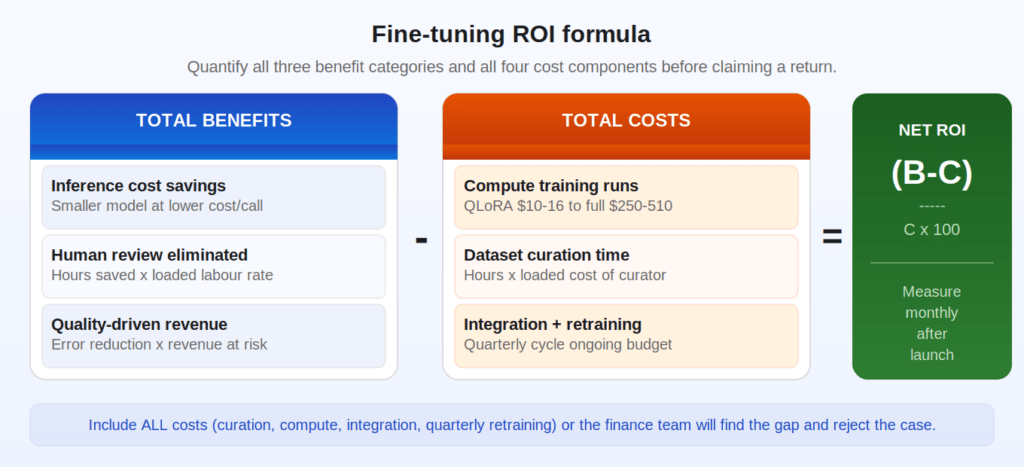
The ROI formula is straightforward. The discipline required to populate it correctly is not.
ROI = (Total Benefits — Total Costs) / Total Costs × 100%
The benefits side requires quantifying three components: inference cost savings from switching to a smaller fine-tuned model, human review time eliminated multiplied by the loaded hourly cost of the reviewers, and any revenue or error-reduction impact attributable to quality improvements.
The costs side must include all four real cost components: compute training runs (QLoRA $10 to $16, full fine-tuning $250 to $510 per Spheron’s March 2026 benchmarks), dataset curation time measured in hours at the loaded cost of whoever curated it, integration and deployment engineering time, and the quarterly retraining budget required to prevent model drift.
The most common reason finance teams reject fine-tuning ROI cases is that the costs presented are incomplete. Including only the compute cost and omitting curation, integration, and retraining produces a number that looks better than the reality and is immediately challenged when finance asks where those line items are. Present all costs from the start.
The monthly tracking requirement matters too. Fine-tuning ROI is not a one-time calculation. Inference costs change as volume scales. Review rates improve as the model is refined. The retraining cost recurs quarterly. Calculate the ROI on a monthly basis and track the payback curve from launch. This is what allows you to report to the board that the investment reached breakeven at month seven, not that it “seems to be working.”
The metrics that finance teams will actually accept
Finance teams do not reject AI ROI because they are hostile to AI investment. They reject it because the metrics they receive are either unverifiable or incomplete. The following four properties determine whether a fine-tuning ROI presentation survives a finance review.
Auditability – Every number must trace back to a source measurement with a date, a methodology, and a sample size. “We estimate it improved quality by 30 percent” is not auditable. “Format compliance measured on the same 500-request eval set rose from 71 percent on 1 February to 96 percent on 1 May, measured using automated JSON parsing” is auditable.
Attribution – The improvement must be causally linked to the fine-tuning, not to other changes that happened at the same time. If you launched a new feature, updated the product, or changed the prompt simultaneously with the fine-tuning, attribution is ambiguous. Control for other variables or the ROI case collapses under the first challenge.
Complete costs – If the compute cost is included but the curation time is not, a finance team will find the gap. Present every cost component, even the unfavourable ones. An ROI case that includes unfavourable costs is more credible than one that appears to have omitted them.
Time-bounded claims – Define what the ROI covers. Is it a 12-month return? 18 months? Does it include projected future savings or only realised savings to date? Unbounded claims (“this will pay for itself many times over”) invite scepticism. Bounded, evidenced claims invite approval.
Common measurement mistakes and how to avoid them
Measuring only training metrics and calling it ROI – Loss and perplexity measure whether the model learned the training data. They do not measure whether the learning produced business value. Always connect training metrics to the baseline evaluation set, and connect the evaluation set to a business outcome.
Skipping the baseline – The baseline is not optional. It is the foundation of the entire ROI case. Teams that complete fine-tuning before establishing baseline metrics cannot report improvement. They can only report a current state.
Underreporting costs – Showing compute cost only is the fastest way to have a ROI case rejected when the full cost picture emerges in a follow-up. Show everything: compute, curation, integration, retraining.
Using the wrong time horizon – Fine-tuning produces upfront costs and ongoing savings. A three-month payback calculation understates the return. A five-year projection without conservative assumptions overstates it. Use 12 to 18 months as the standard reporting window with clearly stated assumptions.
Not separating the three measurement layers – Presenting technical metrics to finance produces confusion. Presenting financial metrics to engineering without the technical foundation loses credibility. Separate the three layers and present each to its intended audience. Businesses planning to improve AI model performance while maintaining measurable ROI visibility can connect with AI specialists to evaluate the right fine-tuning, deployment, and measurement approach for their use case
What happens after you fill-up the form?
Request a consultation
By completely filling out the form, you'll be able to book a meeting at a time that suits you. After booking the meeting, you'll receive two emails - a booking confirmation email and an email from the member of our team you'll be meeting that will help you prepare for the call.
Speak with our experts
During the consultation, we will listen to your questions and challenges, and provide personalised guidance and actionable recommendations to address your specific needs.

Author
SathishPrabhu
Sathish is an accomplished Project Manager at Mallow, leveraging his exceptional business analysis skills to drive success. With over 8 years of experience in the field, he brings a wealth of expertise to his role, consistently delivering outstanding results. Known for his meticulous attention to detail and strategic thinking, Sathish has successfully spearheaded numerous projects, ensuring timely completion and exceeding client expectations. Outside of work, he cherishes his time with family, often seen embarking on exciting travels together.