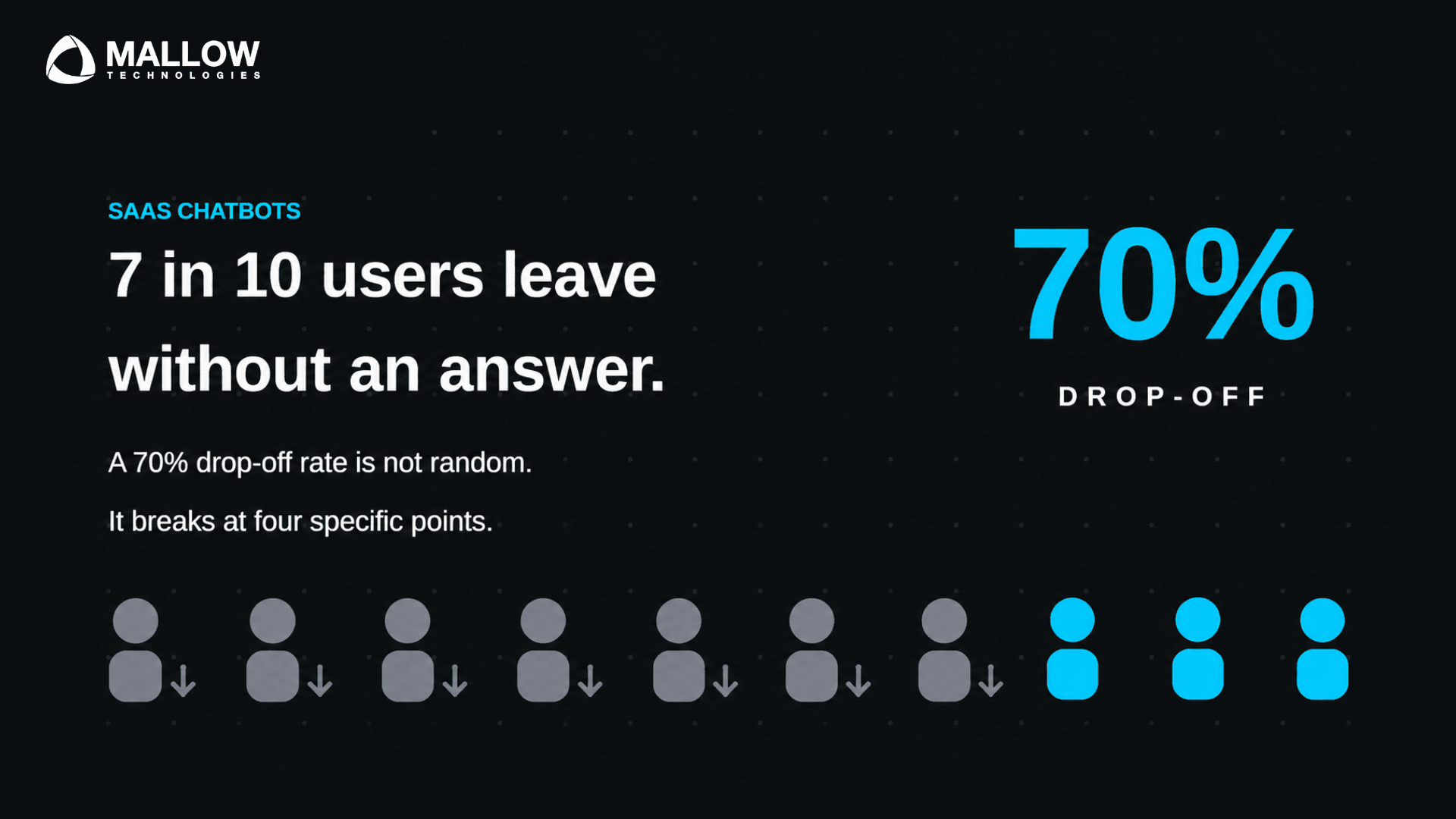
You shipped the chatbot to take pressure off your support team and give users instant answers. The dashboards looked healthy at first. Sessions were happening. Then you looked closer at what those sessions actually contained, and the picture changed. Most people open the chat, type one or two messages, and leave. Seven out of ten conversations end with no answer, no escalation, and a user who has quietly gone back to email or simply churned a little more than they were yesterday.
That number feels like a verdict on the whole idea. It is not. A 70% drop-off rate is one of the most diagnosable problems in a SaaS product, because conversations leave a trail. Every abandoned chat tells you exactly where it broke if you know how to read it. The users are not leaving for mysterious reasons. They are leaving at four specific moments, and most teams are guessing at which one instead of looking.
This piece is about reading that trail. We will walk through the four places a chatbot conversation actually breaks, how to tell which one is costing you the most, and which fix to make first so you are not spending three weeks improving something that was never the real problem. The goal is not a better-sounding bot. It is a bot that more people finish a conversation with.
What a 70% drop-off rate is actually telling you
Drop-off is not one problem. It is a label for several different failures that all end the same way, with a user leaving. Treating it as a single issue is why so many chatbot fixes go nowhere. A team sees the number, assumes the model needs to be smarter, swaps in a newer one, and watches the rate barely move, because the model was never the bottleneck.
It helps to remember where the wider market actually sits. Despite years of investment, a 2025 Gartner survey of customer service leaders found that AI agents still rank outside the top ten technologies those leaders consider most valuable, with many citing concern about tools marketed as smart that behave like rigid scripts underneath. In other words, a high drop-off rate is not a sign that you are behind. It is the normal starting point. The teams that pull ahead are the ones who stop treating the bot as a black box and start treating each abandoned conversation as evidence.
So before changing anything, the first move is to segment the drop-offs. Where in the conversation did each one happen? On the first message, the third, after a specific answer? That single act of categorising turns a scary headline number into a short, ranked list of fixable causes.

The four places a chatbot conversation breaks down
When you sort abandoned sessions by where they died, they almost always fall into four buckets. They are worth naming clearly, because the fix for each is completely different, and applying the wrong fix is the most common way teams waste a quarter.
Failure one - The bot misunderstands what users are asking
This is the earliest and often the largest leak. The user types a real question in their own words, and the bot maps it to the wrong intent, or to none at all, and answers something adjacent or asks them to rephrase. People do not rephrase. They leave.
You can spot this failure because the drop-offs cluster on the first or second user message, and the transcripts show the bot replying confidently to a question nobody asked. The cause is usually an understanding layer built on rigid intent matching that cannot handle the messy, varied ways real users phrase things. The fix is to move the understanding layer onto a language model that interprets meaning rather than matching keywords, so a question asked five different ways still lands on the same answer.
Failure two - The bot understands the question but has no answer to give
Here the bot reads the question correctly, then has nothing useful to say, because the information it needs is not in its reach. It falls back to a generic deflection or a link to a help centre the user already failed to find. The intent was understood. The knowledge was missing.
These drop-offs show up after a correctly understood question, often with the bot producing a vague or templated reply. The root cause is a knowledge base that is stale, thin, or disconnected from where your real answers live, such as product docs, past tickets, and account data. The fix is to ground the bot in current, authoritative content through a retrieval setup, so it answers from your actual knowledge rather than from whatever it was trained on months ago. A bot that can say the specific, correct thing keeps far more conversations alive than one that is merely fluent.
Failure three - The conversation hits a dead end with no way forward
Some questions genuinely should not be handled by a bot. The problem is not that the bot cannot answer. The problem is what happens next. If the only options are to repeat itself or apologise, the user is trapped, and a trapped user leaves angry rather than merely unhelped.
This failure is visible in transcripts that loop, where the bot says some version of the same thing two or three times before the session ends. The fix is the least glamorous and the most reliable: a clean, fast handoff to a human, or to a different flow, the moment the bot detects it is stuck. Counterintuitively, knowing when to give up is one of the strongest retention features a chatbot can have, because it converts a dead end into a path.
Failure four - The bot forgets what was said two messages ago
The final failure is subtle and corrosive. The user gives context in message one, the bot answers, and then in message three the bot acts as though message one never happened, asking for information already provided. Each repetition chips away at trust until the user concludes the thing is not really listening.
You will see this in multi-turn conversations that start well and decay, with the user repeating themselves before leaving. The cause is a system that handles each message in isolation with no memory of the conversation so far. The fix is to carry context across turns, so the bot reasons over the whole conversation rather than the latest line. This one matters more as your use cases get more complex, because the conversations that create the most value are rarely one question long.
What to fix first, and why the order matters

The instinct is to fix all four at once. Resist it. The four failures are not equal in cost, and they are not independent. Fixing them in the wrong order wastes effort, because a downstream fix cannot help a conversation that already died upstream.
The order follows the conversation itself. Start with understanding, because a question the bot misreads never reaches the knowledge layer, so improving knowledge first changes nothing for those users. Once understanding is solid, fix knowledge, so correctly understood questions actually get answered. Then add the human handoff, so the questions that remain unanswerable still resolve well. Context handling comes last for most teams, because it compounds the value of the first three rather than being a leak on its own. The logic of this sequence is simple – each fix only pays off once the one before it is in place.
This is also where honest measurement earns its keep. Pick the single failure bucket that holds the most abandoned sessions, fix that one, and watch whether the drop-off rate actually moves before touching the next. The trajectory of the field rewards getting this right, since Gartner projects that agentic AI will autonomously resolve 80% of common customer service issues by 2029. The bar is rising. A bot that loses most of its users is not on that curve, and the gap will only widen.
How to know your fixes are working
A falling drop-off rate is necessary but not sufficient, because a user can stay in a conversation and still leave unhelped. Track resolution, not just retention. The question is whether the user got what they came for, which you can approximate with a short post-chat confirmation, a re-contact check (did they come back with the same issue within a day or two), and a read of whether escalations are landing on the right cases rather than catching everything the bot should have handled.
Watched together, these tell you something a single rate never can – not just that more people are finishing conversations, but that the conversations are worth finishing. That is the real target, and it is the one your users were quietly measuring all along.
Where this leaves you
A 70% drop-off rate is not a sign the chatbot was a mistake. It is a sign the chatbot was shipped before its four hardest questions were answered, which is normal, fixable, and far cheaper to address now than to keep paying for in lost users. The work is not making the bot sound better. It is finding the specific moment your users give up and removing it, one failure at a time, in the order the conversation actually flows.
Connect with our AI specialists to turn abandoned conversations into resolved customer interactions. Whether your challenge is understanding user intent, improving knowledge retrieval, enabling seamless handoffs, or maintaining conversational context, the right improvements can significantly reduce drop-offs and create better customer experiences.
Your queries, our answers
There is no universal benchmark because chatbot performance depends on the complexity of customer queries and the quality of the chatbot implementation. However, consistently high drop-off rates often indicate issues with understanding user intent, knowledge retrieval, conversation flow, or escalation processes.
Users typically abandon chatbot conversations when the bot misunderstands their question, cannot provide a useful answer, fails to offer a path to human support, or repeatedly asks for information that has already been provided. These issues create friction and reduce trust in the experience.
Start by identifying where users leave the conversation. Focus first on improving intent understanding, then ensure the chatbot has access to accurate and up-to-date information. Adding seamless human handoffs and maintaining conversational context can further improve completion and resolution rates.
Not necessarily. Many chatbot drop-offs are caused by poor knowledge sources, weak conversation design, or missing escalation paths rather than the AI model itself. Upgrading the model alone may have little impact if the underlying experience remains unchanged.
Success should be measured using a combination of metrics, including conversation completion rate, issue resolution rate, customer satisfaction, escalation quality, and repeat contact frequency. A chatbot that resolves customer issues effectively delivers more value than one that simply keeps users engaged longer.
What happens after you fill-up the form?
Request a consultation
By completely filling out the form, you'll be able to book a meeting at a time that suits you. After booking the meeting, you'll receive two emails - a booking confirmation email and an email from the member of our team you'll be meeting that will help you prepare for the call.
Speak with our experts
During the consultation, we will listen to your questions and challenges, and provide personalised guidance and actionable recommendations to address your specific needs.

Author
SathishPrabhu
Sathish is an accomplished Project Manager at Mallow, leveraging his exceptional business analysis skills to drive success. With over 8 years of experience in the field, he brings a wealth of expertise to his role, consistently delivering outstanding results. Known for his meticulous attention to detail and strategic thinking, Sathish has successfully spearheaded numerous projects, ensuring timely completion and exceeding client expectations. Outside of work, he cherishes his time with family, often seen embarking on exciting travels together.