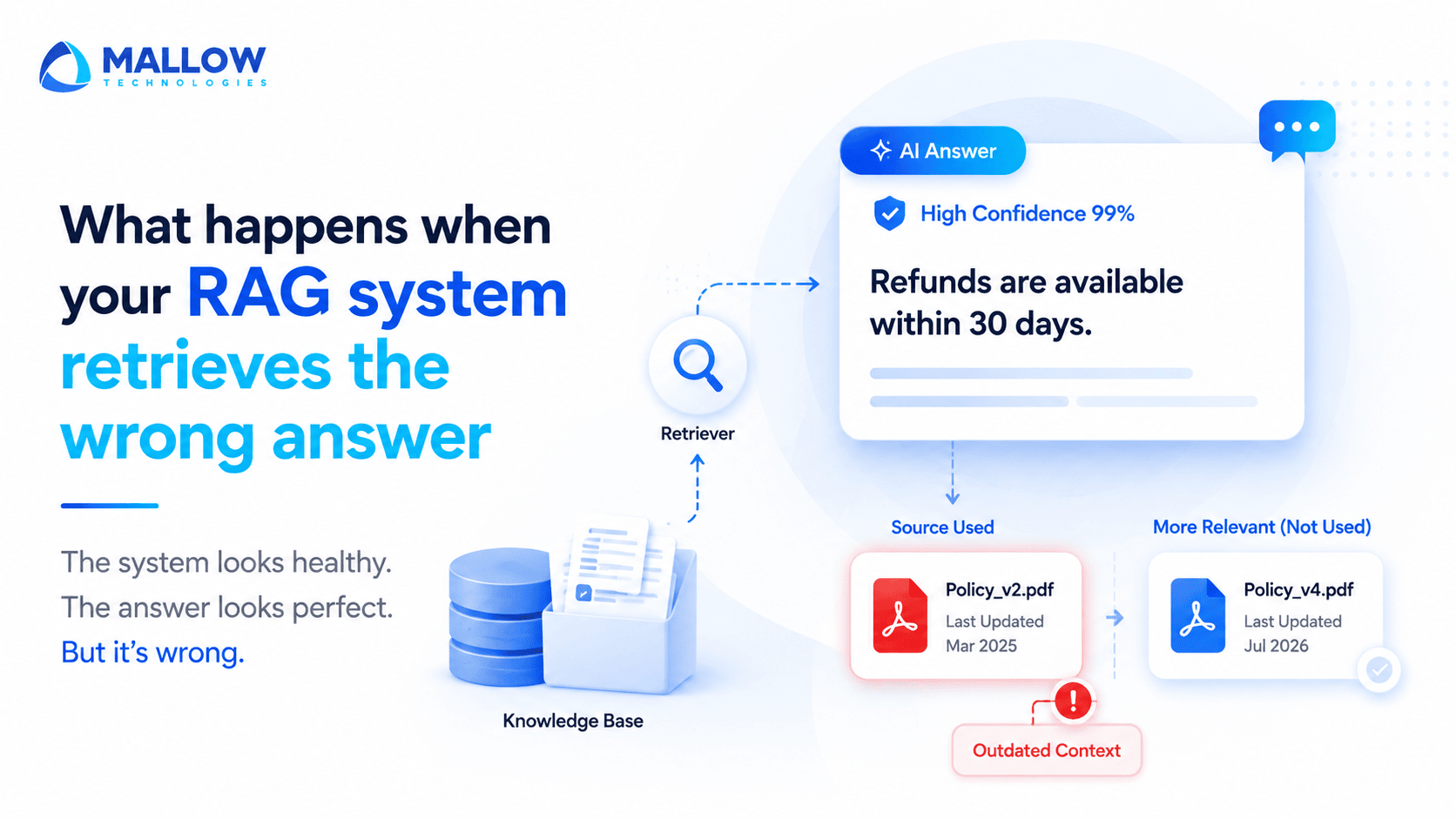
There is a version of RAG failure that nobody in the team notices in time. The system doesn’t crash. The latency looks fine. The monitoring dashboards stay green. A user asks a question. The retriever pulls something that looks relevant. The model produces a clean, well-structured answer in the product’s tone. The answer is wrong. And it sounds completely certain.
That is the failure mode worth understanding before you ship a RAG-based feature. Not the obvious version where the system produces garbage and users complain immediately. The dangerous version is the one where the system is quietly, confidently, fluently wrong for weeks before anyone on the team knows something is broken.
This article is for founders and product leads who are building or evaluating a RAG system and want to understand what that failure actually looks like in practice, what causes it, and what a well-built system does differently to catch and contain it.
The real danger isn't failure. It's not knowing your AI is wrong.
When a traditional software bug ships, users see an error state. A broken API returns a status code. A missing component leaves a gap in the interface. There is a signal. When a RAG system retrieves the wrong answer, none of those signals appear.
Production retrospectives across 2026 consistently identify a 40% retrieval failure rate for naive RAG pipelines on real corpora with real user queries. Naive in this context means the standard setup – fixed-size chunking, single-vector similarity search, top-k retrieval. That’s the architecture most teams ship first because it works well in demos. The demo uses controlled questions against a clean, small document set. Production uses messy questions against a large, inconsistently structured, partially outdated knowledge base. The gap between those two environments is where most RAG failures live.

What makes this hard is that the failure is distributed across two layers. The retriever returns something topically related but not quite right. The model, seeing context that looks like it addresses the question, generates a coherent answer from what it was given. Studies of modern large language models have found that they often produce incorrect answers instead of abstaining when the retrieved context is incomplete, and their expressed confidence rarely reflects that uncertainty. The model doesn’t know it’s working from incomplete evidence. It fills the gap the way a confident generalist does – by extrapolating from what it has.
The result is an answer that reads like a correct answer. There is no error state for a user to report. If the user doesn’t know the right answer themselves, they act on the wrong one.
Four ways retrieval goes wrong
Understanding the failure modes helps you build for them. When RAG fails in production, the retrieval layer is the root cause 73% of the time, not the generation model. Here is what goes wrong there, in the forms most likely to affect a SaaS product.

The right topic, wrong level of detail. The retriever finds a document that is genuinely about the right subject. The chunk it pulls, however, contains the section overview and the surrounding context, not the specific clause, number, or exception the user’s question depends on. The model reads the overview and generates an answer that sounds grounded in policy but misses the detail that actually changes the outcome. A question about a refund window gets an answer about the refund process in general, not about the 14-day exception that applies to the customer’s specific plan.
The correct document, wrong version. Semantic similarity search scores documents on topical relevance, not temporal relevance. A pricing page from eight months ago and a current one will score nearly identically if the language is similar enough. The retriever has no way to prefer the recent document unless temporal metadata is built into the retrieval pipeline explicitly. A system without that metadata will confidently serve outdated pricing, deprecated feature descriptions, and policies that were revised two product cycles ago. Users get burned. They often don’t know they got burned. They just quietly stop trusting the product.
The plausible distractor. Some of the worst retrieval failures involve documents that are not irrelevant. They share the same terminology, product names, and workflow language as the correct source. They just answer a different scenario – a similar plan, a different region, a previous version of the same feature. The model sees familiar-looking context and synthesizes an answer that sounds authoritative. The answer is correct for a case that doesn’t match the user’s actual situation.
The missing answer, with no signal. Sometimes the information a user needs simply doesn’t exist in the knowledge base, either because it was never documented or because the relevant chunk was lost in the chunking process. A well-calibrated system should respond with something like “I don’t have enough information on that.” Most systems don’t. They retrieve whatever is closest and generate from it. The absence of an answer becomes an improvised answer, delivered with the same confidence as a grounded one.
What this does to your product and your users
The business impact of silent retrieval failure compounds in a specific way that is worth naming.
First comes false trust. The system answers correctly often enough that users develop confidence in it. They stop verifying. When a wrong answer eventually affects a real decision, whether that is a customer acting on incorrect pricing, a support agent citing a deprecated process, or a new hire following an outdated runbook, the trust collapses faster than it built. One clearly wrong answer can undo months of positive interactions.
Second comes the monitoring gap. Standard infrastructure monitoring catches latency and error rates. It doesn’t catch semantic accuracy. A system serving wrong answers at low latency with a 200 OK response code looks healthy in every conventional dashboard. This is what makes silent failure genuinely dangerous – the team doesn’t know it needs to act until users start escalating or churning, by which point the damage is already done.

Third comes the update cycle problem. Gartner research on GenAI project failure patterns consistently finds that the gap between a working demo and a reliable production system is underestimated, with data quality issues the primary reason GenAI projects stall or get abandoned after proof of concept. For RAG specifically, the system that worked at launch degrades silently as the underlying knowledge base drifts – documents go stale, new product versions ship without corresponding knowledge base updates, and the retriever keeps returning the old answers with the same confidence.
What a well-built system does differently
The difference between a RAG system that fails silently and one that contains its failures is not model choice. It is what was built around the retrieval pipeline.

Temporal metadata on every document. Every chunk in the knowledge base should carry a last-updated timestamp and, where possible, an expiry date. The retrieval pipeline should use this metadata to score temporal relevance alongside semantic relevance. When a retrieved chunk is older than a defined threshold, the system should either deprioritise it in ranking or flag its freshness to the model explicitly. This doesn’t require a sophisticated architecture change. It requires treating document shelf life as a reliability concern from the start, not an afterthought.
A retrieval grader before generation. The naive architecture sends whatever the retriever returns directly to the model. A more reliable approach adds an intermediate step that evaluates retrieval quality before generation begins – does what was retrieved actually contain enough to answer this question, or should the system route to a fallback? That fallback could be a human handoff, a “I don’t have reliable information on that” response, or a secondary retrieval pass. As Towards Data Science’s analysis of RAG production failures notes, the failure is structural – the model fills gaps with confident generation rather than flagging insufficient context, so that check has to happen upstream of the model, not inside it.
Source citations in the response. A system that shows its sources, and makes those sources inspectable, gives users the mechanism to verify answers before acting on them. It also gives the team a diagnostic signal – when a citation points to an outdated or incorrect document, that is a retrieval quality problem the team can fix. Systems without citations give users no way to distinguish a grounded answer from an improvised one. They look identical.
Accuracy sampling as an ongoing practice. Retrieval quality is not a launch-time metric. A system that evaluated well at launch will degrade as the knowledge base ages, as the distribution of user queries shifts, and as new product features introduce gaps in the documentation. A monthly or quarterly pull of a random sample of production answers, manually checked for accuracy against the actual source, is one of the lowest-cost ways to catch silent failure before it reaches users at scale.
Explicit escalation paths. Some questions should not be answered by a RAG system at all – billing disputes, legally sensitive requests, queries that require judgment a knowledge base can’t supply. A well-structured system includes documentation about when to escalate as part of its retrieval corpus. When a question matches an escalation pattern, the system should route to a human, not improvise.
The question to ask before you ship
Most RAG evaluations test the system on questions the team already knows the answers to, against a clean subset of the knowledge base. That testing catches obvious failures. It doesn’t catch the failure modes that show up in production – messy real-world queries, documents that haven’t been updated since last quarter, topics that fall into gaps in the knowledge base, and questions where the most relevant-looking retrieved chunk is technically accurate but missing the specific detail that changes the answer.
The right pre-launch question is not “does it answer our test questions correctly?” It is “what does the system do when it doesn’t have enough to answer reliably, and does that behaviour protect the user or expose them?”
If the answer to that question is “it generates something anyway and sounds confident,” you have the architecture most teams ship first. It works well enough to demo. It is not ready to handle real users who will act on what it tells them.
Validate your RAG system before launch
The RAG pattern is genuinely useful. The risk isn’t in the architecture itself. It’s in the gap between how it behaves in a controlled demo and how it behaves six months into production, when the knowledge base has drifted, the queries are noisier than expected, and the monitoring dashboard is showing a healthy green while users are quietly getting wrong answers. Building for that failure mode before launch is not a large engineering investment. It is a documentation decision, a metadata decision, and a routing decision. The cost of those decisions is low. The cost of discovering the failure through user trust erosion is not.
If you’re building a RAG based feature and want to validate whether your retrieval pipeline is ready for production, connect with our experts. We can review your retrieval architecture, identify potential failure points, and help you build a more reliable RAG system before it reaches your users.
Your queries, our answers
Related but distinct. LLM hallucination is when the model generates content not supported by any source. RAG retrieval failure is when the model generates content that is grounded in something it retrieved, but what it retrieved was wrong, outdated, incomplete, or the right topic at the wrong level of specificity. Both produce wrong answers. The retrieval version is harder to catch because the response has a source citation that looks legitimate.
No. Research on frontier models confirms they generate confident wrong answers when given insufficient retrieved context, regardless of model quality. The fix is upstream - better retrieval, temporal metadata, retrieval grading, and more explicit escalation paths. Upgrading the model while leaving the retrieval architecture unchanged does not address the root cause.
Pull a sample of recent production answers. For each one, check three things - does the citation resolve to a real retrieved chunk, does that chunk actually support the claim in the answer, and is the cited document current. A system without inline citations is harder to audit but the same check applies - find the source that should have grounded the answer and verify it matches. The third question, on freshness, is the one most teams skip.
Add temporal metadata to your document schema and use it in retrieval scoring. Add an explicit "I don't have reliable information on that" fallback for queries the system can't confidently ground. Both changes can be made without restructuring the retrieval pipeline.
Both, with different stakes. A customer-facing wrong answer erodes trust and can affect business outcomes. An internal wrong answer, in a support agent tool or an engineering runbook assistant, affects the quality of decisions made inside the team. The failure mode is identical. The audience for the error is different.
What happens after you fill-up the form?
Request a consultation
By completely filling out the form, you'll be able to book a meeting at a time that suits you. After booking the meeting, you'll receive two emails - a booking confirmation email and an email from the member of our team you'll be meeting that will help you prepare for the call.
Speak with our experts
During the consultation, we will listen to your questions and challenges, and provide personalised guidance and actionable recommendations to address your specific needs.

Author
SathishPrabhu
Sathish is an accomplished Project Manager at Mallow, leveraging his exceptional business analysis skills to drive success. With over 8 years of experience in the field, he brings a wealth of expertise to his role, consistently delivering outstanding results. Known for his meticulous attention to detail and strategic thinking, Sathish has successfully spearheaded numerous projects, ensuring timely completion and exceeding client expectations. Outside of work, he cherishes his time with family, often seen embarking on exciting travels together.