The adoption curve for agentic AI in SaaS is moving faster than most teams expected and producing less value than most demos implied. According to McKinsey’s State of AI 2025 survey of nearly 2,000 organisations, 88% of companies now use AI in at least one business function, and 62% are at least experimenting with AI agents. But only 23% are actually scaling an agentic system somewhere in their operations, only 39% report any enterprise-level financial impact from AI at all, and just 1% describe their AI strategy as fully mature.
That gap between experimentation and measurable return is not a technology problem. It is a workflow selection problem. The teams pulling ahead are not the ones with the most sophisticated agent architecture. They are the ones that identified the right workflows to start with and deployed narrow, well-scoped agents against those workflows before trying to build anything more ambitious.
This article is a concrete map of which SaaS operations workflows are producing the fastest ROI from agentic AI right now, and the filter that separates ready workflows from ones that look similar but are not.
What makes a workflow ready for agentic AI
Not every workflow benefits from an agent. Some workflows that seem like automation targets are actually too variable in their inputs, too dependent on human judgment, or too consequential when wrong to deploy agents against safely right now.
Four characteristics reliably identify workflows where agentic AI produces ROI quickly –
High frequency. The workflow runs dozens or hundreds of times per day or week. At low frequency, the cost of building and maintaining the agent exceeds the time saved. At high frequency, the return compounds rapidly.
Rule-governable. Clear conditions reliably predict the right action. Not every response is identical, but the decision logic is stable enough to encode. If the workflow requires a human to weigh competing considerations on every instance, it is not ready for an agent to execute independently.
Multi-tool coordination as the bottleneck. The workflow requires data or actions across more than one system – a CRM, a ticketing platform, a billing provider, an internal database. If the bottleneck is purely analytical (a human thinking), an AI assistant may be better. If the bottleneck is routing, updating, retrieving, and responding across multiple systems, an agent changes the economics significantly.
Measurable outcome. The workflow has a clear success metric – ticket resolved, lead qualified, user activated, contract renewed. Workflows where success is subjective or hard to track produce agents that are difficult to evaluate and improve.
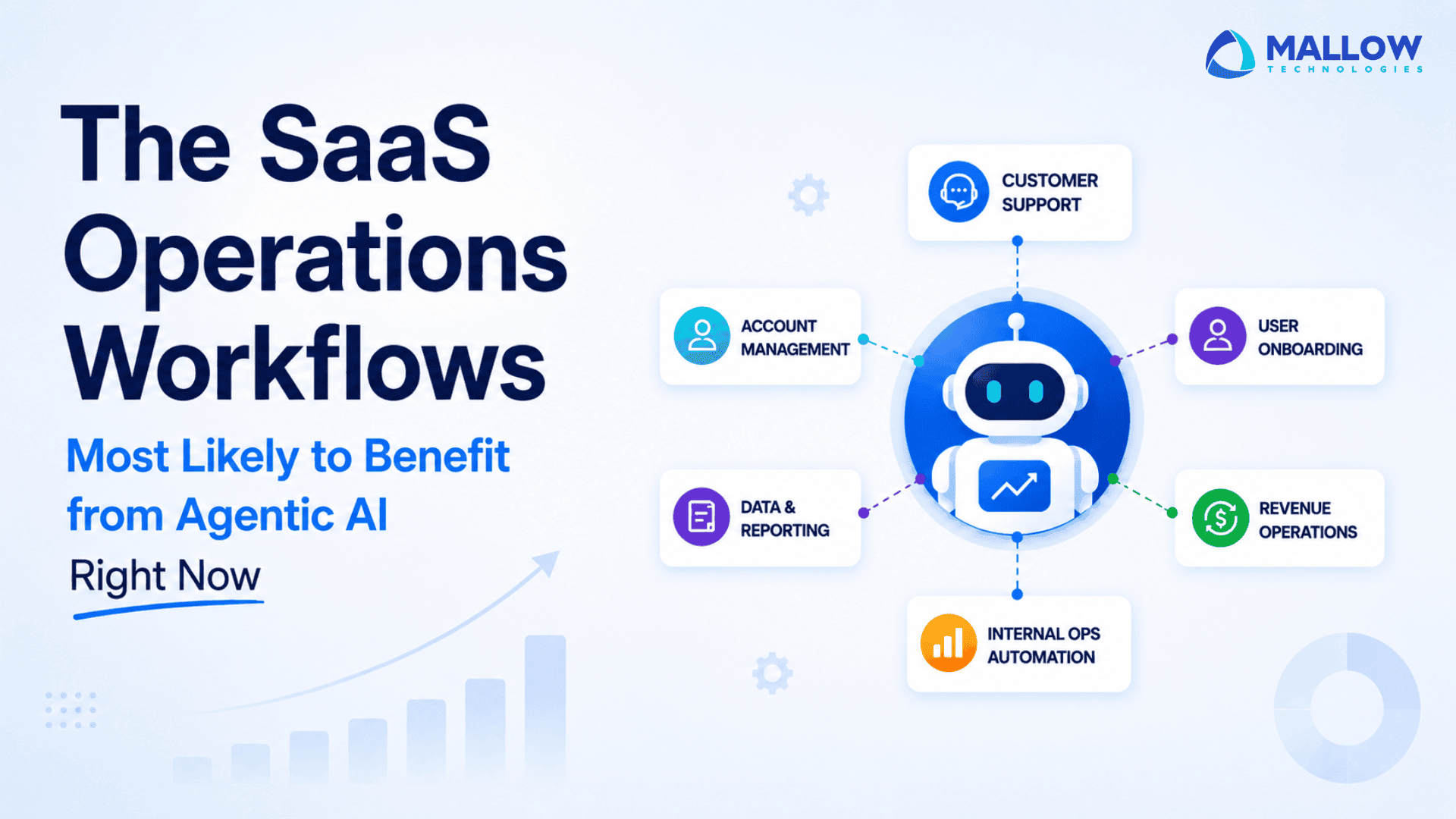
Applying this filter to a typical SaaS operations stack consistently surfaces the same five categories.

Customer support triage and Tier 1 resolution
Support is where most SaaS teams deploy their first agent, and for good reason – the ROI case is the clearest of any operational category. A large share of support volume, estimates put it at around 80% of Tier 1 queries, consists of questions that are frequent, well-documented, and low-risk – billing questions, feature FAQs, account resets, access requests, configuration guidance. These queries meet every criterion in the filter above.
The agent monitors the incoming queue continuously, classifies the query against the knowledge base, resolves what it can, and routes what it cannot to a human agent with full context pre-loaded. The human receives escalations that already have the customer’s account history, previous interactions, and the specific issue identified, rather than starting from scratch.
The operational numbers from early production deployments are consistent. Intercom’s Fin AI customer service benchmark reports that its AI agent autonomously handles around 50% of Tier 1 support tickets across its customer base. BCG’s research on agentic AI deployments also found that organisations using AI agents to coordinate multi-step business processes achieved 30% to 50% faster execution.
Another reason support is such a practical starting point for Seed to Series B SaaS companies is that most of the required knowledge already exists. Help centre articles, support documentation, macros, and historical ticket data provide much of the information an agent needs to operate effectively. The preparation work is real, but it is contained, and the business impact is often visible within the first month.
The biggest mistake is trying to automate every type of support request from day one. Teams that begin with a narrow scope, typically billing and configuration questions, have time to validate performance, improve accuracy, and build confidence before expanding into more complex scenarios. Teams that start too broadly often end up with agents that perform adequately for only a portion of requests while creating confusion for the rest.

User onboarding orchestration
Onboarding is the highest-churn-risk window in a SaaS product’s customer lifecycle. Most churn attributable to poor onboarding is invisible at the moment it is being caused – the user is stuck, the team does not know it, and by the time someone notices the account is inactive, the decision to leave has already been made.
The agentic pattern that works here is not a chatbot that answers onboarding questions. It is an orchestration agent that monitors activation signal across the product, triggers the right intervention at the right moment, and coordinates across the tools the onboarding process touches – the product itself, the CRM, the email platform, the support ticketing system.
When a user completes step three but never reaches step four, the agent does not wait for a weekly review meeting to surface that. It identifies the stall pattern, checks whether it matches a known friction point, routes to the appropriate response, which might be an automated help message, a task for the customer success team, or a configuration adjustment, and logs the outcome for the product team. That loop closes in minutes instead of days.
For a SaaS team with 50 to 500 active accounts, this is the kind of workflow where agentic AI changes the economics of customer success. The human CS function becomes genuinely more productive, focused on accounts that require judgment rather than accounts that just need a nudge that the agent could have provided automatically.
The readiness condition – this workflow requires reasonably reliable activation signal from the product itself. If there is no event tracking or product analytics in place, the agent has no signal to monitor. Fixing that instrumentation is a prerequisite, not a parallel workstream.

Lead qualification and routing
Sales qualification is a high-frequency, rule-intensive workflow that maps almost perfectly to the agentic AI filter. An inbound lead arrives. Someone needs to score it against the ICP, enrich it with firmographic and behavioural data, determine which sales rep it should go to, and prepare the context card the rep will need for the first conversation. In most SaaS companies under Series B, this work is done manually, takes hours or days, and is inconsistently applied because different reps apply different mental models.
An agent handles all of this in real time. It scores the lead against the current ICP definition, pulls firmographic data from the relevant enrichment tool, checks for signals like recent funding, relevant job postings, or prior product engagement, and routes the qualified lead to the right rep with context pre-loaded. The rep’s queue contains only leads worth calling, with the research already done.
The metric that matters here is not the agent’s output volume. It is conversion rate from first contact to meeting, and meeting to qualified opportunity. When a rep spends the opening minutes of a call confirming basic qualification data, those minutes are a tax on every conversation. When the agent absorbs that tax, the rep starts the conversation further along.
The qualification criteria do need to be encoded explicitly and kept current. An agent running against a stale ICP definition is producing consistently wrong answers, and consistently wrong answers on lead quality are expensive. This workflow requires a quarterly review of the scoring model as a standing operational practice, not just a setup task.
Contract and renewal management
Contract renewals in SaaS are a predictable trigger-action workflow that consistently underperforms when managed manually. The signals are knowable in advance – contract expiry dates, usage patterns, support ticket volume, feature adoption data, account health scores. The actions are well-defined – outreach, internal approval routing, escalation to account owner, documentation preparation. Yet most SaaS teams under 100 people manage this with a calendar or a spreadsheet.
A renewal agent monitors contract expiry dates continuously, surfaces risk signals ninety days out, generates personalised renewal outreach, triggers the internal approval workflow, and escalates to the account owner only when human judgment is genuinely required. The account team’s attention concentrates on the accounts that are actually at risk, rather than spreading equally across every upcoming renewal.
As McKinsey’s data and a subsequent Forbes analysis both highlight, the organisations that are scaling agents in production are overwhelmingly doing so in one or two well-defined functions, not broadly across the business. Contract management is one of the functions where narrow deployment against a clear trigger event produces the most consistent results, precisely because the workflow is defined by dates, thresholds, and conditions rather than subjective judgment.
The prerequisite is contract data in a usable state – expiry dates, account owners, usage data, and customer health signals all accessible from the same pipeline. This is often the real project, and it takes longer than expected.
Internal IT and HR service desk
This category is less visible to SaaS founders who focus on customer-facing workflows, but it is producing some of the most consistent ROI in the operations data, particularly for teams that are growing faster than their internal support capacity can follow.
The pattern – employees submit requests across predictable categories. Password resets. Access provisioning. Expense queries. Benefits questions. New hire equipment and system setup. Each of these individually is low value for a human to spend time on, but collectively they consume significant hours from IT, HR, and finance teams as headcount grows.
An agent handles the intake, classifies the request, resolves what is within a defined scope autonomously, and escalates what is not with the full request context attached. The IT or HR team receives only the requests that genuinely require a human decision. The rest close automatically within minutes of submission.
For a SaaS company between Series A and Series B scaling from 30 to 80 people, this is the workflow category where the operational tax on internal teams is most acute. It also tends to be the category where the agent can be deployed most quickly, because the knowledge base is entirely internal and the team has full control over the documents that ground the agent’s responses.
A practical note on sequencing
These five categories are not equally tractable for every team. The order worth considering – support triage first, because the knowledge base is usually closest to ready and the ROI is fastest to measure. Onboarding orchestration second, because the churn impact is high and the workflow is well-structured once product instrumentation is in place. Lead qualification third, once the ICP definition is stable. Contract and renewal management fourth, as a reliability improvement rather than a breakthrough. Internal service desk as a parallel track whenever internal team growth is creating operational drag.

The temptation to start with the most ambitious workflow, the one that seems most impressive in a demo, is also the temptation most likely to result in a pilot that never reaches production. Gartner projects that 40% of enterprise applications will embed AI agents by the end of 2026, up from fewer than 5% in 2025. The teams that are actually inside that 40% will get there by deploying narrow, well-scoped agents against well-selected workflows, not by trying to automate everything at once.
Ready to identify the right workflow for agentic AI?
The majority of SaaS teams evaluating agentic AI are not stuck on the technology. They are stuck on the question of where to start in a way that produces a real number within a real quarter. The answer is almost always the same – identify the workflow that is most repetitive, most multi-tool, most clearly measured, and most closely matched to a problem the team is already complaining about. That workflow, not the most impressive demo use case, is where a first agent should go.
If you want a second opinion on which of your team’s workflows are the best candidates for an agentic deployment right now, book a strategy call with our team. We’ll help you evaluate your operational workflows, prioritise the opportunities with the highest business impact, and define a practical roadmap for a successful agentic AI implementation.
Your queries, our answers
Apply the four-part filter - high frequency, rule-governable, multi-tool coordination bottleneck, measurable outcome. If a workflow fails any of those criteria, conventional automation or a simpler AI tool is likely the right answer before an agent is.
Support triage and internal service desk make sense once the team is handling more than 30-50 repetitive queries per week. Onboarding orchestration is worth building once the account base makes it impossible to manually track activation for every user. Lead qualification starts paying at volume where a rep is spending more than two hours per day on pre-call research.
It depends on how much the workflow touches proprietary data. Support triage and lead qualification often have viable off-the-shelf starting points. Onboarding orchestration and contract management almost always require custom integration into the product's own data layer. The build vs. buy decision is primarily a question of where the differentiated data lives.
Data access. The agent is ready before the data pipeline connecting the required systems is. Most pilots that stall are waiting not on model capability but on whether the CRM, the product database, and the support platform can actually talk to each other in a reliable, structured way.
Pick one metric per workflow - ticket deflection rate for support, activation rate at day 14 for onboarding, conversion rate from first contact for lead qualification, renewal close rate for contract management. A single measurable number is more useful than a dashboard full of activity metrics.
What happens after you fill-up the form?
Request a consultation
By completely filling out the form, you'll be able to book a meeting at a time that suits you. After booking the meeting, you'll receive two emails - a booking confirmation email and an email from the member of our team you'll be meeting that will help you prepare for the call.
Speak with our experts
During the consultation, we will listen to your questions and challenges, and provide personalised guidance and actionable recommendations to address your specific needs.

Author
SathishPrabhu
Sathish is an accomplished Project Manager at Mallow, leveraging his exceptional business analysis skills to drive success. With over 8 years of experience in the field, he brings a wealth of expertise to his role, consistently delivering outstanding results. Known for his meticulous attention to detail and strategic thinking, Sathish has successfully spearheaded numerous projects, ensuring timely completion and exceeding client expectations. Outside of work, he cherishes his time with family, often seen embarking on exciting travels together.