The internal RAG demo always looks impressive. The team asks questions. The system retrieves the right documents. The answers are clear, well-structured, and grounded in actual product content. Someone says “we’re ready to ship.” Then the first real users arrive.
Real users do not ask the questions you rehearsed. They do not know what the system does or doesn’t have access to. They carry expectations shaped by every AI experience they have had before yours, most of which have not gone well. And they arrive inside a broader trust environment that your feature did not create but cannot ignore.
A Gartner survey of over 1,500 US consumers, conducted in October 2025, found that 50% say they would prefer to give their business to brands that do not use GenAI in consumer-facing messages and content. That figure does not mean users have stopped using AI. It means they have started paying attention to when AI is serving the brand more than it is serving them. Sixty-one percent of the same respondents say they frequently question whether information they use to make decisions is reliable. Sixty-eight percent frequently wonder whether the content they see is real.
Your RAG feature is shipping into that environment. Understanding it is not a marketing problem. It is a product design problem.
What the trust gap actually means for a RAG feature
There is a common misreading of AI skepticism data – that users don’t want AI, so product teams should hide it or downplay it. The Gartner data does not say that. What it says is that consumers are skeptical of AI they cannot evaluate, cannot verify, and cannot escape from. The aversion is to the combination of confident output and no mechanism to check it.
A RAG system that shows its sources, acknowledges what it does not know, and routes clearly to a human when the question is outside its scope is not the product consumers are pushing back against. It is the other kind – the one that answers every question with the same authoritative tone, never says it is uncertain, and replaces the escalation path with another AI response.
This distinction matters more now than it did two years ago because the novelty premium on AI has expired. According to ContentGrip’s analysis of consumer trust in AI search, the share of consumers who rated AI as more helpful than traditional search fell from 82% in 2025 to 54% in 2026, a 28 point drop in a single year. Users are no longer giving AI the benefit of the doubt. They are applying the same scrutiny they give any other information source.
What users will tolerate
The tolerance question is not binary. It varies by what is at stake in the answer.
Consumer research consistently shows that users accept AI answers readily when the cost of a wrong answer is low and reversible – style recommendations, content discovery, how-to guidance, FAQ responses. The same users apply much more scrutiny when the answer affects something they cannot easily undo – pricing, billing, account status, legal terms, health-related information.
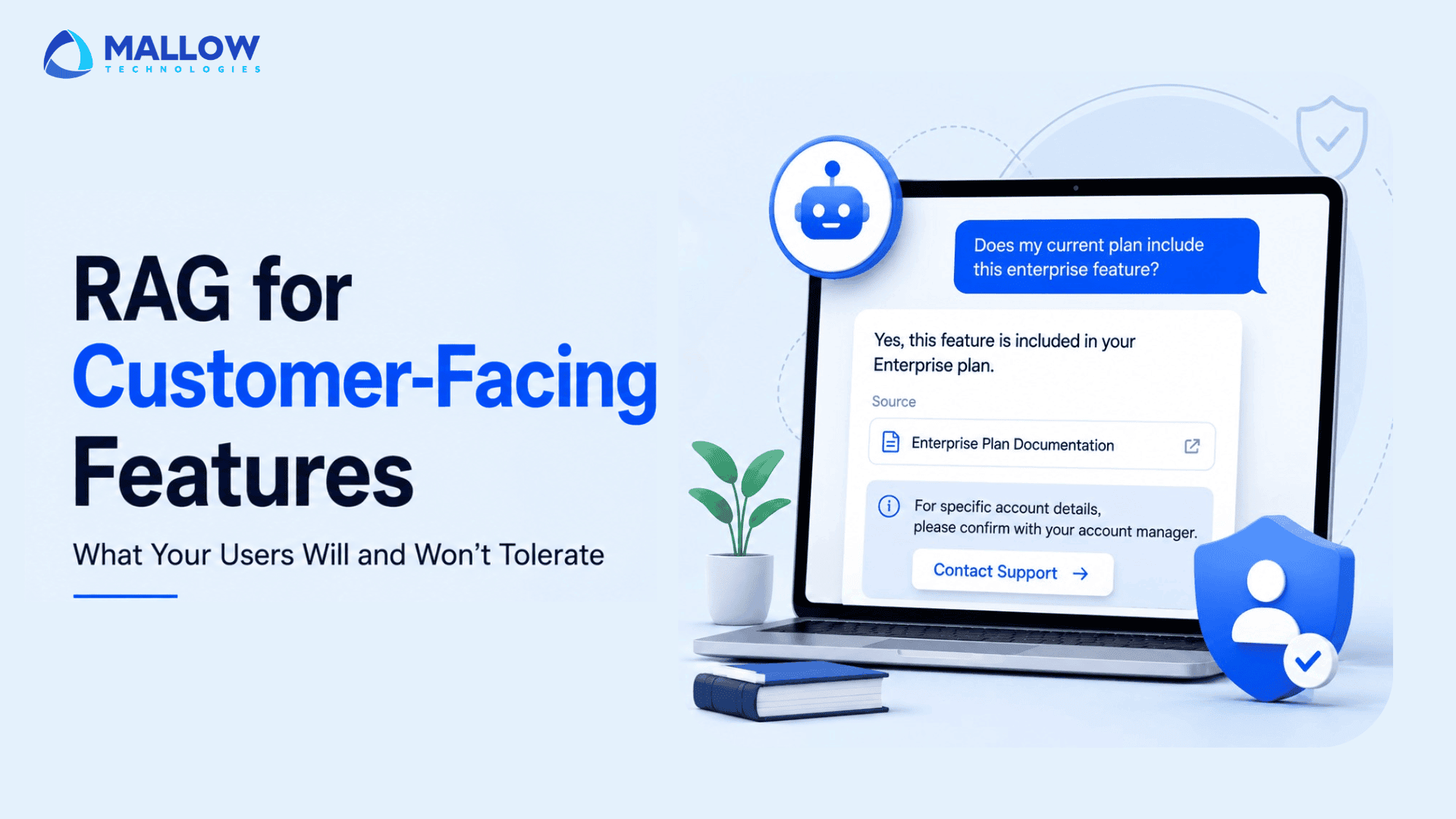
For a SaaS product, this maps cleanly. A RAG-powered help feature that answers “how do I export my data?” is in low-stakes territory. A RAG-powered feature that answers “does my current plan include this enterprise feature before I sign an annual contract?” is not. The same architecture, the same retrieval pipeline, the same model, and two completely different trust thresholds depending on what the user plans to do with the answer.

Users will also tolerate uncertainty when it is communicated honestly. A response that says “based on our documentation this policy applies, but I’d recommend confirming with the team on your specific account” is one users consistently describe as trustworthy in usability research. It names its own limitations. It does not pretend to certainty it does not have. That design choice costs almost nothing to implement and changes the trust dynamic significantly.
What users will not tolerate – a confident wrong answer on a question that mattered to them.
What users won't tolerate
The tolerance ceiling collapses when two conditions are present simultaneously – the AI gave them wrong information, and they had no way to catch it before they acted on it.

A wrong answer with a visible source they could have checked is a recoverable situation. A confident wrong answer with no citation, no uncertainty signal, and no escalation path is not. That is the trust damage that does not repair itself. The user does not blame the model. They blame the product. More precisely, they blame the company for putting them in that position.
According to Product.ai’s Trust in AI Commerce Report, 86% of consumers who used AI for product or service research verified the AI’s recommendation through another source before acting on it. That verification behavior is not a sign of distrust. It is a sign of appropriate caution that is already built into how users interact with AI outputs. The question for your product is – are you designing for that verification behavior, or are you designing against it?
Designing against it looks like – removing source citations to make the interface cleaner, suppressing uncertainty signals to make responses sound more authoritative, hiding the escalation path because the product goal is to reduce support volume. Each of those choices prioritises a team metric at the cost of user trust. Users who cannot verify and cannot escalate do not become more trusting over time. They become more likely to churn, and to describe the product negatively to peers.
The other thing users will not tolerate is loss of their escalation path. When a user has a billing question, a legal concern, or a complaint about a transaction, they expect a human to be available. A RAG feature that deflects those queries with more AI output is not solving a support problem. It is creating a reputation problem.
The verification behavior you haven't designed for
Most customer-facing RAG implementations are designed around the assumption that users will read the answer and act on it. The evidence suggests the majority of users will read the answer and then go look it up somewhere else.

That verification loop is where your product either confirms its credibility or undermines it. When a user receives an AI answer from your product and then visits your documentation directly, they are checking whether what the AI said is actually there. If it is, the trust compounds. If it isn’t, or if the documentation says something different, the trust collapses, and it collapses for the entire product, not just the AI feature.
This has a specific implication for RAG data preparation. The document the user checks after seeing an AI answer and the document the AI retrieved that answer from need to be in sync. When product documentation is updated and the RAG index is not refreshed promptly, users catch the gap themselves during verification. The exact kind of trust-building moment the feature was designed to create becomes the trust-breaking moment that sends them to your support queue instead.
Source citations in the AI response are not just a transparency feature. They are also what the verification behavior needs to function correctly. A cited source lets the user confirm the answer in one click, rather than hunting through documentation trying to find whether the AI made something up. When you remove citations from a customer-facing RAG feature because the design team found them visually noisy, you are removing the mechanism users most rely on to trust what they just read.
Where RAG earns trust in a customer-facing context
RAG features that earn customer trust in production share several consistent design properties, regardless of the underlying architecture.

They answer within a defined scope and say so clearly. “I can help with questions about your account settings, billing, and platform features” tells the user what the system covers and implies what it doesn’t. Users who know what a tool can do trust it more within that scope than users who are discovering its limits through failure.
They show where their answer came from. This does not require a complex citation interface. A simple “from your plan documentation” or a linked source is enough for most users. What matters is that the answer is visibly grounded in something the user could check, rather than appearing to come from nowhere.
They escalate gracefully. A well-structured knowledge base includes explicit documentation about when to involve a human. When a user asks a question the system identifies as outside its reliable scope, a response that names the relevant support path, account manager, or escalation route, and routes there directly, is significantly better received than one that generates a confident-sounding answer anyway.
They acknowledge uncertainty without hedging everything. There is a difference between “based on our current documentation” (useful, accurate calibration) and qualifying every single response with a lengthy disclaimer that makes the feature feel unreliable. The goal is honest confidence – direct answers where the retrieval is clean, explicit acknowledgment where it is not.
The design decision that determines almost everything
Before a single line of code is written for a customer-facing RAG feature, there is one design question that determines most of the trust outcomes downstream – what is this feature not allowed to answer?
Defining the out-of-scope cases is not a limitation. It is the architecture of trust. When a system reliably does one thing well and reliably routes to humans for everything else, users learn where they can trust it and behave accordingly. When a system attempts to answer everything with the same confidence, users cannot calibrate when to trust it and when to verify, so they verify everything, or they abandon it after the first wrong answer on a question that mattered.
The out-of-scope list for most SaaS RAG support features includes – billing disputes, pending renewals or cancellations, legal or contractual queries, account security concerns, escalations involving dissatisfied or churning customers, and any question where the honest answer is “I don’t know and neither does the documentation.” Documenting those cases explicitly, and building the routing logic before the feature ships, is the design work that protects both the user and the product’s long-term reliability.
Build customer trust before you build the feature
The user sitting in front of your RAG feature has already formed an expectation based on every other AI experience they have had this year. Many of those experiences have been overconfident, generic, and hard to verify. The opportunity your feature has is to be specifically the opposite – accurate within a named scope, honest about its limits, transparent about its sources, and connected to a human for everything it cannot reliably handle. That is a product decision as much as a technical one. And it is the decision that determines whether the feature builds trust over time or quietly erodes it.
If you’re designing a customer-facing RAG feature and want to think through the trust and UX implications before launch, discuss your RAG implementation with our team. We’ll help you evaluate your approach, identify potential trust and usability gaps, and build a customer experience users can rely on.
Your queries, our answers
Consistently yes. Users who can trace an answer to a specific document they can inspect are more likely to report trusting the response, regardless of whether they actually click through. The visible citation changes the experience from "the AI said so" to "the documentation says so." Those are different trust anchors.
Yes, and Gartner's consumer data supports this explicitly - consumers who know when AI is being used, and can opt out, report higher trust than consumers who discover it unexpectedly. Transparent disclosure is not a trust cost. Discovering undisclosed AI use is.
Design an explicit fallback response: something that names the limitation, suggests the right verification step, and offers the escalation path. "I don't have reliable information on that in my current documentation. Your account manager can confirm" is substantially better than an improvised answer that sounds confident but may be wrong.
The immediate risk is a user acting on incorrect information about their account, billing, or product capabilities. The longer-term risk is the trust damage that follows: users who receive a confident wrong answer on a high-stakes question rarely return to the feature. They escalate to humans and advise others to do the same.
Yes, in customer-facing contexts. A well-configured RAG system backed by an accurate, current, well-structured knowledge base consistently outperforms a more sophisticated model running against stale or inconsistent documentation. Users experience the output, not the architecture. If the output is accurate and sourced, trust builds regardless of which model generated it.
What happens after you fill-up the form?
Request a consultation
By completely filling out the form, you'll be able to book a meeting at a time that suits you. After booking the meeting, you'll receive two emails - a booking confirmation email and an email from the member of our team you'll be meeting that will help you prepare for the call.
Speak with our experts
During the consultation, we will listen to your questions and challenges, and provide personalised guidance and actionable recommendations to address your specific needs.

Author
SathishPrabhu
Sathish is an accomplished Project Manager at Mallow, leveraging his exceptional business analysis skills to drive success. With over 8 years of experience in the field, he brings a wealth of expertise to his role, consistently delivering outstanding results. Known for his meticulous attention to detail and strategic thinking, Sathish has successfully spearheaded numerous projects, ensuring timely completion and exceeding client expectations. Outside of work, he cherishes his time with family, often seen embarking on exciting travels together.