There is a version of this conversation that goes very well in a board meeting. “We’re building multi-agent AI.” It sounds sophisticated. It signals technical ambition. It gets nodded at by investors who have just read about it in three different newsletters.
The problem is that many SaaS teams building multi-agent systems right now are doing it with a vague sense of direction. They know it is the right investment, but they have not resolved a question that matters enormously for how they actually build. Does this create something users will notice and value, or does it make the backend run better while the experience stays roughly the same?
That is not a philosophical question. It is an architectural one. And getting it wrong does not just waste engineering months. It shapes product positioning, pricing, onboarding, and whether users feel the difference at all.
This article maps out where multi-agent orchestration genuinely belongs on the user-value side of your product, where it belongs in the operational layer, and how to think about that boundary clearly enough to make useful decisions.
What multi-agent orchestration actually means in a SaaS context
A single AI agent, given a task, will try to complete it. A well-designed single agent can do quite a lot. But single agents hit a ceiling when tasks are genuinely multi-step, require different types of reasoning at different stages, or depend on data that lives across systems.
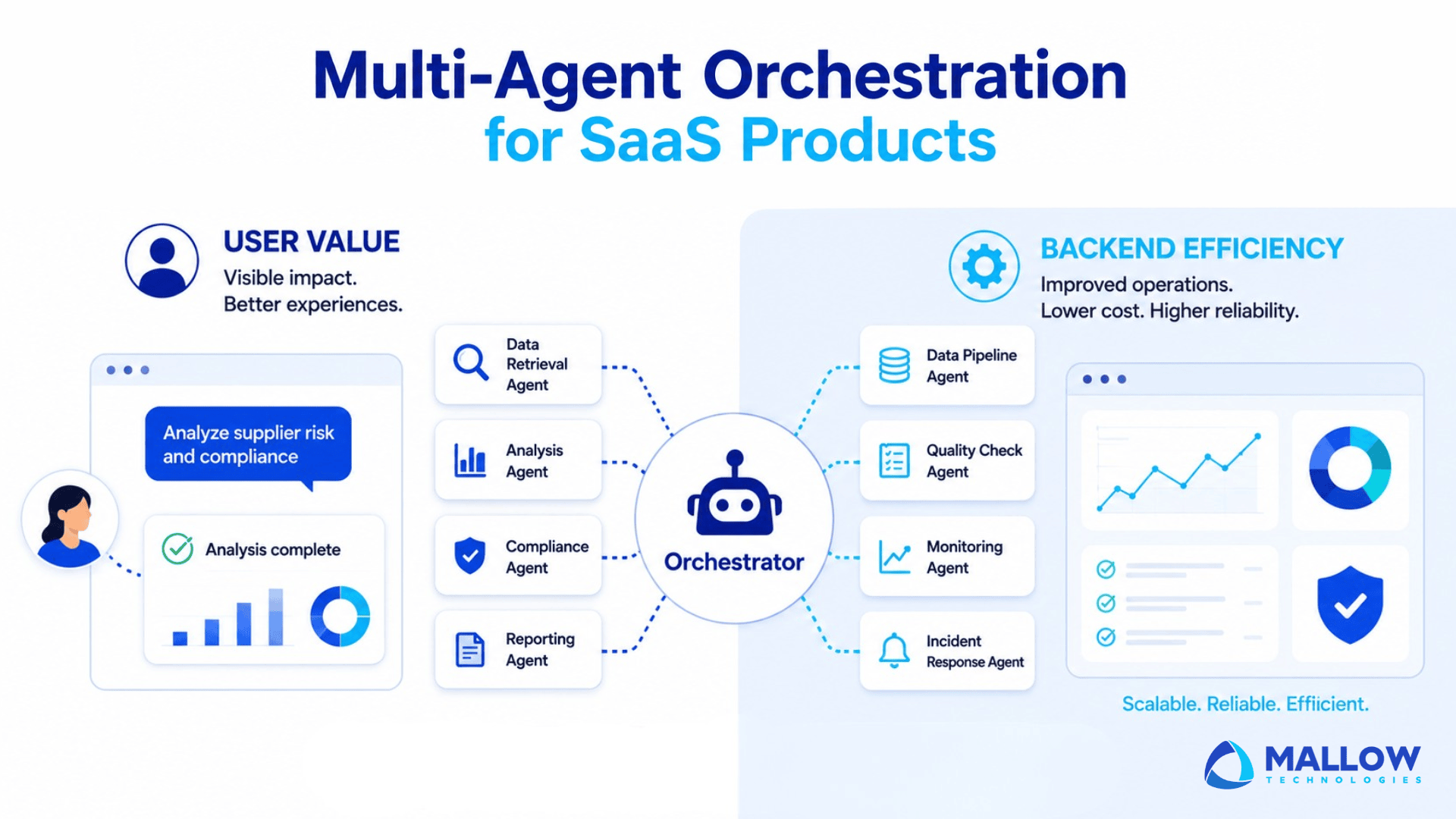
Multi-agent orchestration is the practice of coordinating multiple specialised agents under a shared execution framework. Rather than one generalist agent attempting everything, you have a coordinator, often called an orchestrator, that routes tasks to agents built for specific functions. Each agent operates on its domain, returns results, and the orchestrator manages context continuity, sequencing, and handoffs between them.
The practical analogy is not exotic. Think of it as the difference between a single employee trying to handle procurement, legal review, and supplier negotiation alone, and a team where each person handles what they are actually good at, coordinated by someone whose job is to keep the work flowing.

Task-specialised AI agents are becoming a more common part of enterprise applications, particularly where multiple agents can coordinate work that a single agent cannot handle effectively. Gartner predicted in August 2025 that 40% of enterprise applications would embed task-specific AI agents by the end of 2026, up from under 5% the year prior. That shift reflects growing recognition that well-coordinated, specialised agents can handle complex tasks more effectively than single-agent systems.
But the adoption data has a counterbalance worth understanding. Gartner also estimates that over 40% of agentic AI projects could be cancelled by 2027, citing unclear value, rising costs, and weak governance. The gap between those two statistics is exactly what this article tries to close.
The two zones - A framework that matters
When you are deciding where multi-agent orchestration belongs in your SaaS product, the most useful distinction is not technical. It is about visibility and impact.
Zone 1 – User-facing orchestration
The agent coordination produces an experience the user directly perceives. They get something done faster, get output they could not have produced themselves, or navigate the product in a way that feels genuinely intelligent rather than automated.
Zone 2 – Backend efficiency orchestration
The agent coordination improves how your system processes, scales, or operates. The user’s interface may not change at all. What changes is cost, speed, reliability, or internal data quality.
Neither zone is inherently better. Both are legitimate reasons to build. But they require different success metrics, different testing approaches, and different conversations with your users.

Confusing them by building Zone 2 and expecting Zone 1 impact is one of the most common misalignments in agentic AI product development right now.
Where orchestration creates direct user value
This is the territory where multi-agent AI earns its place on the features page, not just the infrastructure diagram.
Complex, multi-step tasks that users currently do manually
If your users regularly complete a task that requires gathering data from multiple places, applying different kinds of reasoning at each stage, and then synthesising a result, you have a strong candidate for user-facing orchestration.
An example is a B2B SaaS platform for procurement teams. A user wants to evaluate whether a supplier meets requirements across pricing, compliance, delivery history, and risk profile. Today, they pull four reports, cross-reference them manually, and write a summary. With properly orchestrated agents, one handling pricing data retrieval, one running compliance checks, one analysing delivery records, and one assessing risk signals, the user asks one question and receives a structured evaluation. The work is still happening. They just are not doing it.
This is what creates user value. The task was genuinely complex. Orchestration made it feel simple. The user experiences capability, not infrastructure.
Adaptive, context-aware outputs
Single-agent systems struggle when context changes mid-workflow. A user starts a task, provides more information, changes scope, asks a follow-up, and a single agent either handles the entire chain gracefully or loses track.
Multi-agent systems with proper shared memory allow different agents to pick up context from where another left off. IBM’s documentation on AI agent orchestration notes that orchestrated agents can enhance operational performance and provide more accurate and personalised support, resulting in measurably more satisfying experiences for customers and employees. The personalisation element is especially relevant for SaaS products where users expect the system to learn and adapt within a session.
Intelligent handoff in user workflows
If your product involves sequential stages, where a user starts a process, reaches a point that requires a different capability, and then continues, orchestration can manage those transitions invisibly. The user does not navigate between features. The right capability arrives when it is needed.
This is particularly powerful in verticals like legal tech, healthtech, or financial planning tools, where a workflow might require document analysis, regulatory lookup, calculation, and then output generation in sequence. Each stage needs a different agent. The experience should feel like one continuous interaction.
Where orchestration belongs in the backend
This is equally valuable territory, but the conversation with your product, marketing, and customer success teams needs to frame it correctly. Backend efficiency gains are real. They just do not show up in a user interview.
Data pipeline automation
Many SaaS platforms sit on top of complex data pipelines. Data arrives from multiple sources, needs to be cleaned, classified, enriched, and routed. A single agent handling all of that is less reliable than a set of specialised agents with defined responsibilities.
Research on AI agent orchestration highlights that when multiple agents are deployed in isolation, they create fragmented experiences, governance challenges, and unreliable workflows. Centralised orchestration eliminates application sprawl, scales adaptively, and embeds compliance into workflows.
For SaaS teams running multi-tenant architectures with diverse customer data formats, orchestrated data agents can dramatically reduce pipeline fragility. The user never sees this. Their reports just load correctly. That is still a product outcome worth building for.
Automated quality and compliance checks
Regulated SaaS products such as fintech, healthtech, and HR platforms often have compliance logic that runs in parallel with user actions. An agent that checks every submitted document against regulatory requirements, routes flagged items to a specialised review agent, and logs decisions for audit purposes is doing genuinely important work. It is just invisible to the end user.
The value here is not user experience. It is risk reduction, operational reliability, and audit readiness. Organisations deploying multi-agent orchestration in groups under central coordination have been measured delivering 3.2 times more business value compared to single-agent deployments, according to analysis of enterprise adoption data.
Intelligent monitoring and incident response
SaaS operations teams benefit significantly from orchestrated monitoring agents. One agent watches system health metrics, another monitors error rates, another correlates anomalies against recent deployments, and a fourth drafts incident reports and routes them appropriately. This is a meaningful operational improvement. But it belongs in the platform layer, not in a product feature brief.
The boundary question - How to decide which zone you are building for
Most SaaS teams building multi-agent AI for the first time do not make this decision explicitly. They start with a use case, build the agents, and discover the zone they landed in after the fact. The better approach is to decide before building.
Four questions that clarify the zone –

1. Does the user see or feel the result directly?
If yes, it belongs in the user value zone. If the result feeds into a backend process and the user only sees downstream effects, it belongs in the backend efficiency zone.
2. Can you measure impact through user behaviour metrics?
Time on task, task completion rate, feature adoption, and NPS on specific workflows are user value signals. If your metrics are latency, error rate, and pipeline throughput, you are measuring backend efficiency.
3. Would removing this change the user’s onboarding story?
If you could credibly describe this capability in a demo, a features section, or a product tour, it creates user value. If the right place to describe it is an engineering blog or an SLA document, it belongs in the backend.
4. Does it solve a problem the user is aware of?
User-facing orchestration solves a friction the user can describe. Backend orchestration solves a problem the user benefits from without knowing it exists.
None of these questions suggest one zone is more worth building. They exist to ensure you build with clarity about what success looks like.
The architectural implications of getting this right
Designing for user-facing orchestration and backend efficiency orchestration involves different technical choices.
User-facing orchestration demands low-latency execution, high contextual coherence, and graceful failure handling that does not surface errors to the user. When one agent in a user-facing chain fails, the experience should degrade gracefully rather than collapse visibly.
Backend orchestration can tolerate more asynchronous execution, retry logic, and eventual consistency. The stakes of a partial failure are lower because the user is not watching in real time.
Both require shared memory and context management, but the memory architecture differs. In production SaaS systems, context continuity between agents becomes a critical design concern. When one agent passes a task to another, maintaining context is not optional. It determines whether the system behaves coherently.
The governance layer also differs. The 2026 Gartner Hype Cycle for Agentic AI found that only 17% of organisations have deployed agents to date, while over 60% expect to within two years. This is the most aggressive adoption curve among all emerging technologies measured in the survey. That gap between intent and deployment reflects how many teams underestimate the governance requirements. User-facing agents need tighter guardrails because user trust is at stake. Backend agents need auditable logs because operational accountability is at stake. These are distinct design requirements, not the same checklist with a different label.
Common mistakes in multi-agent SaaS product decisions
Treating orchestration as a single architectural choice. Teams often decide “we are going multi-agent” and then implement it uniformly. The smarter decision is to identify which workflows belong in Zone 1, which belong in Zone 2, and design each appropriately.
Measuring backend outcomes with user-value expectations. If you build backend efficiency orchestration and then wonder why users are not noticing or engaging differently, the measurement frame is the problem, not the engineering.
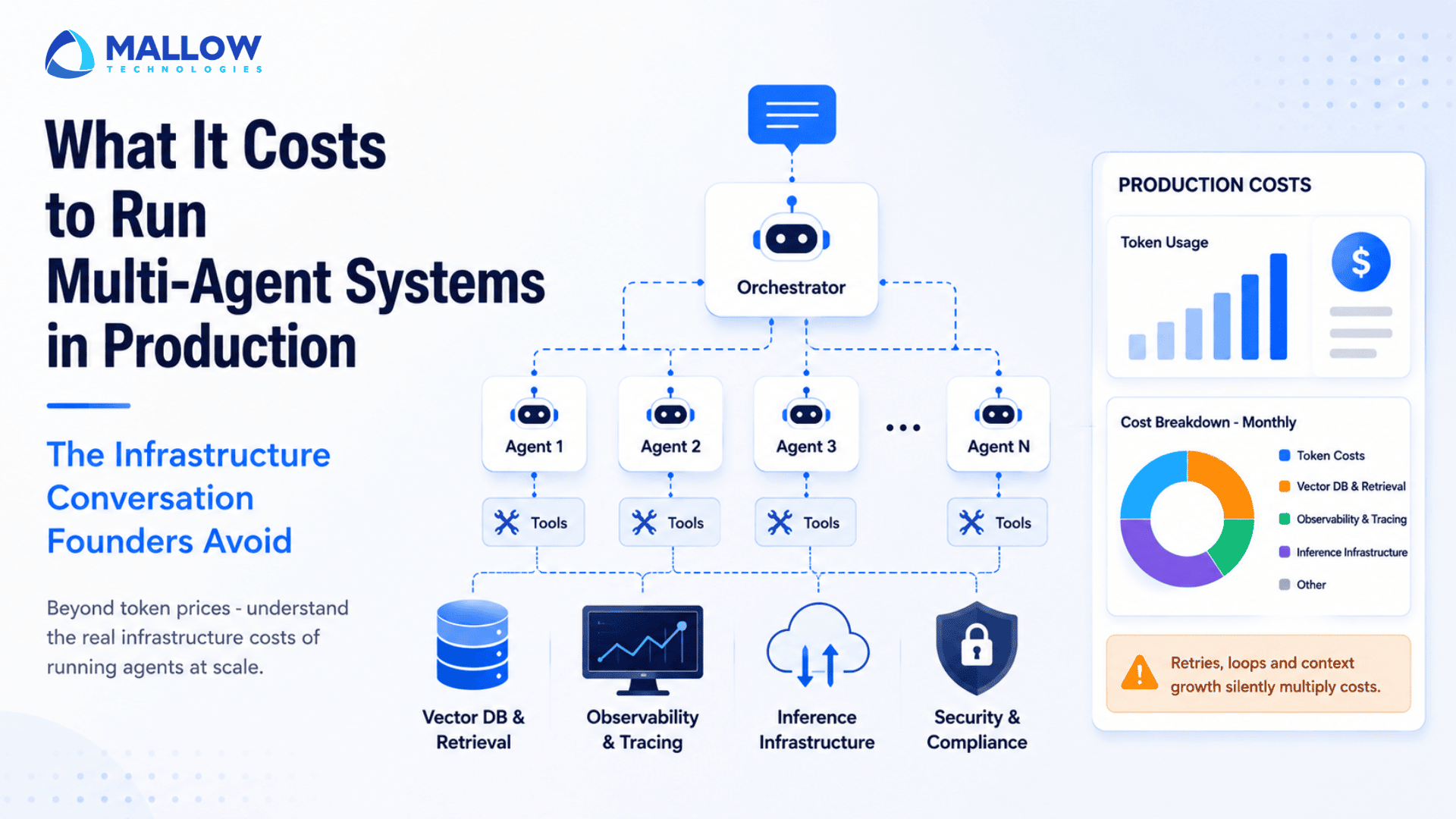
Underestimating operational overhead. Enterprise case studies report a wide range of timelines to production depending on complexity and governance requirements, and without hard exit conditions, documented cases exist of simple tasks reaching significant per-run costs through uncontrolled retries. Cost management and observability are not optional extras. They are part of the system design from the beginning.
Skipping context design. Many first-generation multi-agent implementations treat each agent as independent. They work for isolated tasks and degrade badly for sequential ones. Shared memory, context handoff protocols, and state management need to be designed before the agents are built.
A practical starting point for SaaS teams
If you are evaluating multi-agent orchestration for the first time, the most productive starting point is a workflow audit rather than a technology audit.

List the five to ten workflows in your product where users currently spend the most time or express the most frustration. For each, ask whether the complexity is inherent to the task or whether it exists because your current architecture does not coordinate information and reasoning well enough.
Separately, list the five to ten backend processes where errors, inconsistencies, or manual interventions create the most operational drag. Ask the same question. Is the problem inherent or architectural?
The workflows that fail the architecture test, where the task is actually achievable but your current system lacks coordination, are your best candidates for multi-agent investment. Start there. Build tightly. Measure clearly. Expand from a foundation that actually works rather than scaling a hypothesis.
McKinsey’s State of AI survey found that 62% of organisations are at least experimenting with AI agents, but only 23% are scaling an agentic system in any function. The organisations closing that gap are not necessarily the ones with the most sophisticated architectures. They are the ones who were clearest about what they were building and why before they started.
Build multi-agent systems where they create the most value
Multi-agent orchestration is not valuable simply because it uses more agents. It creates value when the architecture matches the problem you are solving. Some workflows deserve user-facing orchestration because they simplify complex tasks, reduce friction, and make the product noticeably more capable. Others belong entirely behind the scenes, where coordinated agents improve reliability, scalability, and operational efficiency without changing the user experience. Both approaches are valuable, but they should never be measured by the same success criteria.
If you’re evaluating where multi-agent orchestration fits into your SaaS product, get in touch with our team. We’ll help you identify the workflows where coordinated AI agents create meaningful user value, improve backend efficiency where it matters most, and design an architecture that’s built for long-term scalability rather than short-term complexity.
Your queries, our answers
A single agent handles the full scope of a task on its own. A multi-agent system distributes that task across specialised agents, each responsible for a defined function, coordinated by an orchestration layer that manages sequencing, context, and handoffs. Multi-agent systems become the better choice when tasks are genuinely multi-step, require different types of reasoning at different stages, or involve data from multiple systems.
If the orchestration reduces something the user currently does manually or produces an output they could not generate themselves without multi-step effort, it creates visible user value. If it improves how your system processes data in the background, it belongs in the backend efficiency category. Both are worth building. They just require different success metrics and different conversations with your users.
The most common mistake is implementing orchestration without deciding in advance which zone it belongs to: user-facing or backend efficiency. Teams build agents, launch them, and then measure the wrong outcomes. Backend efficiency agents are evaluated against user engagement metrics they were never designed to influence. Clarity about the zone before building prevents most of this.
LangGraph, CrewAI, and Microsoft's unified Agent Framework are the most widely used in 2026. LangGraph suits teams that need precise state management and production-grade control. CrewAI is better suited for rapid prototyping and hierarchical agent structures. The Model Context Protocol (MCP) has emerged as a widely adopted standard for giving agents secure, consistent access to external tools and data sources.
User-facing agents need graceful degradation logic. If one agent in the chain fails, the system should surface a useful partial result or a clear message rather than a broken experience. Background orchestration can tolerate retry loops and asynchronous resolution. The failure handling strategy is part of the architectural decision, not an afterthought.
Costs depend heavily on the number of agents, the models used, the volume of requests, and the complexity of the orchestration layer. Teams that do not set exit conditions on agent loops have reported significant per-run costs through uncontrolled retries. Cost management and observability tooling are not optional. They belong in the architecture from the start.
User-facing agents require tight guardrails because trust is at stake. Backend agents require auditable logs because operational accountability is at stake. In regulated markets such as fintech, healthtech, and HR platforms, the compliance requirements affect both zones differently. Any agent making decisions that affect user-visible outcomes needs explainability and override mechanisms. Backend agents processing regulated data need audit trails and access controls aligned with your compliance framework (SOC 2, GDPR, HIPAA, as applicable).
What happens after you fill-up the form?
Request a consultation
By completely filling out the form, you'll be able to book a meeting at a time that suits you. After booking the meeting, you'll receive two emails - a booking confirmation email and an email from the member of our team you'll be meeting that will help you prepare for the call.
Speak with our experts
During the consultation, we will listen to your questions and challenges, and provide personalised guidance and actionable recommendations to address your specific needs.

Author
SathishPrabhu
Sathish is an accomplished Project Manager at Mallow, leveraging his exceptional business analysis skills to drive success. With over 8 years of experience in the field, he brings a wealth of expertise to his role, consistently delivering outstanding results. Known for his meticulous attention to detail and strategic thinking, Sathish has successfully spearheaded numerous projects, ensuring timely completion and exceeding client expectations. Outside of work, he cherishes his time with family, often seen embarking on exciting travels together.