The first production incident in a multi-agent system almost always goes the same way.
Something in the output is wrong. Someone files a bug.
An engineer opens the logs. The logs show that every individual agent reported success. The orchestrator reported success. The output is still wrong.
The engineer spends four hours in traces before finding that agent two handed off a subtly malformed context to agent three, agent three processed it without flagging anything, and the error compounded through two more steps before producing the wrong output at the end of the chain.
Welcome to multi-agent debugging. It is not harder than single-agent debugging in the way that a bigger system is harder than a smaller one. It is harder in a qualitatively different way, because the failure is distributed, often silent, and almost never where you first look for it.
Why single-agent debugging intuitions break
In a single-agent system, the debugging problem is contained. There is one context window, one decision path, one trace to follow. When something goes wrong, there is one place to look. The failure either happened in the model’s reasoning, in a tool call, or in the inputs the model received. Inspecting any of those three points eventually leads to the cause.
Multi-agent systems dissolve that containment. When multiple agents coordinate, the context of any one agent is a function of what every upstream agent passed to it. A reasoning error in agent one does not produce an error in agent one’s output. Instead, it produces a subtly wrong handoff.
Agent two processes the subtly wrong input and produces something that looks correct by its own standards. The error compounds through each subsequent agent, getting further from its source with every step before it finally surfaces in an output that a human inspects.
The MAST-Data dataset of 1,642 annotated execution traces across seven major multi-agent frameworks, accepted at NeurIPS 2025, found failure rates between 41% and 86.7% across every framework it studied. These are not fringe tools. These are production systems that teams are actively running. And the taxonomy’s central finding deserves emphasis: improvements in base model capabilities will be insufficient to address the full failure taxonomy. These are architecture problems, not model problems. A better LLM will not fix a coordination failure between two agents that are operating on incompatible state representations.
The four failure patterns that cross agent boundaries
Understanding the specific patterns is what makes debugging tractable. Each failure pattern leaves different traces and requires a different investigative approach.

Cascading errors
The most common failure type in production multi-agent systems. One agent produces an output that is subtly wrong, often because of a tool call that returned a partial result, a context window that silently truncated important information, or a hallucinated fact that was not flagged. The downstream agent treats that output as correct input. It applies its own reasoning on top of a flawed foundation and produces something that looks internally consistent. By the time a human sees the final output, the error has been laundered through two or three agents, and the original cause is invisible in the final trace.
Silent state overwrites
When two agents are operating on shared state simultaneously, a race condition can produce results that neither agent would produce individually. Agent A reads the state, prepares an update, and writes it. Agent B reads the state before Agent A’s write, prepares a different update, and writes it. Agent A’s update is silently overwritten. Neither agent logged an error. The state is now wrong in a way that is not attributable to any individual agent’s failure.
Coordination deadlocks
An agent is waiting for input from another agent that is, in turn, waiting for the first agent to take an action. Unlike traditional software deadlocks, which are usually immediately visible because the process halts, multi-agent coordination deadlocks often manifest as timeouts that get swallowed by the orchestrator’s error handling, producing a degraded output rather than an explicit failure.
Non-termination and step repetition
The Multi-Agent System Failure Taxonomy (MAST) identified step repetition as the most common single failure mode at 15.7% of traced failures, and failure to recognise termination conditions as the third most common at 12.4%. An agent that repeats a step it has already taken is not obvious from the output if the repeated step produces the same result. It is obvious from the cost because of repeated tool calls, repeated API requests, and latency that is significantly higher than expected without a clear cause.
What distributed tracing for AI agents actually requires
Conventional application logging gives you the inputs and outputs of individual components. For multi-agent systems, that is insufficient. You need a complete, correlated execution graph that shows every decision, every tool invocation, every handoff, and every token spent across the entire agent workflow, linked by a shared trace identifier so you can follow a single request from entry to exit across every agent it touched.
MLflow’s production AI agent guidance identifies three specific requirements for production-ready agent observability – agent-level evaluation at every boundary so you can score each agent’s output independently; typed, testable execution paths for deterministic tasks so failures in those paths produce explicit errors rather than plausible-looking wrong outputs; and interface abstractions around model calls so individual agents can be tested, versioned, and upgraded without redeploying the entire system.
The distinction that matters most for debugging – individual agent success does not imply system success. Every agent in your system should report not just whether it completed its task but whether it had enough reliable context to complete it correctly. An agent that processed degraded input and produced a result should signal that, even if the result looks well-formed. Without that signal, the cascade that produces wrong outputs will look like a sequence of successful steps.
Practically, this means every agent handoff needs to carry metadata – the confidence level of the outgoing context, the completeness of the information passed, and a trace identifier that links this handoff to the full execution chain. Systems that build this into the handoff protocol from the start debug in hours. Systems that add it retroactively after the first major incident spend weeks rebuilding the observability layer.

Incident response for multi-agent systems
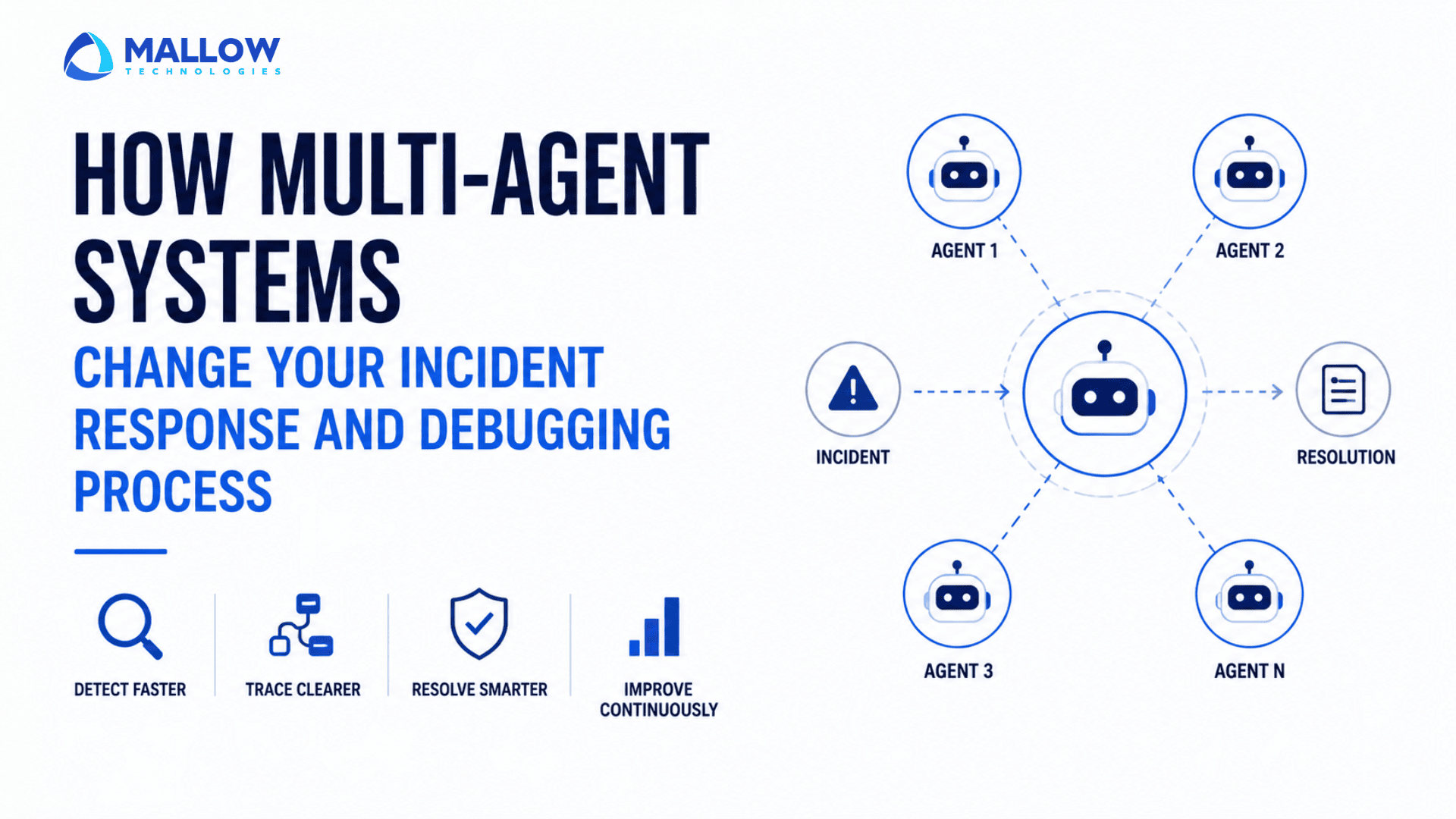
The incident response playbook for multi-agent systems has three components that are different from both single-agent AI incident response and traditional software incident response.

Isolation before diagnosis
In traditional software incident response, the first step is often to reproduce the bug. In multi-agent systems, reproduction is expensive because the system is stateful and the execution is non-deterministic. The first step should be isolation – identify which segment of the execution chain the failure is most likely concentrated in. If the final output is wrong, work backwards through the execution graph looking for the first agent whose output does not match what you would expect given its inputs. The error is usually at or near that boundary.
Agent replay, not full system replay
Microsoft’s Azure documentation on debugging production multi-agent incidents describes agent replay capabilities as the critical tool for controlled reproduction – the ability to feed the recorded inputs from a specific execution into a specific agent in isolation, without triggering the rest of the system. This allows you to confirm whether the failure is in that agent’s reasoning, in the handoff protocol, or in the state it received from upstream. Replaying the full system to reproduce a failure in one agent is the equivalent of deploying your entire application to fix one function.
Automated failure pattern detection
Once a multi-agent system has been in production long enough to accumulate failure patterns, aggregating similar failures across traces identifies systematic issues rather than treating each incident as isolated. Step repetition in a specific agent under specific input conditions is a pattern. Coordination failures at a specific handoff point under high load is a pattern. Individual incident investigation catches the symptom. Pattern analysis catches the underlying architectural issue before it produces the next ten incidents.
Gartner predicts that by 2027, 40% of enterprises will demote or decommission autonomous AI agents due to governance gaps identified only after production incidents. The gap between a multi-agent system that survives contact with production and one that gets decommissioned after six months is almost always the observability and incident response infrastructure built before the first failure, not the model choice.
The post-mortem that multi-agent systems need
A multi-agent system post-mortem has to answer questions that a standard software post-mortem never asks.

Which agent introduced the error versus which agent surface the error? These are often different. An agent that surfaced a wrong output may have done its job correctly. The agent that introduced the corrupted input is where the architectural fix needs to happen.
Was the failure detectable at the handoff point where it occurred? If the agent that produced the wrong context had reported lower confidence or incomplete information, would the downstream agents have handled it differently? If yes, the fix is in the handoff protocol. If no, the fix is upstream in the agent’s own evaluation logic.
Was this failure mode in the MAST taxonomy? Step repetition, reasoning-action mismatch, unawareness of termination conditions, and task derailment are all recognised failure categories. If the incident maps to one of these categories, the remediation is already understood. Architectural changes that address the category are more durable than point fixes that address the specific instance.
Did the incident reveal a gap between what the agents were told to do and what they were allowed to do? Multi-agent incidents often expose permission or scope mismatches that were latent before the system was under real load. The post-mortem should capture whether the incident was caused by an agent acting outside its intended scope, not just outside its expected behaviour.
What to build before the first incident
Teams that invest in multi-agent observability infrastructure before their first production incident recover from that incident in hours. Teams that discover they have no cross-agent tracing during their first incident often spend weeks on it, debugging what would have been a four-hour investigation.
The minimum viable observability stack for a multi-agent system in production – a shared trace identifier on every request that follows it across every agent; per-agent output quality scoring that runs at every handoff; a replay mechanism for individual agents using recorded inputs; and an alerting threshold for coordination anomalies, specifically deviations from the expected agent invocation pattern for a given request type.
None of that requires advanced MLOps tooling. All of it requires that the decision to build it is made before the first deployment, not after the first incident.
Building reliable multi-agent systems starts with the right foundation
The teams that build reliable multi-agent systems are not the ones that have fewer failures. They are the ones that have built the infrastructure to find failures quickly, contain them before they compound, and extract architectural improvements from every incident rather than just patching the symptom. That infrastructure is cheaper to build before the first failure than after it. And the first failure, in a multi-agent system, is a matter of when rather than if.
Whether you’re building your first AI agent or scaling a multi-agent system, let’s discuss your project and explore how to make it production ready.
Your queries, our answers
The underlying distributed tracing principle is similar. You need a correlation ID that follows a request across components. The difference is non-determinism. In microservices, the same input produces the same output. In multi-agent systems, the same input may produce different outputs depending on model state, context window content, and tool call results. Reproducing a failure requires recorded inputs, not just the parameters of the failed request.
Yes, but individual agent logs are necessary but not sufficient. You need cross-agent tracing that links individual agent logs into a complete execution graph. Individual logs tell you what each agent did. Cross-agent tracing tells you what each agent was working from, which is where most failures actually originate.
Work backwards from the wrong output through the execution graph, looking for the first agent whose output does not match what you would expect given its inputs. The failure is usually at or near that boundary. This is much faster than starting from the first agent and tracing forward.
Inject known failure conditions into individual agents using controlled inputs, such as tool call timeouts, incomplete context, and contradictory instructions. Observe how the system handles each condition and whether the failure propagates or gets caught at the injection point. The MAST taxonomy's 14 failure modes provides a useful test matrix for this.
Define the categories before deployment. Failures that affect customer-facing outputs, billing, or account security should trigger automatic escalation to a human. Failures in internal workflow steps that can be retried without customer impact can be handled by automated remediation. The rollback/review decision should be encoded in the out-of-scope list for the orchestrator, not determined on a case-by-case basis during an incident.
What happens after you fill-up the form?
Request a consultation
By completely filling out the form, you'll be able to book a meeting at a time that suits you. After booking the meeting, you'll receive two emails - a booking confirmation email and an email from the member of our team you'll be meeting that will help you prepare for the call.
Speak with our experts
During the consultation, we will listen to your questions and challenges, and provide personalised guidance and actionable recommendations to address your specific needs.

Author
Jayaprakash
Jayaprakash is an accomplished technical manager at Mallow, with a passion for software development and a penchant for delivering exceptional results. With several years of experience in the industry, Jayaprakash has honed his skills in leading cross-functional teams, driving technical innovation, and delivering high-quality solutions to clients. As a technical manager, Jayaprakash is known for his exceptional leadership qualities and his ability to inspire and motivate his team members. He excels at fostering a collaborative and innovative work environment, empowering individuals to reach their full potential and achieve collective goals. During his leisure time, he finds joy in cherishing moments with his kids and indulging in Netflix entertainment.