The phrase “agentic workflows” has arrived in almost every AI conversation happening in boardrooms and product planning sessions this year. It is being used to describe everything from a simple chatbot automation to a full multi-agent system running across an enterprise tech stack, and that range of meanings is creating real confusion for the teams that need to decide what to build next.
This article cuts through that confusion. It explains what agentic workflows actually are, how they differ from standard automation, where they produce genuine value, and what a team needs in place to run one reliably. No vendor pitch. No hype. Just a working understanding you can take into your next product or planning conversation.
What an agentic workflow actually is
An agentic workflow is a sequence of automated steps in which an AI agent can make decisions, use tools, and adapt its behaviour based on what it finds, rather than following a fixed, predetermined script.
The word “agentic” comes from “agency,” the capacity to act independently toward a goal. In practice, this means the system does not just react to a prompt and produce a response. It receives a goal, figures out what steps are needed to achieve it, executes those steps using the tools available to it, checks whether the results are useful, and adjusts if something does not go as expected.
What makes agentic workflows meaningfully different is not artificial intelligence alone. It is the combination of reasoning, tool use, and iteration that traditional automation systems do not have.
How agentic workflows differ from traditional automation
The distinction between agentic workflows and traditional automation is one of the most important things a business or product team can understand before making an investment decision. They look similar on the surface. They work very differently underneath.
| Dimension | Traditional Automation | Agentic Workflow |
|---|---|---|
| How it starts | Triggered by a fixed rule or schedule | Triggered by a goal, event, or instruction |
| How it decides | Follows a predefined decision tree | Reasons over available context and chooses dynamically |
| How it handles exceptions | Fails or routes to a human | Attempts to resolve; escalates when defined conditions are met |
| Memory across steps | Stateless: each run starts fresh | Stateful: maintains context across steps and sessions |
| Tool use | Calls predefined integrations in a fixed order | Selects which tools to use and in what order based on the task |
| What happens when inputs vary | Often breaks if format or data changes | Adapts interpretation based on context |
| Best suited for | Stable, repetitive, rule-governed tasks | Variable, multi-step, judgment-adjacent tasks |
| Risk profile | Predictable failures; easy to debug | Non-deterministic; requires evaluation infrastructure |
The practical implication is this – traditional automation is the right choice when your process is stable and well-defined. Organizations planning workflow modernization can also explore how enterprises are transitioning from deterministic automation toward adaptive agentic AI workflows.
How an agentic workflow runs - step by step
Understanding the mechanics helps teams brief development partners more precisely and evaluate vendor claims more critically. Here is how a typical agentic workflow runs from start to finish.
- A goal or trigger arrives – This could be a user instruction (“summarise all support tickets opened this week and flag the ones mentioning billing”), a scheduled event, or a signal from another system such as a new record in a CRM or a file upload.
- The agent interprets the goal – Using its reasoning layer (typically a large language model), the agent breaks the goal into subtasks and determines what information it needs and which tools it should use to get there.
- The agent calls its first tool – This might be a database query, an API call to your product, a search across a document store, or any other integration defined as part of the agent’s toolkit. The agent passes parameters to the tool, receives the output, and evaluates whether the result is useful.
- The agent continues or adjusts – If the first tool call produced what was needed, the agent moves to the next step. If it did not, the agent reasons over why and either retries with different parameters, tries a different tool, or determines it needs more context before proceeding.
- The workflow progresses through all required steps – Each step is evaluated before the next begins. The agent maintains a running record of what has happened so far, which informs its decisions at each subsequent step.
- A human checkpoint is triggered if required – For high-stakes decisions, approvals, or situations where the agent’s confidence is below a defined threshold, the workflow pauses and surfaces the decision to a human with full context.
- The output is delivered – The final result lands in a defined destination: a Slack message, a Jira ticket, a report, a CRM update, an email draft, or whatever format the workflow was designed to produce.
- The workflow logs its run – Every step, every tool call, every decision, and every output is recorded for observability, evaluation, and iteration.
The core components that make agentic workflows function
A production-grade agentic workflow is not a single piece of software. It is a combination of components working together. Understanding these helps teams ask better questions when evaluating technical approaches.
- The reasoning layer – The large language model that interprets inputs, plans steps, and evaluates outputs. This is where the “agentic” behaviour originates. Different steps in a workflow may use different models depending on the complexity of the reasoning required and the cost constraints in place.
- The tool layer – The set of defined actions the agent can take: querying databases, calling APIs, reading documents, writing records, sending notifications. Each tool has a clear input and output contract. The quality of this layer directly determines what the agent can actually accomplish.
- Memory – Short-term memory holds the current conversation or task context. Long-term memory, typically stored in a vector database or external store, allows the agent to reference information from past interactions or sessions. Structured memory pulls specific data from your existing databases on demand.
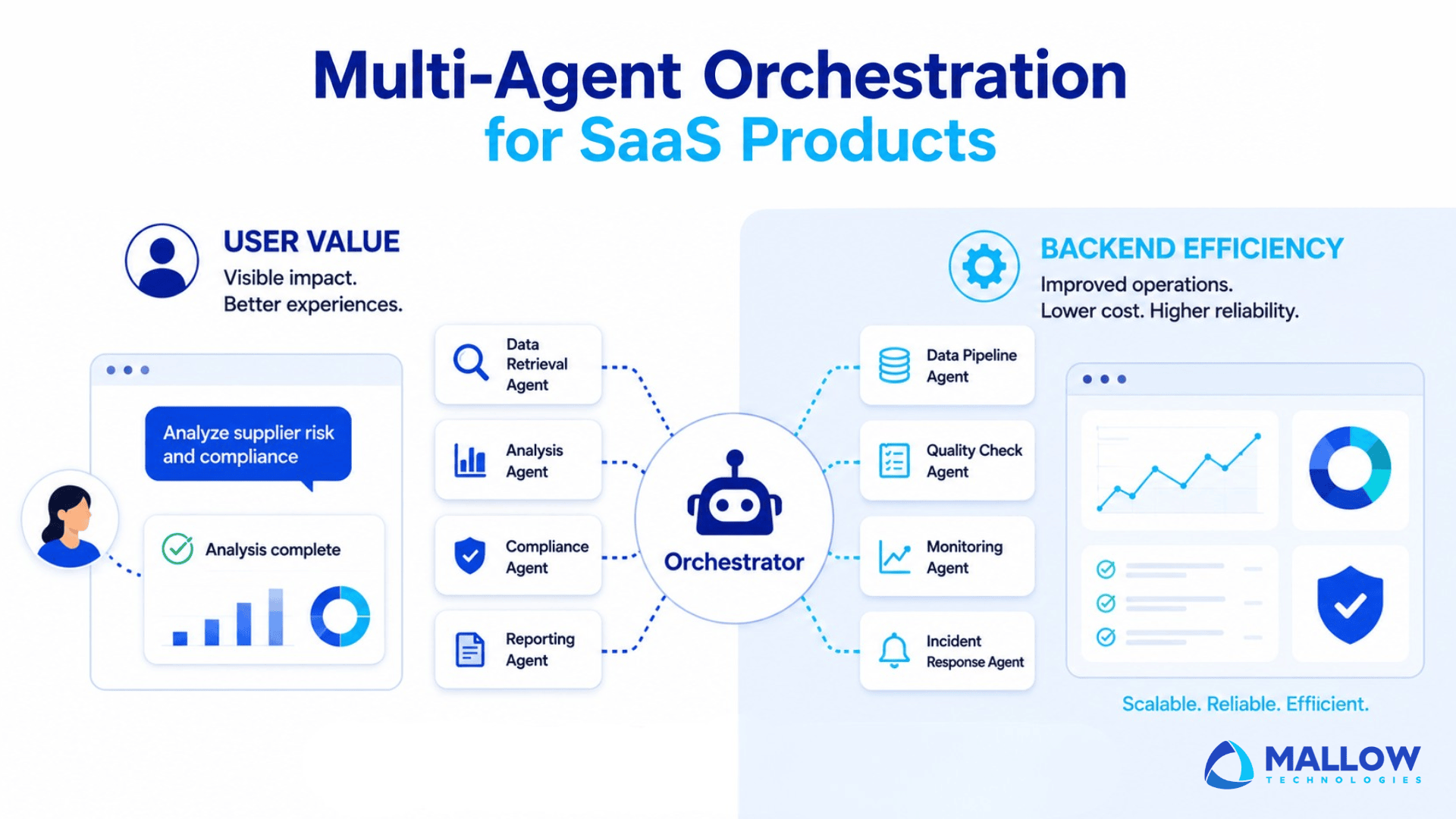
- The orchestration layer – The framework that coordinates how the agent plans, selects tools, handles errors, and sequences its steps. Frameworks like LangChain and LangGraph operate at this layer. Orchestration design is where most production failures originate when it is done poorly.
- The evaluation layer – The system that measures whether the workflow is producing accurate, useful outputs. In agentic systems, evaluation must happen at the step level (did this tool call return useful data?) and at the chain level (did the full workflow achieve the goal?). Without this layer, production problems become invisible until a user reports them. Technical teams planning enterprise rollout strategies can also explore how organizations move GenAI systems from prototype environments into scalable production operations.
- The observability layer – Logging that captures reasoning traces, tool call results, latency at each step, and failure patterns. Standard application monitoring is not sufficient for agentic systems. You need visibility into what the agent decided and why, not just what it returned.
Where agentic workflows deliver the most value for business and product teams
Agentic workflows create the most value when three conditions align: the task involves multiple steps that depend on each other, the data or inputs vary enough that a fixed rule-based script would frequently break, and the output feeds directly into a workflow your team already uses. Here is where those conditions appear most consistently.
Customer-facing workflows
- Intelligent support triage – An agent receives an incoming support request, reads it, identifies the intent, queries the customer’s account history, determines whether it can resolve autonomously or needs escalation, and either resolves it or routes it to the right team with full context attached.
- Personalised onboarding sequences – Rather than following a fixed onboarding checklist, an agent adapts the sequence based on how a user responds, what they have completed, and where they appear to be struggling.
- Proactive churn detection – An agent monitors product usage signals, identifies accounts that match defined risk patterns, generates a personalised outreach brief, and routes it to the customer success team for review before the account becomes at risk.
Internal operations workflows
- Request and approval routing – An agent receives an internal request (access, budget, resource), validates the information provided, identifies the correct approver based on the request type and organisational rules, notifies them through the right channel, tracks the response, and confirms the outcome to the requester.
- Knowledge management – An agent answers employee questions about internal systems, policies, or processes by pulling from documentation, runbooks, and decision records rather than requiring a human to respond to each query individually.
- Automated reporting – An agent pulls data from defined sources at a scheduled time, structures it into a report format, flags anomalies that require attention, and delivers the completed report to the relevant audience.
Product development workflows
- Feedback synthesis – An agent ingests customer feedback from multiple sources, clusters it by theme and severity, tracks changes over time, and produces a structured brief for the product team on a regular cadence.
- Release documentation – An agent reads the completed tickets and code changes from a sprint, generates a first draft of release notes and internal documentation, and routes it for review rather than leaving the task to an individual’s bandwidth at the end of a busy sprint cycle.
- Anomaly alerting – An agent monitors product analytics and surfaces signals such as feature adoption rates dropping below expected thresholds or specific user cohorts showing unusual behaviour, before these issues appear in a sprint review.
How to tell if a workflow is ready for an agentic approach
Not every workflow benefits from an agentic approach. Below is a practical framework for assessing whether a given process is ready.
| Signal | Indicates Readiness | Indicates Not Ready Yet |
|---|---|---|
| Data availability | Inputs exist in structured or semi-structured form, accessible via API | Data is fragmented, inconsistently formatted, or requires manual assembly |
| Process stability | Core steps are understood even if inputs vary | The process itself is still changing regularly |
| Output destination | There is a defined place the output goes and a team that will use it | The output format or destination is unclear |
| Failure tolerance | A wrong output can be caught and corrected by a human before it causes harm | A wrong output has immediate high-stakes consequences |
| Volume | The task happens frequently enough that the automation pays for itself | The task is rare enough that manual handling is cheaper |
| Current bottleneck | The task is consuming disproportionate team time or is regularly missed | The task is handled efficiently by the current process |
A workflow that scores well across most of these dimensions is a good first candidate. SaaS founders evaluating implementation readiness can also read our complete guide on AI architecture planning, orchestration strategy, and operational scalability considerations before scaling agentic systems further. A workflow that fails on data availability or output destination is likely to require foundational work before the agentic layer can deliver value.
What agentic workflows require to run reliably in production
Designing a proof of concept for an agentic workflow is significantly easier than running one reliably in production. The gap between the two is where most projects stall. Here is what the production environment actually requires.
Clean, accessible data – Agentic workflows reason over the data available to them. Inconsistent schemas, stale records, or fragmented data stores produce agents that reflect that fragmentation in their outputs. Data readiness is not a technical footnote. It is a prerequisite.
Well-defined tool contracts – Every action the agent can take needs to be explicitly defined with clear inputs, outputs, and error behaviour. Ambiguous or poorly documented tool integrations are the most common source of silent failures in production.
An evaluation pipeline – Because agentic outputs are non-deterministic, a passing test run does not guarantee the next run will be correct. Teams need an evaluation framework that runs continuously, covers both step-level and chain-level accuracy, and can detect when model updates cause regression in behaviour.
Human-in-the-loop design – The workflows that produce reliable outcomes are the ones that have defined the boundaries of autonomous action deliberately. Where the stakes are high, where the input is ambiguous, or where confidence is below a defined threshold, the workflow should pause and surface the decision to a human with full context. This is not a limitation. It is a design principle.
Observability from day one – Standard application logs are not sufficient for agentic systems. You need to be able to see the agent’s reasoning trace, the inputs and outputs of each tool call, latency at every step, and the distribution of failure types. Without this, post-launch iteration is essentially guesswork.
If you want to understand how these requirements map to your specific product or team context, talk to our team about agentic workflow design.
The adoption reality in 2026 - Where most teams actually are
The picture painted by most vendor content is that agentic workflows are already everywhere. The research tells a more measured story, and it is worth understanding.
According to McKinsey’s State of AI 2025 survey, conducted across 1,993 organisations in 105 countries, 62 percent of organisations are at least experimenting with AI agents. But only 23 percent report scaling an agentic system anywhere in their enterprise, and those scaling efforts are typically limited to one or two business functions. As a separate McKinsey infrastructure analysis notes, in any individual business function, fewer than 10 percent of organisations report actively scaling AI agents.
The gap between experimentation and scaled deployment is real and it has a consistent cause: teams underestimate the data readiness, integration design, and evaluation infrastructure required to make agentic workflows run reliably beyond a controlled pilot environment.
That said, the direction is clear. According to Gartner’s October 2025 Top Strategic Technology Trends report, by 2028 at least 15 percent of day-to-day work decisions will be made autonomously through agentic AI, up from effectively zero in 2024. And according to Gartner’s August 2025 enterprise applications analysis, 40 percent of enterprise applications will include task-specific AI agents by the end of 2026.
The teams getting ahead are not the ones moving fastest. They are the ones choosing the right first workflow, building the foundational infrastructure properly, and iterating from a reliable base rather than rebuilding after a failed pilot.
Our agentic AI development services are designed around exactly this approach: narrow scope, proper infrastructure, production-grade from the first build.
Your queries, our answers
An agentic workflow is a sequence of automated steps in which an AI agent can make decisions, select and use tools, and adapt its behaviour based on what it encounters, rather than following a fixed script. Unlike traditional automation, an agentic workflow receives a goal and determines how to achieve it, rather than executing a predetermined sequence of steps regardless of what happens along the way.
Traditional automation follows fixed rules and predefined sequences. If the input changes or an exception occurs, it typically fails or requires human intervention. An agentic workflow uses a reasoning layer to interpret inputs, choose which tools to use, evaluate its own outputs, and adjust when something does not go as planned. It is adaptive where traditional automation is rigid.
Agentic workflows work best for tasks that involve multiple steps, variable inputs, or decisions that depend on context that changes. Customer feedback synthesis, support triage, release documentation, internal approval routing, and anomaly detection are all strong early candidates. Tasks that are stable, repetitive, and rule-governed are often better served by traditional automation.
A production agentic workflow requires a reasoning layer (an LLM), a defined set of tools the agent can call, a memory architecture for short-term and long-term context, an orchestration layer to coordinate the steps, an evaluation pipeline to measure output quality, and an observability layer to monitor behaviour in production.
The most common causes are data that is not clean or accessible enough for the agent to reason over reliably, tool integrations that are poorly defined and fail unpredictably, missing evaluation infrastructure that makes problems invisible, and workflows designed without human-in-the-loop controls for high-stakes decisions. The gap between a demo and a production-grade system is primarily a data and infrastructure problem, not a model problem.
For a well-scoped first workflow on a reasonably structured tech stack, expect six to twelve weeks from architecture design to production deployment. Timeline extends when data preparation is required, when multiple system integrations are involved, or when the workflow involves complex human oversight logic. Discovery and architecture work should precede any commitment to scope.
A team is ready when: the target workflow's input data is structured and accessible via API, the output has a clear destination that the team already uses, the task volume justifies the automation investment, and the team has defined how human oversight will work within the workflow. Teams that cannot answer those four questions clearly yet should treat the answer period as the first phase of the project.
In-house development is appropriate when the team has senior engineers with prior production experience in LLM-based systems and can absorb the R&D timeline without compromising the core product roadmap. For most Seed to Series B teams, a specialist development partner brings production experience that compresses timeline and significantly reduces the risk of architectural decisions that need to be rebuilt later.
What happens after you fill-up the form?
Request a consultation
By completely filling out the form, you'll be able to book a meeting at a time that suits you. After booking the meeting, you'll receive two emails - a booking confirmation email and an email from the member of our team you'll be meeting that will help you prepare for the call.
Speak with our experts
During the consultation, we will listen to your questions and challenges, and provide personalised guidance and actionable recommendations to address your specific needs.

Author
Jayaprakash
Jayaprakash is an accomplished technical manager at Mallow, with a passion for software development and a penchant for delivering exceptional results. With several years of experience in the industry, Jayaprakash has honed his skills in leading cross-functional teams, driving technical innovation, and delivering high-quality solutions to clients. As a technical manager, Jayaprakash is known for his exceptional leadership qualities and his ability to inspire and motivate his team members. He excels at fostering a collaborative and innovative work environment, empowering individuals to reach their full potential and achieve collective goals. During his leisure time, he finds joy in cherishing moments with his kids and indulging in Netflix entertainment.