Shipping a model feels like the hard part. For most SaaS teams, it is the part they prepared for. They ran experiments, evaluated accuracy, tested edge cases, and deployed. The model went live. Nothing caught fire. 

Then, three months later, something is quietly wrong. 

The recommendation feature is surfacing less relevant results. The churn prediction model is missing customers who leave. The fraud detection system is letting through transactions it used to catch. Nobody filed a bug report. There are no error logs. The API is still returning 200s. The product is just getting worse, slowly, and nobody knows why. 

This is how most AI products fail. Not at launch. After it. 

MLOps exists to prevent exactly this. Here is what it does and how it works. 

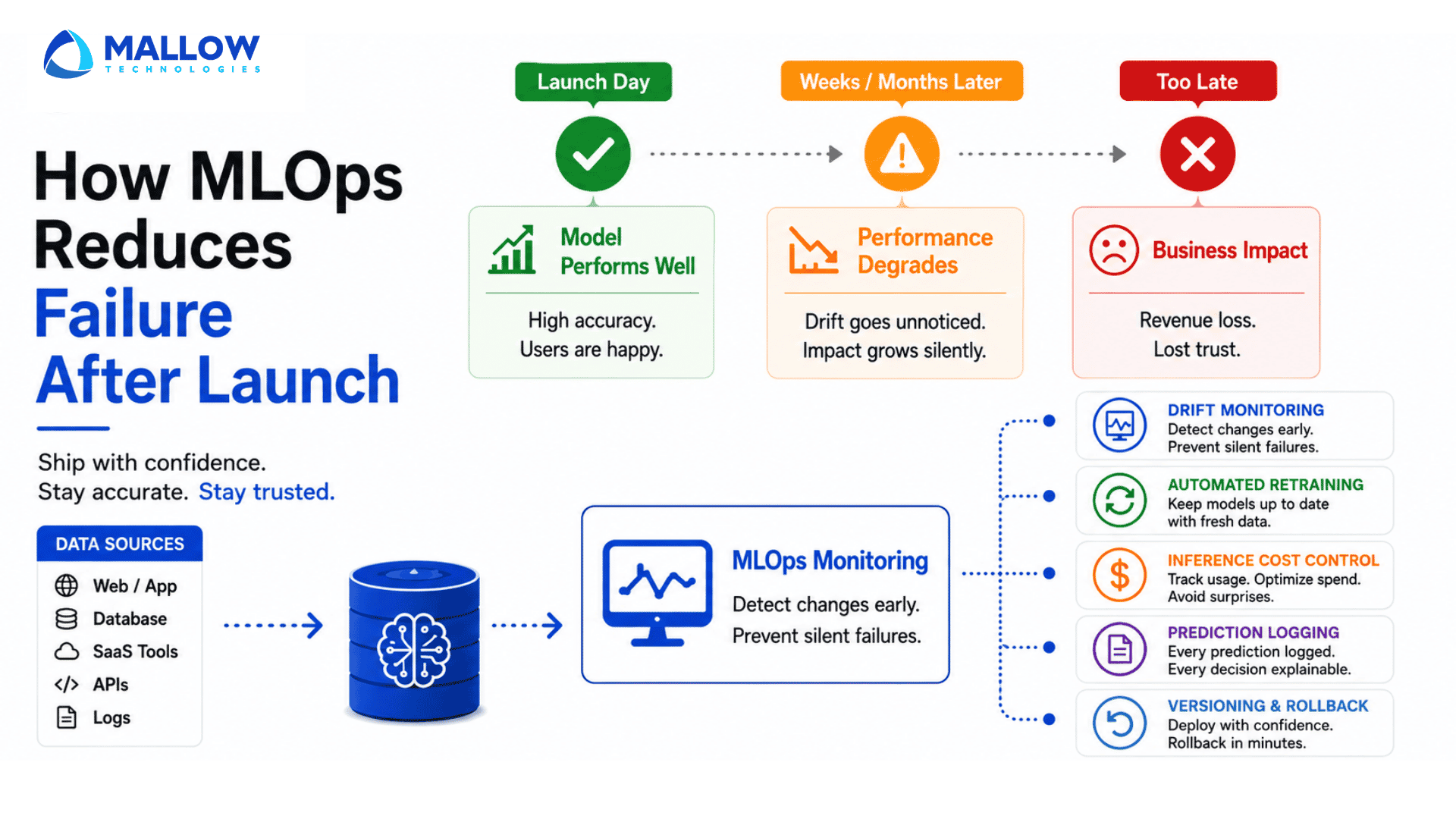
At launch, a model is at its most accurate. It has just been trained on the most recent data available. The gap between training data and production data is at its smallest. Everything is working. 

What changes is the world. User behaviour shifts. Market conditions evolve. The inputs your model receives in production gradually drift away from the inputs it was trained on. And unlike a software bug, this does not produce an error. It just produces slightly worse predictions, consistently, over time. 

Google’s Rules of Machine Learning identifies this as one of the central challenges of production ML – the technical debt that accumulates around a model in production is largely invisible. No test suite catches model decay. No uptime monitor alerts on a drop in prediction quality. Without deliberate infrastructure to track it, the degradation compounds undetected. 

Five common ways AI products fail after launch including ignored model drift, missing retraining pipelines, rising inference costs, lack of auditability, and no rollback mechanism.

The five most common failure modes after launch all share the same characteristic – they are silent, they are gradual, and by the time someone notices, the product has already been underperforming for weeks or months. 

What does failure actually look like in a production AI system?

Concrete examples help. These are the patterns that show up repeatedly in production AI products –

Case - I

A SaaS product uses a recommendation engine trained on user engagement data. Six months after launch, the user base has grown and behaviour has shifted. The model still runs, still returns recommendations, but the click-through rate has dropped steadily. Nobody connects the drop to the model because the model is not throwing errors. 

Case - II

A B2B SaaS uses an AI feature to flag at-risk accounts. The model was trained on churned accounts from two years ago. The product has evolved significantly since then. The signals that predicted churn then no longer reliably predict churn now. The feature is still live. Sales is still trusting it. But it is missing half the accounts that are about to leave. 

Case - III

A fintech SaaS uses ML to detect unusual transactions. The fraud patterns have shifted. The model’s false negative rate is climbing. Nobody knows because nobody is watching prediction-level accuracy, only API availability. 

In each case, the failure is not technical. The service is running. The problem is that the model is no longer fit for the data it is receiving. This is exactly what MLOps infrastructure is designed to catch. 

How MLOps addresses each failure mode directly

Drift monitoring stops silent accuracy loss

Drift monitoring instruments the model’s input and output distributions and alerts when they shift beyond a defined threshold. This turns an invisible, gradual failure into a detectable event. 

Evidently AI provides open-source tooling for data drift, concept drift, and prediction drift reports that run against live production data. AWS SageMaker Model Monitor provides the same capability as a managed service for teams already running on AWS infrastructure. 

The result is that the team gets an alert when the model starts degrading, not when a customer complains. 

Automated retraining keeps the model current

Detecting drift triggers a decision – retrain. Without an automated retraining pipeline, this means a manual process that takes days and requires engineering time every single cycle. With one, the pipeline pulls fresh data, retrains the model, evaluates it against a held-out dataset, and promotes it only if it outperforms the current production model. 

MLflow handles model versioning and promotion workflow so every retrain is tracked, every version is recorded, and rolling back to a previous model is a controlled operation rather than an emergency. 

For Rails and Laravel backends, this pipeline integrates through the existing job queue (Sidekiq or Laravel Horizon) and object storage layer (S3 or GCS). The application does not need to be rebuilt. The infrastructure is added around it. 

Inference cost controls prevent financial surprise

Without visibility into per-prediction cost, the first signal of a cost problem is the monthly cloud bill. By then, the overspend has already happened. 

Cost controls at the prediction level mean the team can see cost trends in near real-time, identify which features or user segments are driving disproportionate inference load, and make informed decisions about batching, caching, or model size before costs compound. 

Prediction logging makes every decision explainable

Every prediction the model makes in production should be logged with – the input that arrived, the output the model returned, the model version that was active, and the business logic that converted the prediction into a product action. 

Without this, a customer complaint about an AI decision, or a regulator asking why a specific outcome was produced, cannot be answered. With it, the answer is a database query. 

For SaaS products in regulated verticals, this is not optional. For products in any vertical, it becomes a sales requirement the moment an enterprise prospect asks about AI transparency. 

Four MLOps safeguards that help prevent AI product failure after launch including drift monitoring, automated retraining, inference cost controls, and prediction audit logs.

Without MLOps vs with MLOps - the same scenario, two outcomes

The difference is not in whether problems occur. Models drift. Costs spike. Bad updates happen. The difference is in how quickly the team can detect, respond to, and recover from each problem. 

Comparison table showing how AI product issues are handled without MLOps versus with MLOps, including model drift, retraining delays, failed deployments, lack of prediction logs, and rising inference costs.

Without MLOps, each of these scenarios plays out slowly and expensively. With the right infrastructure in place, most are resolved before they affect users at all. 

When should you add each MLOps layer?

The honest answer is before launch. The realistic answer is – start with what you can implement now and layer in the rest over the following months. 

Timeline infographic showing when SaaS teams should add different MLOps layers before launch, during week one, month one, and month three plus, including prediction logging, drift monitoring, retraining pipelines, rollback testing, audit logs, and cost optimisation.

Before launch, or immediately if the model is already live – prediction logging, model version tagging per prediction, and a basic uptime alert. These three alone close the most expensive gaps – you can answer questions about past decisions, you know which model version produced each output, and you know when the service goes down. 

In the first month – drift monitoring and inference cost tracking. These give you the visibility to know when the model starts degrading and what it is costing to run. 

By month three – an automated retraining pipeline with an evaluation gate, a tested rollback mechanism, and a documented process for what happens when each alert fires. By this point, the team has moved from reactive to proactive. Problems are caught before they reach users. 

The CNCF MLOps landscape maps the full ecosystem of tooling across each of these layers if you want a broader view of what is available at each stage. 

What this means for a Rails or Laravel SaaS product

Most Rails and Laravel SaaS products that have added AI features did not build a model-first architecture. Instead, they integrated an ML component into an existing application. That is a reasonable approach, and it has a clear MLOps integration path. 

The application layer handles user events, data collection, and business logic. The model serving layer handles inference. The MLOps layer wraps around both – monitoring inputs and outputs, orchestrating retraining when needed, tracking model versions, and logging decisions. 

Building this does not require replacing the application. It requires identifying the right integration points and connecting the infrastructure deliberately. The job queue is already there. The database is already there. The deployment pipeline is already there. MLOps connects them into a system that can sustain a model in production over time, not just at launch. 

Mallow works with SaaS teams to build exactly this kind of integration. If you already have a model in production but are not confident in your monitoring, retraining, or logging setup, now is the right time to address it before small gaps turn into expensive production issues. Connect with our team to assess your current AI infrastructure and build an MLOps setup that can scale reliably with your product. 

Your queries, our answers

Why does AI failure happen after launch rather than at launch?

Because at launch, the model is freshly trained on data that closely matches what it will see in production. Over time, the real world changes. User behaviour shifts, business context evolves, and the data the model receives gradually diverges from its training distribution. This is called model drift, and it does not produce errors. It produces worse predictions, gradually, until the gap becomes visible through a product metric or a customer complaint. 

How does MLOps prevent post-launch AI failure?

MLOps adds four layers of protection: drift monitoring to detect when the model starts degrading, automated retraining to keep the model current, inference cost controls to prevent financial surprises, and prediction logging to make every AI decision explainable and auditable. Together these convert silent, invisible failures into detectable, actionable events. 

What is the minimum viable MLOps setup for a SaaS team?

Three things that can be implemented before or immediately after launch: prediction logging with model version attached to each record, a basic drift check running against production data, and a documented manual retraining process. This does not require a dedicated MLOps engineer or a complex toolchain. It requires deliberate ownership of each area. 

How long does it take to add MLOps to an existing Rails or Laravel product?

The basic layer (logging, version tagging, uptime alerting) can typically be added in days. A full automated retraining pipeline with evaluation gates and rollback takes longer, usually several weeks of engineering time, depending on the complexity of the training process and the existing infrastructure. The investment is front-loaded. The ongoing maintenance is significantly lower than the cost of managing model failures reactively. 

What happens if a bad model gets deployed without MLOps in place?

Without a model registry and rollback mechanism, reverting to a previous model version typically means a full redeployment from source, which takes time and carries its own risk. With MLOps, the previous version is stored in the model registry and can be promoted back to production in minutes. The difference between a five-minute rollback and a two-hour incident response is usually the presence or absence of this one piece of infrastructure. 

What happens after you fill-up the form?
Request a consultation

By completely filling out the form, you'll be able to book a meeting at a time that suits you. After booking the meeting, you'll receive two emails - a booking confirmation email and an email from the member of our team you'll be meeting that will help you prepare for the call.

Speak with our experts

During the consultation, we will listen to your questions and challenges, and provide personalised guidance and actionable recommendations to address your specific needs.

Author

SathishPrabhu

Sathish is an accomplished Project Manager at Mallow, leveraging his exceptional business analysis skills to drive success. With over 8 years of experience in the field, he brings a wealth of expertise to his role, consistently delivering outstanding results. Known for his meticulous attention to detail and strategic thinking, Sathish has successfully spearheaded numerous projects, ensuring timely completion and exceeding client expectations. Outside of work, he cherishes his time with family, often seen embarking on exciting travels together.