The question most SaaS founders ask about agentic AI is – “what can I build with it?” The question that matters more for competitive strategy is – “what does it do to what I have already built?”
Agentic AI does not create a competitive moat. It reveals whether you already have one. For some products, it accelerates an advantage that was already compounding. For others, it removes barriers that were protecting a position nobody had explicitly built. Understanding which situation you are in is the strategic decision that shapes everything downstream – how aggressively to move, where to invest, and what your product needs to be in three years.
The model is not the advantage
When a new AI capability ships, every founder in the market can access it at roughly the same time. OpenAI’s latest model, Anthropic’s latest model, and Google’s latest model all become available via API within days or weeks of each other. If your competitive position depends on access to the most capable model, your competitors gain the same access simultaneously.
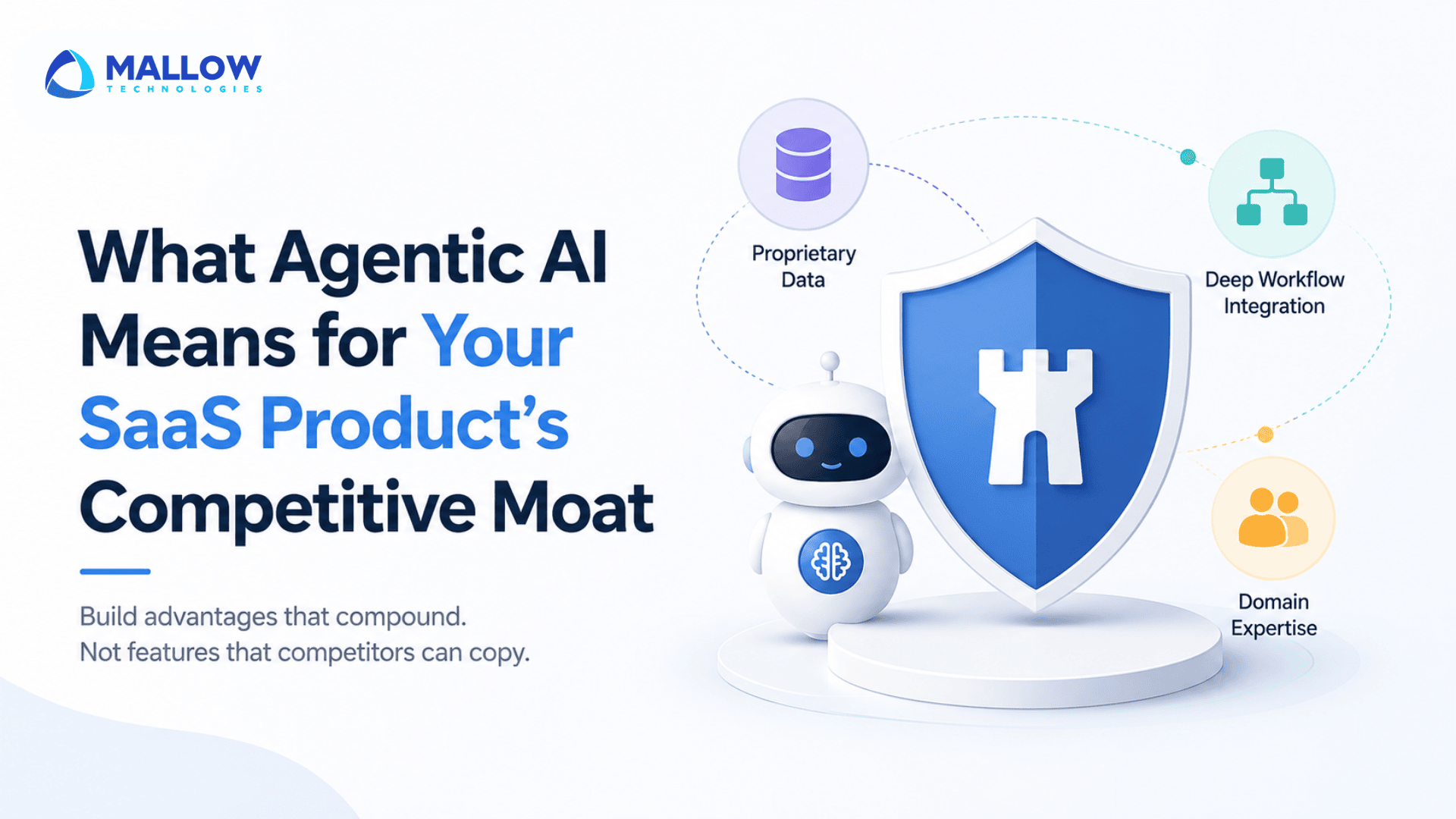
McKinsey’s May 2026 research on building competitive moats names this directly – when access to models is universal, advantage shifts to what competitors cannot replicate. The model is infrastructure. What gets built on top of it, with what data, embedded in which workflows, and serving which specific domain is where the defensibility lives. McKinsey’s analysis found that companies they describe as “rewired,” those that have integrated AI deeply into their operations rather than adding it as a layer, improve EBITDA by 10 to 30 percent. The gap comes not from model choice but from the three compounding assets they build around their model – proprietary data, deep workflow integration, and capabilities that become harder to move away from over time.
For a Seed-to-Series-B SaaS founder, this means the first question about agentic AI should not be which agent framework to use. It should be which of those three assets is your product currently building, how fast it is compounding, and what an agentic layer would do to the rate of compounding.
What has stopped being a moat
Before examining what creates defensibility in the agentic era, it is worth being direct about what does not.

Feature parity is not a moat. A feature that took three engineering sprints to ship in 2022 can now be prototyped in an afternoon with AI-assisted development. The time advantage of building a specific feature first is compressing from months to weeks. In some categories, a competitor using a general AI agent can replicate a product’s core output in minutes without subscribing to the product at all.
Workflow lock-in based on interface familiarity is not the same moat it was. The traditional argument for stickiness was that users had learned to work in a specific tool and would resist relearning. AI agents change the interface equation. An agent can often abstract the interface away entirely, pulling data and actions from a tool without the user directly interacting with it. What felt like workflow integration was, for many products, really interface familiarity. Those are different things.
Integration count is not a moat unless the integrations create data advantages. SaaS products have competed for years on the number of third-party integrations they maintain. Agentic AI can orchestrate across tools that have never formally integrated, using API access and workflow design to connect systems that were previously siloed. An agent that reads from Salesforce, writes to HubSpot, and triggers a Slack message is doing what an integration catalogue used to do. It can now do this with any combination of tools, not just the ones for which a vendor team built connectors.
The three sources of a durable moat
What survives the shift is harder to replicate and takes longer to build. None of these three sources are technology choices. They are strategic choices about what kind of asset your product is accumulating.

Proprietary data that compounds with use
The most durable AI-era moat is data that gets better as more of your specific users use your specific product. Not general-purpose data a model can be trained on from the public web. Data that only exists because your product generates it, the resolution patterns from your support system, the design decisions made in your design tool, the behavioural signals captured from your workflow platform. This data is what makes your AI features different from a competitor using the same foundation model on different data. The more of it you have, the better your AI features get, in ways that accelerate as the base grows. A competitor cannot buy or imitate that corpus. They have to start from zero and wait.
Deep workflow integration that makes migration expensive
Agentic AI changes the moat value of integration depth. Shallow integrations, such as a webhook that passes data between systems, can be replicated or abstracted away. Deep integrations that are embedded into how a customer’s team actually runs a core operational process are different. When an agent is wired into a customer’s onboarding sequence, their contract renewal workflow, their support escalation tree, extracting it requires redesigning those processes, not just cancelling a subscription. McKinsey’s analysis of AI-enabled competitive advantages identifies this specifically – advantage shifts toward AI-enabled strengths that deepen with use, including customer benefits created by embedding AI directly into customer workflows that reduce the incentive to switch.
Domain specificity that a generalist agent cannot match
A general AI agent can draft a support response, write a legal clause, or generate a financial projection. What it cannot do is apply the accumulated domain knowledge of 500 dental practices, 2,000 freight logistics dispatchers, or 300 commercial real estate underwriters, unless that knowledge is encoded in a product that specifically serves those domains. Vertical SaaS products that build AI features on top of domain-specific data, domain-specific prompting, and domain-specific evaluation standards have a moat that general AI agents cannot erode, because the general agents have access to the same foundation model but not to the domain corpus.
What agentic AI specifically adds to the moat question
Agentic AI introduces two dynamics that were not present in simpler AI integrations, and both of them have competitive implications.
The first is the agent as buyer. Gartner has projected that by 2028, 90% of B2B buying will be intermediated by AI agents, with more than $15 trillion of B2B spend flowing through agent driven purchasing decisions. When an AI agent is responsible for discovering and evaluating tools on behalf of a user, the competitive question changes. The agent is not browsing your pricing page and reading reviews. It is evaluating whether your product exposes a reliable API, whether it participates in interoperability standards, and whether it can be programmatically instructed. Gartner’s guidance on API-based integration for agentic AI highlights why enterprise systems need standardized, secure APIs that AI agents can reliably discover and interact with. Products that are not agent addressable will increasingly become invisible to agent mediated discovery and procurement.
The second is that agentic AI compounds moat advantages faster than simpler AI. A product with deep proprietary data and deep workflow integration that adds an agentic layer is creating an AI system that improves with every interaction at a rate a competitor starting from scratch cannot match. The data is richer. The workflow integration means the agent has more surface area to act on. The domain specificity means the agent’s decisions are more accurate for the specific context. Each of those factors accelerates independently. Together, they compound.
For a product without those foundations, adding an agentic layer accelerates very little. It adds a capability without the proprietary data to make it distinctive, the workflow integration to make it sticky, or the domain depth to make it accurate. The result is a feature that looks like a competitor’s feature because it was built on the same model without the differentiating substrate.
The honest question to ask about your product
There is a version of this strategic question that can be answered concretely, without a long consulting engagement – if your product were shut down tomorrow, what would your best customers not be able to get from a general AI agent?

If the answer is “the integrations,” the moat depends on whether those integrations create data advantages or just convenience. Convenience is replicable. Data is not.
If the answer is “the institutional memory of how we use the product,” the moat depends on whether that institutional memory is stored in the product itself, or just in the habits of your users. Habits change. Stored operational data is harder to migrate.
If the answer is “access to our specific customer data,” the moat is real only if the product does something with that data that improves as more of it accumulates. A repository of data that does not learn from itself is a migration problem, not a moat.
If the answer is “nothing that a general AI agent could not replicate in a few months,” the foundation needs to change before the agentic layer gets built on top of it. An agent built on a weak foundation compounds the weakness faster than a simpler product would.
What to do with this now, at Series A or B
The strategic work required is not an immediate technology investment. It is a data strategy decision that determines what your AI features will be able to do in eighteen months.

Specifically, what proprietary data is your product generating that could be used to make your AI features better than a competitor’s AI features running on the same model? If there is no clear answer to that question, the data strategy conversation needs to happen before any agentic build.
The second question is about workflow depth – are your integrations creating switching costs based on data accumulation, or just on interface familiarity? The first survives agentic AI. The second does not.
The third question is about domain focus – is your product narrow and specific enough to encode domain knowledge that a general AI cannot access? Broad horizontal SaaS products face more exposure from general AI agents than narrow vertical ones. Being specific is becoming a strategic choice, not a positioning limitation.
None of those questions require an immediate build decision. They require an honest assessment of where the product is generating assets that compound rather than assets that erode.
Ready to build a lasting AI competitive advantage?
The SaaS founders who will look back on 2026 as the moment they built something defensible are not the ones who shipped the most AI features. They are the ones who used this period to answer a harder question – what does my product accumulate that compounds over time and cannot be replicated by a competitor with access to the same foundation model? The answer to that question is the moat. Everything built on top of that answer is what makes the moat real.
If you’re evaluating how your product’s data strategy, workflows, and domain expertise can create a lasting competitive advantage in the age of agentic AI, get in touch with our experts. We’ll help you identify the assets that compound over time and build an AI strategy that strengthens your product’s long-term defensibility.
Your queries, our answers
No. Adding an agentic layer to a product without proprietary data, deep workflow integration, or domain specificity creates a feature, not a moat. A competitor can add the same agentic capability using the same foundation model in a comparable time frame. The moat is what the agent learns from, not the agent itself.
Speed is meaningful at the capability level and less meaningful at the moat level. A competitor who ships agentic features first on a shallow foundation gains a short-term advantage. A product that ships second but on a proprietary data foundation gains a compounding advantage. The question is which of those situations describes each side of the competitive match.
Yes, but only structural network effects, where the product is genuinely more valuable when more of the user's actual colleagues or suppliers are on it. Network effects built on accumulated content, templates, or integrations that AI can replicate or abstract are weaker than they were. The test is whether additional users increase the value to existing users in a way that AI could not provide without the network.
It means the product exposes a reliable, well-documented API, participates in authentication standards that agents can use programmatically, and can receive and execute instructions through structured interfaces rather than requiring a human at a keyboard. Products that are not agent-addressable will be harder for AI-driven purchasing and procurement processes to evaluate and select.
The data strategy decisions made now are the ones that determine AI era defensibility eighteen to thirty six months out. The agent features themselves can be added quickly. The data moat that makes those features distinctive cannot be built quickly because it has to accumulate. Starting the data strategy work later than competitors means starting the compounding later, which creates a gap that continues to grow instead of closing.
What happens after you fill-up the form?
Request a consultation
By completely filling out the form, you'll be able to book a meeting at a time that suits you. After booking the meeting, you'll receive two emails - a booking confirmation email and an email from the member of our team you'll be meeting that will help you prepare for the call.
Speak with our experts
During the consultation, we will listen to your questions and challenges, and provide personalised guidance and actionable recommendations to address your specific needs.

Author
SathishPrabhu
Sathish is an accomplished Project Manager at Mallow, leveraging his exceptional business analysis skills to drive success. With over 8 years of experience in the field, he brings a wealth of expertise to his role, consistently delivering outstanding results. Known for his meticulous attention to detail and strategic thinking, Sathish has successfully spearheaded numerous projects, ensuring timely completion and exceeding client expectations. Outside of work, he cherishes his time with family, often seen embarking on exciting travels together.