Board meetings that include an agentic AI agenda item tend to produce one of three responses.
The board gets excited and approves everything without asking the questions they should.
The board gets worried and starts asking for controls that the team is not yet positioned to implement, which stalls the project.
Or the board delegates entirely, treating it as a technical matter for the CEO and CTO to sort out, and checks back in when something goes wrong.
None of those outcomes is what you need.
What you need is a board that understands clearly what an agent actually does, what it cannot do, what oversight means in practice, and what they are being asked to approve.
That level of shared understanding is achievable in a thirty-minute board conversation, but only if the person presenting it frames it correctly.
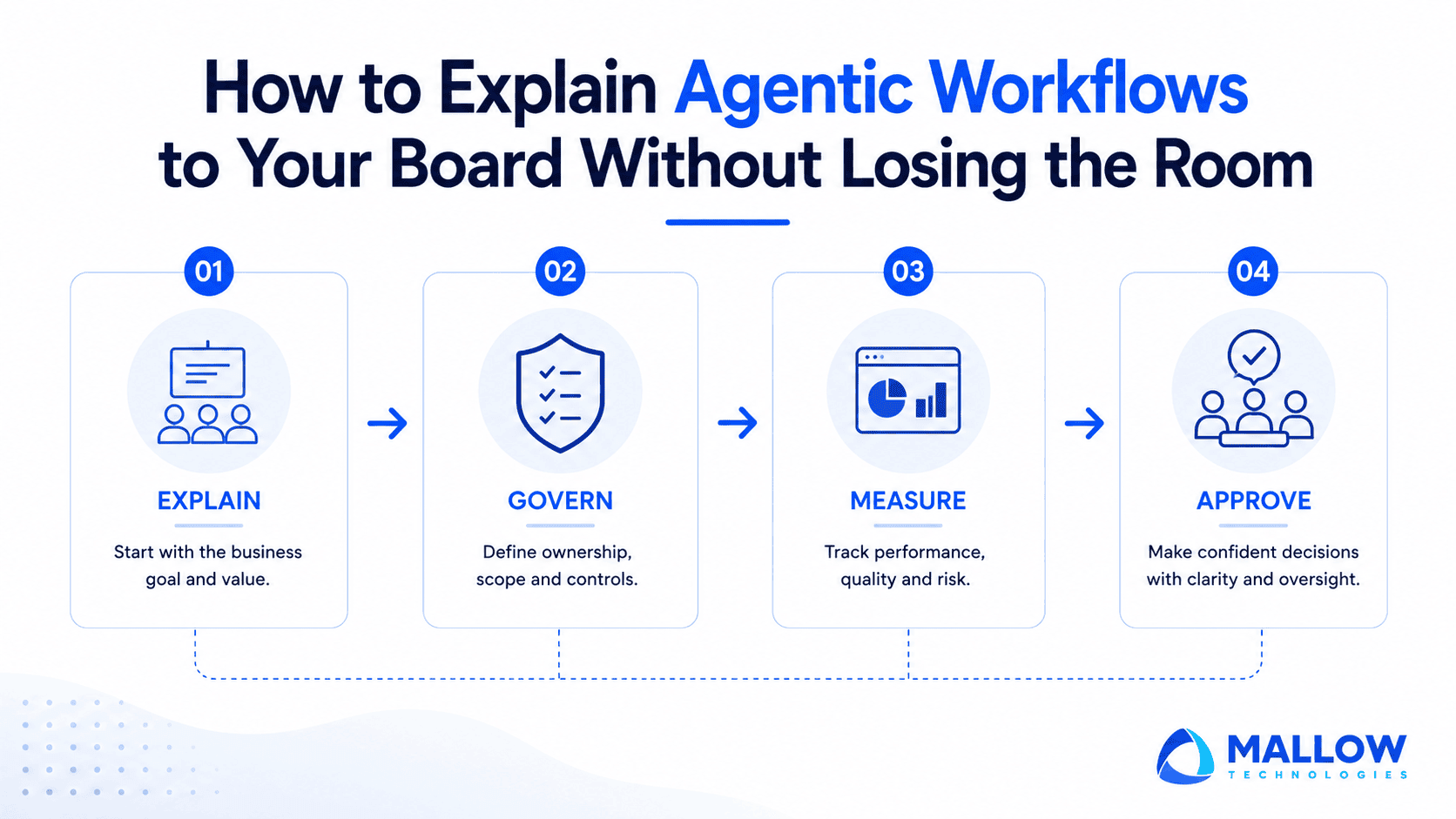
The sections that follow focus on how to explain agentic AI in business terms, so your board can evaluate the opportunity, understand the risks, and provide effective oversight.
Why the conversation starts in the wrong place
The instinct most founders follow when introducing agentic AI to their board is to lead with the capability. They describe what the agent can do – it monitors the support queue, classifies tickets, resolves the standard cases, escalates the complex ones. The board hears “autonomous system making decisions” and the conversation quickly moves to risk, compliance, and liability before any useful context has been established.
The alternative instinct is to minimise it by calling it “enhanced automation” or “an AI-assisted workflow” to avoid triggering the risk conversation. But that leaves the board approving an automation upgrade without understanding the autonomous decision-making it is actually overseeing. When something goes wrong, they discover they never fully understood what they signed off on.
BCG’s 2026 global survey of 625 CEOs and board members captured the misalignment precisely – 60% of CEOs think their boards are too impatient with the pace of AI transformation, and 35% think boards overestimate what AI can actually replace. At the same time, 40% of board members who consider themselves less AI-savvy than their peers worry the organisation is not moving fast enough. What that creates is a board simultaneously pushing for speed and lacking the context to evaluate whether the speed is appropriate. Both sides are making decisions in an information vacuum, and the founder presenting the agenda item is the only person who can fill it.
The definition that actually works for a board conversation
The biggest communication mistake in a board AI presentation is attempting to explain how the technology works. Boards do not need to understand LLMs, orchestration layers, or RAG pipelines. They need to understand what the system does and what happens when it does it without a human in the loop.
The most useful single definition for a board audience – an agent is a system that can take a sequence of actions across your software tools to complete a task, without a human approving each step.
That definition does three things well. It names the autonomy, which is the part that carries governance implications. It scopes the action to the existing tool stack, which makes it concrete rather than abstract. And it says nothing about how it works, which avoids ten minutes of technical clarification that the board will not retain.

A practical framing to follow with – before an agent, a customer submitting a support request needed a human to read it, categorise it, check the relevant documentation, write a response, and send it. The agent does all of those steps, in sequence, without a human approving each one. It escalates to a human when it encounters something outside its defined scope.
Then stop. Most founders add three more sentences here that undo the clarity they just created.
What the board is actually asking when they ask about risk
Board members asking about risk during an AI presentation are usually asking three underlying questions, even if they do not phrase them this way.

What can this thing do that we did not tell it to?
The honest answer is – very little, if the agent is scoped correctly. An agent operating on a defined corpus of knowledge and a defined set of tools can only take actions within those parameters. The risk is not that it spontaneously expands its scope. The risk is that it takes an action within scope that produces an unintended outcome, because the scope was defined too broadly, or the knowledge base it retrieves from was inaccurate.
Who is accountable when it gets something wrong?
This is the question that most board-level conversations about AI fail to answer in advance. The honest answer has to name a person, not a process. Not “the team will review flagged cases.” A specific named role that is accountable for monitoring the agent’s outputs, reviewing a sample of cases on a defined cadence, and escalating to the board if a systematic problem is detected. Boards understand accountability structures. They do not govern well through abstract monitoring commitments.
What does it do when it does not know?
This is the question that separates a well-designed agentic workflow from a poorly designed one. An agent that improvises when it encounters something outside its scope is dangerous. An agent that escalates to a human when it encounters a defined class of cases, and that refuses to answer rather than generating a confident wrong response, is governable. Telling the board explicitly what the agent will not do is more reassuring than any capability description.
The governance framework every AI initiative needs
Boards cannot govern what they cannot see. The governance ask needs to give the board a structure, not just an assurance.
The MIT Sloan Management Review and BCG 2025 report on the emerging agentic enterprise, which surveyed 2,102 executives across 21 industries and 116 countries, found that 76% of executives now view agentic AI more like a coworker than a traditional tool. That shift in framing is useful for a board conversation. A new coworker whose performance nobody is monitoring is a governance failure. A new coworker who has an assigned manager, a defined scope of authority, and a performance review on a schedule is not. Boards understand the second scenario immediately because it maps to how they already think about human workforce oversight.
The specific structure that gives boards something to govern –

A named owner with defined accountability for the agent’s outputs. Not the engineering team. A person with the domain authority to evaluate whether the agent’s business outcomes are correct.
A defined out-of-scope list. The specific case types the agent will never handle autonomously, with a route to a human for each. For a SaaS product, this typically includes billing disputes, legal or contractual queries, and account security concerns.
A review cadence that reports to the board. Not a technical dashboard reading. A monthly or quarterly summary from the named owner that reports accuracy rate, escalation volume, cases outside scope, and any systematic issues identified in quality sampling. That summary goes to the board in the same format as any other operational metric.
A defined incident response path. If the agent produces a systematic error, what happens in the first 24 hours? Who is notified? What is the rollback procedure? The board does not need to own this. They do need to know it exists.
What to put in the board presentation itself

Length – one slide of substance, two at most. The rest of the board’s AI anxiety comes from presentations that try to convey too much and leave directors with more questions than they arrived with.
The substance on that slide – what the agent does, in one sentence. What it escalates to a human, in two bullet points. Who owns it, by name and role. What the review cadence is. What “off” looks like if the board decides to pause it.
The last point is worth emphasising. A board that knows there is a clear pause or rollback mechanism available to them is significantly less likely to block a deployment than a board that feels they cannot reverse the decision once made. Telling the board how you would turn it off if needed is not an invitation to turn it off. It is the confidence signal that lets them approve it.
The number that determines the conversation
Every board presentation about an agentic initiative should include one operational metric, measured before the agent was deployed, and a target for what it should look like three months after. Not an AI metric. An operational one. Ticket resolution time. Onboarding completion rate at day 14. Time from lead to first qualified meeting. Whatever the agent is being deployed to improve.
MIT Sloan’s reporting on real agentic deployments found that 80% of the actual work in a production agentic system was unglamorous – data engineering, stakeholder alignment, governance, and workflow integration. The technology is a smaller variable than almost anyone expects. The board does not need to know that breakdown in detail. What they do need to understand is that the metric will take time to move because the foundations that make the agent accurate take time to build. Setting that expectation before the first board update prevents the conversation three months in where the board asks why the number has not changed yet.
What your board should see one year after launching an AI initiative
The goal of the initial board presentation is not approval. It is calibration. A board that leaves the meeting with an accurate picture of what the agent does, who owns it, what it cannot do, and what they will see on their monthly reporting is a board that can provide meaningful governance without slowing down the initiative.
Meaningful governance in practice looks like – the named owner provides a quarterly summary to the board, which takes three minutes to present; The board asks two or three specific questions based on the summary instead of revisiting what the agent is or how it works; and if the metric moves the wrong direction, the board has a framework for deciding whether to adjust the scope, pause the deployment, or investigate a specific failure mode — rather than having to make that call without the vocabulary to evaluate what went wrong.
That outcome does not require the board to become technically literate in agentic AI. It requires the founder to give them the framing, the accountability structure, and the right question to ask at every subsequent meeting. A well-run board AI conversation is one where the board’s main contribution is asking “Is the named owner satisfied with the quality review this quarter?” That question is governable, repeatable, and exactly right.
Prepare your leadership team for agentic AI success
The board does not need to understand agentic AI. They need to understand what your agentic AI initiative does, who owns it, what it cannot do, and what they will see from it in six months. Every element of a board AI presentation should be in service of one of those four things. Anything else does not belong in the room.
If you want help preparing a board-ready framing for your agentic AI initiative, including your governance structure and the operational metrics, get in touch with our team. We’ll help you establish the right governance framework, define clear ownership, and prepare your board for informed, confident decision-making.
Your queries, our answers
Almost none. Define what the agent does and what it escalates. Name the owner and the review cadence. Show one operational metric. Everything else should be available to answer a direct question, but not included in the initial framing. Technical detail in a board presentation almost always produces confusion rather than confidence.
Take the concern seriously and be specific. If they are worried about data privacy, describe exactly what data the agent accesses and what it does not. If they are worried about accuracy, describe the quality review process and what the escalation threshold is. Vague reassurances do not resolve specific anxieties. Specific mechanisms do.
Answer by describing the rollback mechanism you have already designed, and name a specific condition that would trigger a review. A board that knows you have thought through the pause scenario is more likely to proceed than one that suspects a pause would be logistically impossible. Having the rollback plan makes approval more likely, not less.
Only if it adds a useful reference point. The MIT Sloan and BCG 2025 research on agentic enterprise adoption is useful context - 35% of organisations have already deployed agentic AI and another 44% plan to do so. That helps a board understand the competitive timeline without manufacturing urgency. Data that makes the board feel behind is useful. Data that just adds volume to the slide is not.
Presenting capabilities before presenting accountability. A board that understands what the agent can do before it knows who is responsible for what it does will instinctively move to risk management. A board that hears the accountability structure first and then the capability is positioned to evaluate the capability against the oversight framework, which produces a more productive conversation.
What happens after you fill-up the form?
Request a consultation
By completely filling out the form, you'll be able to book a meeting at a time that suits you. After booking the meeting, you'll receive two emails - a booking confirmation email and an email from the member of our team you'll be meeting that will help you prepare for the call.
Speak with our experts
During the consultation, we will listen to your questions and challenges, and provide personalised guidance and actionable recommendations to address your specific needs.

Author
SathishPrabhu
Sathish is an accomplished Project Manager at Mallow, leveraging his exceptional business analysis skills to drive success. With over 8 years of experience in the field, he brings a wealth of expertise to his role, consistently delivering outstanding results. Known for his meticulous attention to detail and strategic thinking, Sathish has successfully spearheaded numerous projects, ensuring timely completion and exceeding client expectations. Outside of work, he cherishes his time with family, often seen embarking on exciting travels together.