The diagnosis is almost always delivered too late.
A team has spent six months building an automation workflow.
It works in the demo.
It breaks in production.
An engineer spends two months patching it. It breaks again in a different place. Eventually the project quietly gets deprioritised in favour of something with cleaner momentum, and agentic AI goes on the roadmap as the next thing to try.
Then the same thing happens with the agent.
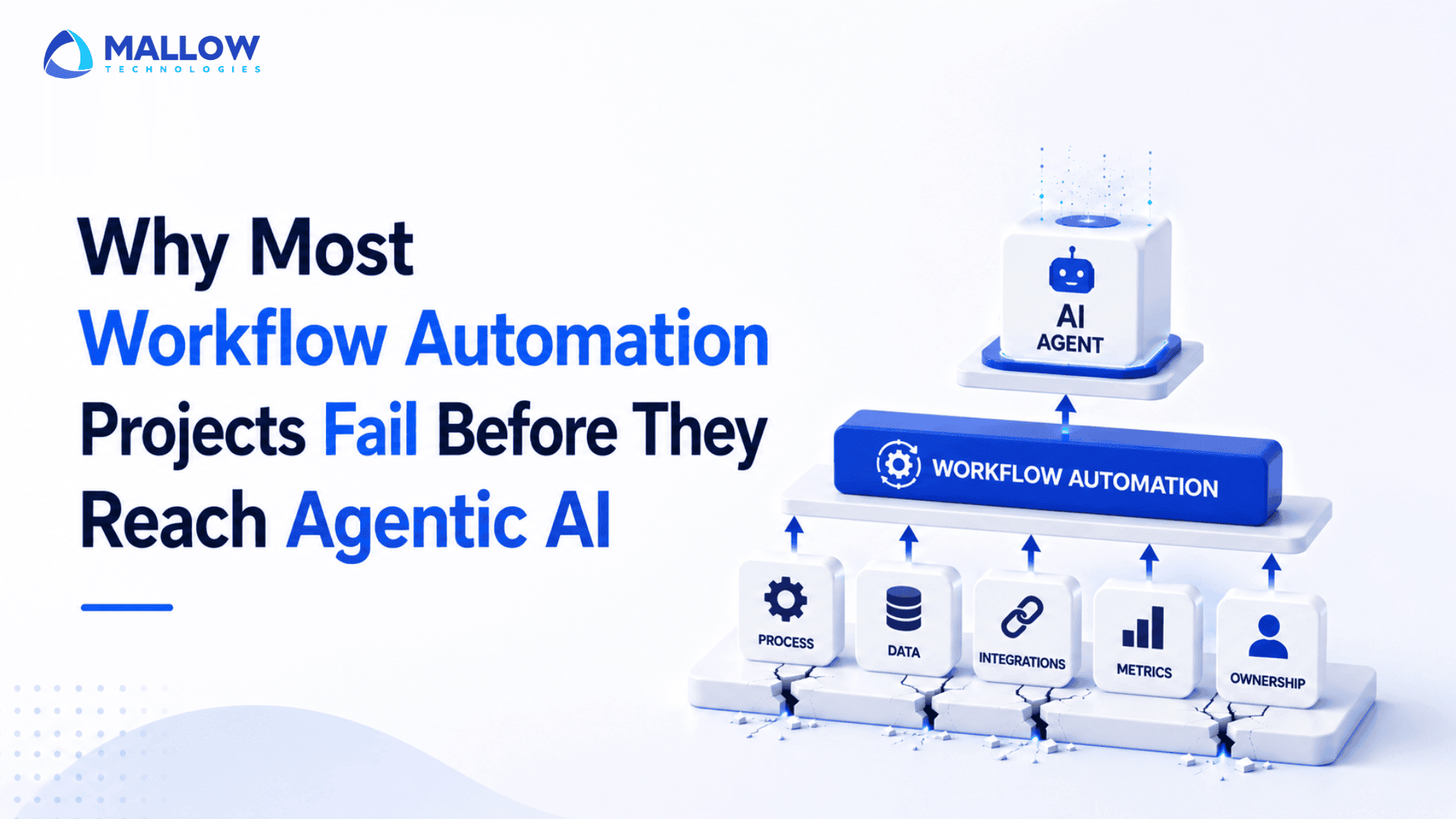
Agentic AI gets blamed for failures that started before anyone mentioned an agent. The model is usually not the problem. The agent architecture is usually not the problem. The failure is almost always upstream – a process that was not ready to be automated, a data layer that was not structured for machine consumption, integration debt that made multi-system execution impossible, a project with no defined outcome, or an owner who was never assigned. Each of those problems predates the agent by months or years. The agent runs into them and fails. The team concludes the agent doesn’t work yet and waits for the technology to mature.
The technology is not what needs to mature.
The pattern repeats at every level of AI ambition
Many AI initiatives struggle to deliver the business outcomes they were expected to achieve. In most cases, the failure is not caused by the AI model itself. Projects stall because the underlying processes, data, integrations, success metrics, or ownership are not ready to support automation at scale.
When organisations look back on unsuccessful AI initiatives, the same pattern appears repeatedly. Teams often assume that a more capable model or a different AI platform will solve the problem, when the real issues existed long before AI entered the picture. Technology simply exposes weaknesses that already exist in the workflow.
The same pattern is reflected in McKinsey’s State of AI 2025 research, which found that companies reporting significant financial returns from AI were twice as likely to have redesigned their end-to-end workflows before selecting a model or technology. The sequence matters. Organisations that start with the workflow and then introduce AI build on a stable foundation. Those that begin with the technology and work backwards often discover process, data, and integration problems only after deployment, when they become far more expensive to fix.

Failure mode 1 - Automating a broken process
The most common reason a workflow automation project fails before anyone considers an AI agent is also the most avoidable. The team automated a process that was not working well manually, and automation faithfully reproduced every flaw, faster and at scale.
A process with unclear decision logic becomes an agent with unpredictable output. A process where two people apply different rules to the same case becomes an automated system that produces different outputs for identical inputs with no human available to catch the inconsistency. A process that works by informal escalation, where the right person finds out because they happen to check the right system at the right moment, becomes an automated system where nobody is notified because the informal signal was never formalised.
This is a sequencing problem, not a technology problem. Automation can accelerate a well designed workflow, but it cannot correct one that is fundamentally flawed. When the underlying process is inconsistent, incomplete, or dependent on tribal knowledge, automation simply reproduces those weaknesses at greater speed and scale. The tool is not the fix for a process that was never designed correctly.
The diagnostic question to ask before any automation build is simple: if a new person joined the team tomorrow and their only job was to follow this process, could they produce consistent outcomes from a written description? If the answer is no, the process is not ready to be automated.
Failure mode 2 - The missing data foundation
Agents need data. Not in the abstract sense that all software uses data, but specifically – they need relevant, accurate, current, structured, and retrievable information at query time. When any one of those five properties is absent, the agent produces outputs that look like the right structure but carry the wrong content.
The 60% abandonment prediction Gartner made for AI projects lacking AI-ready data has proven directionally accurate. The problem is not usually that the data does not exist. In most SaaS organisations, the data exists across multiple systems, in formats that were designed for human consumption rather than machine retrieval, with varying quality standards depending on which team maintains which system. Customer data in the CRM looks different from customer data in the billing system, which in turn looks different from customer data in the support tool. None of those systems were built to talk to each other through a shared schema.
An agent that needs to answer a question about a specific customer account, combining their plan details, their recent support history, and their current billing status, needs all three of those data sources to be reliably structured and accessible. If any one of them is incomplete, inconsistently formatted, or requires a human to retrieve and normalise, the agent either produces an incorrect answer or fails to produce one at all.
The data foundation has to be built before the agent. Not as a parallel workstream. Not as the first sprint after the agent is deployed. Before. Every week of agent development that happens on top of an unresolved data layer is a week of technical debt that doubles back on the team during deployment.
Failure mode 3 - Integration debt that blocks multi-system execution
One of the characteristics that makes agentic AI genuinely different from simpler automation is that agents are designed to act across multiple systems. They read from one place, process in another, write to a third, trigger a fourth. That multi-system execution is exactly what makes them useful for complex operational workflows. It is also exactly what breaks them when the integration layer was not designed to support it.
Most SaaS organisations have accumulated integration debt over years of adding tools. A CRM may be connected to the email platform through a custom webhook that later breaks and is patched without proper documentation. The support system may export data via a CSV that someone on the operations team downloads and uploads into the billing tool each week. The product analytics platform and the customer database may never have been connected because nobody found the time.
When an agent attempts to execute a workflow that spans those systems, it encounters the integration debt directly. The webhook returns an error because the endpoint changed. The CSV data is out of date because the manual upload has not happened yet. The product and customer data cannot be joined because there is no shared identifier. The agent logs the error, fails the task, and produces a failure mode the team was not prepared to debug.
Building an agent on top of unresolved integration debt does not solve the integration debt. It moves it from a background operational inconvenience to an active production blocker. The integration work has to happen first, or the agent’s scope has to be explicitly constrained to the systems that are reliably connected.

Failure mode 4 - No defined outcome before build starts
One of the most common reasons automation and agentic AI projects fail is that success was never clearly defined before development began. Teams often start building with a broad objective, such as improving efficiency or reducing manual work, without agreeing on how success will actually be measured.
In the absence of a defined outcome, teams optimise for what is visible and measurable by default: the agent ran, the workflow triggered, the API call returned a 200. All of those are process metrics. None of them tell the team whether the workflow produced the right business result. Without a clear business outcome, teams have no reliable way to evaluate whether the automation is delivering value or simply completing tasks.
A support triage agent can resolve 90% of tickets and still produce worse customer satisfaction scores than the human team it replaced because ticket resolution was tracked, while customer satisfaction was not. Technical success does not always translate into business success.
The outcome question has to be answered before the first line of code is written for the automation or the agent: What is the single number that proves this project worked? That number needs to be tracked before deployment so the team has a baseline, during deployment so they can detect drift, and after deployment so they can confirm the return. An agent evaluated against the right metric can be improved incrementally. An agent with no metric runs until something breaks badly enough to get noticed.

Failure mode 5 - The ownership vacuum
This failure mode connects directly to the previous article in this series, but it shows up earlier in the lifecycle than most teams expect. It is not only a problem that emerges after an agent goes live. It is a problem that prevents the project from getting properly scoped, funded, and championed in the first place.
Automation projects often stall before completion when nobody with sufficient authority is personally invested in the outcome. This is not a technical failure. It is a project that runs out of executive support, clear ownership, and organisational momentum before it reaches production.
The pattern in SaaS teams is familiar. An engineer or product manager identifies an automation opportunity, builds a prototype in their own time, demonstrates it internally, and receives positive feedback. But the project waits for funding or dedicated resources because nobody with budget authority owns the business outcome. The prototype gradually becomes outdated, priorities shift, and the opportunity returns to being handled manually.
An agent that nobody owns does not make it to production. The ownership conversation has to happen before the scope is defined, not after the first incident.
What has to be true before agentic AI is the right next step
Running through these five failure modes provides a practical readiness test that is more honest than any vendor assessment –
The process is documented well enough that a new person could follow it consistently from written instructions. The data the process depends on exists in a structured, retrievable form across the systems involved. The integrations between those systems are reliable and do not require manual intervention. The team has named one metric that will prove the project worked, and has a baseline measurement. Someone specific, not the team, is accountable for the outcome.
If all five of those conditions are true, an agentic build has a real foundation to stand on. If any one of them is not, fixing it should come first. Not as the last item in the project plan. First.

This is not a pessimistic view of agentic AI. It is the view that matches the data. The organisations generating measurable returns from automation and from agentic AI are not the ones with the most sophisticated technology stack. They are the ones that did the unglamorous pre-work of getting the process, the data, the integrations, the metrics, and the ownership right before the first deployment. That sequence is slower to start and faster to compound.
Build the foundation before you scale agentic AI
Agentic AI is a real capability with real production value. The reason most teams are not capturing that value is not that the technology is too early. It is that the work that has to come before the technology has not been done. Process clarity. Data structure. Integration reliability. A defined outcome. A named owner. Those five things are the difference between a project that gets to production and one that joins the initiatives abandoned before anyone ever writes the post-mortem.
If your team has a stalled automation project or an agentic build that is not making it out of the pilot stage, book a strategy call with our team. We’ll help you identify the upstream issues, strengthen your automation foundation, and build a practical roadmap to production-ready agentic AI.
Your queries, our answers
Simpler automation tends to operate within a single system or a narrow set of rules. When it fails, it fails obviously - the rule is wrong, the trigger did not fire, the system returned an error. Agentic AI operates across multiple systems and makes judgment calls, which means failures are subtler and harder to trace. The same underlying problems that caused a simpler automation to produce inconsistent results will cause an agent to produce inconsistently reasoned results, which are harder to detect and more expensive to fix.
It depends almost entirely on how much work has already been done on the process, data, and integration layers. Teams that have invested in clean data pipelines, well-documented processes, and reliable integrations can be ready in weeks. Teams starting from scratch on a complex workflow can spend three to six months on the foundations before a responsible agentic build is possible.
Usually at least one of them is a contributing factor. The most common single cause is failure mode 1 - the process was not well-defined before the pilot began, so the pilot produced results that were difficult to evaluate against a standard that was never set.
Rarely, and usually at high cost. Building an agent is not a good way to discover that your data schema is inconsistent across systems. Discovering that during development is expensive. Discovering it in production is worse.
Concluding that the technology is not ready and waiting for better models. The technology in most cases is not the constraint. Starting the next pilot without resolving the upstream problems produces the same result from a more expensive starting point.
What happens after you fill-up the form?
Request a consultation
By completely filling out the form, you'll be able to book a meeting at a time that suits you. After booking the meeting, you'll receive two emails - a booking confirmation email and an email from the member of our team you'll be meeting that will help you prepare for the call.
Speak with our experts
During the consultation, we will listen to your questions and challenges, and provide personalised guidance and actionable recommendations to address your specific needs.

Author
SathishPrabhu
Sathish is an accomplished Project Manager at Mallow, leveraging his exceptional business analysis skills to drive success. With over 8 years of experience in the field, he brings a wealth of expertise to his role, consistently delivering outstanding results. Known for his meticulous attention to detail and strategic thinking, Sathish has successfully spearheaded numerous projects, ensuring timely completion and exceeding client expectations. Outside of work, he cherishes his time with family, often seen embarking on exciting travels together.