The support agent has been live for six weeks. It is resolving 40% of Tier 1 tickets without human involvement. Then one week it starts closing tickets that should have been escalated. The escalation pattern has changed. A product update shifted some of the decision logic the agent was operating on, and nobody caught it because nobody had been assigned to catch it. The support lead assumed it was the engineer’s job. The engineer assumed it was the product manager’s job. The product manager was not aware the agent had escalated anything to the support team in the first place.
That is not an edge case. It is the most common failure mode in early agentic deployments, and it is not caused by the agent. It is caused by a team that designed the agent without designing the ownership model around it.
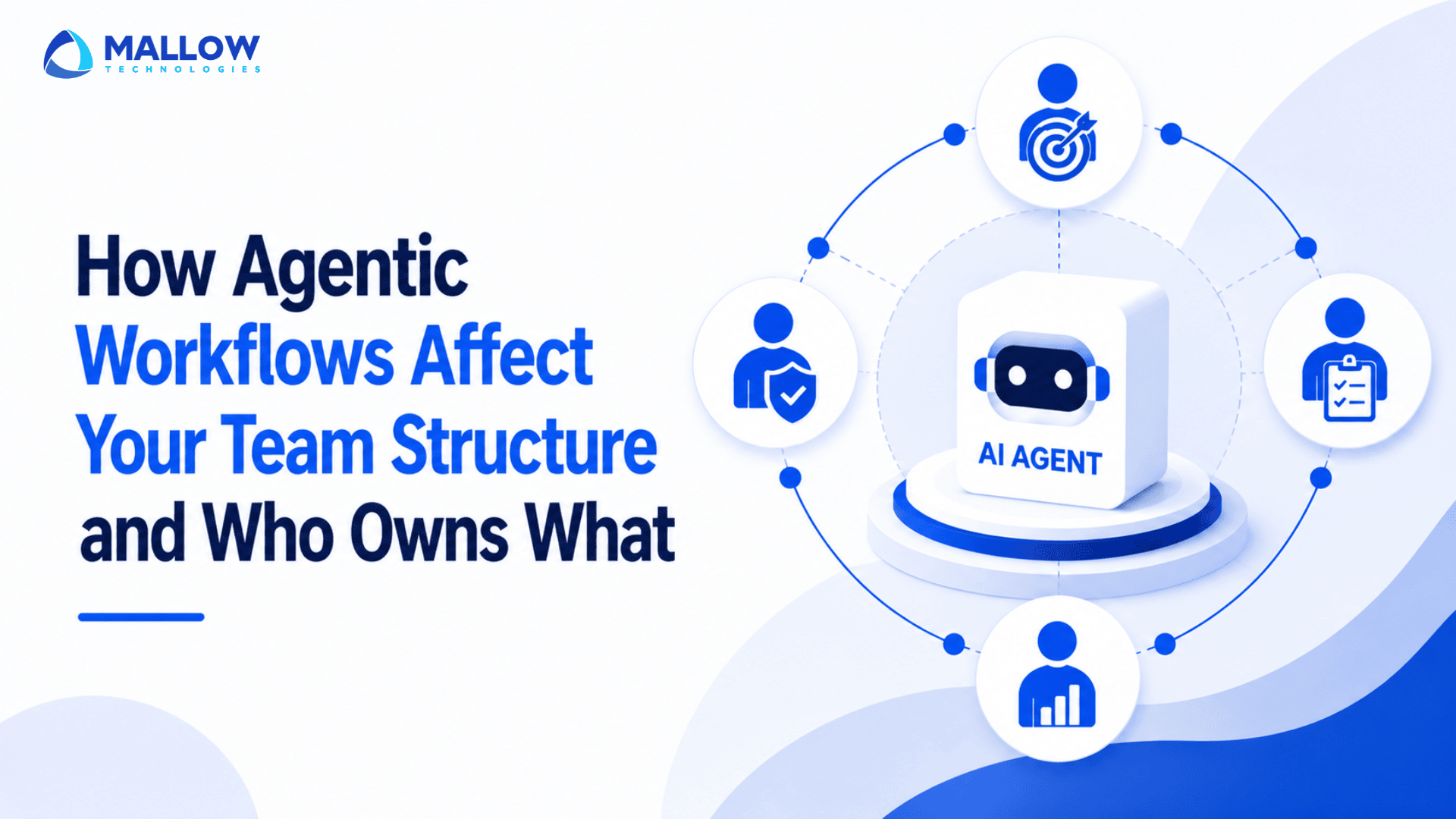
Agentic workflows shift who does the work without automatically shifting who is responsible for the outcome. Those are two different questions, and the second one does not resolve itself. This article is about how to design the answer to it deliberately, before the first deployment goes live rather than after the first incident.
How human roles actually shift when agents execute
The clearest finding from Microsoft’s 2026 Work Trend Index, a mixed-methods study of 20,000 AI-using knowledge workers across 10 countries plus telemetry from the Microsoft 365 ecosystem, is that as agents take on more execution, human work concentrates upward toward intent-setting, judgment, quality evaluation, and accountability for outcomes. Sixty-six percent of AI users in the study say AI has allowed them to spend more time on high-value work. Fifty-eight percent say they are producing work they could not have produced a year ago.
Those are genuine productivity signals, but they describe the output side of the shift. The input side is less comfortable – what humans are now primarily responsible for is making sure the agent’s output is correct, deciding when the agent should not be trusted, and owning the outcome when it is not. The report found that 86% of AI users treat agent output as a starting point, not a final answer. That means the human role is increasingly editorial – directing, reviewing, correcting, and signing off.
For a SaaS team deploying an agentic workflow for the first time, this produces a role change nobody explicitly signed up for. The person who used to complete the task now monitors the agent that completes it, evaluates the quality of what it produces, catches the cases the agent handles incorrectly, and takes accountability for everything that ships from that workflow whether they touched it personally or not. That is a genuinely different job, and most job descriptions do not describe it yet.

The three ownership failure patterns
When teams deploy agents without explicitly assigning ownership of their outputs, one of three failure patterns usually emerges. Understanding them in advance is the fastest way to avoid building them in.
Ownership vacuum
Nobody is formally assigned to review, monitor, or answer for the agent’s outputs. The workflow runs. Nobody is watching it. When something goes wrong, the team discovers it through a customer complaint or a downstream error, not through monitoring. This is the most common pattern in early deployments and the one most likely to produce the kind of incident described in the opening – weeks of silent drift before anyone identifies the problem.
Accountability diffusion
Multiple people have some connection to the agent’s workflow but none has full accountability for its outcomes. The support team owns the customer relationship. Engineering owns the agent’s infrastructure. The product manager owns the workflow design. When the agent behaves unexpectedly, each of those people has a partial claim on responsibility and a full claim on deniability. The resolution process is slow, contentious, and expensive in team time.
Wrong-person ownership
The engineer who built the agent is named as the owner. Engineering accountability for an agent’s behaviour is appropriate during development. Operational accountability for whether the agent’s business outcomes are correct, whether a support resolution met quality standards, whether a lead qualification decision was right for this specific prospect, is not an engineering judgment. It requires domain expertise the engineer may not have and authority over business decisions the engineer is not positioned to make. When engineering owns operational outcomes by default, either the engineer is making business calls they are not equipped to make or the actual decision-maker is doing the work informally with no accountability structure around them.

What owning an agentic workflow actually requires
Operational ownership of an agentic workflow is not the same as ownership of any prior workflow. It combines three things that were previously distributed across multiple roles and in many cases were never explicitly assigned to anyone at all.
Outcome accountability
The owner is responsible for the result the workflow produces, not just the process it runs. If the support agent resolves a ticket incorrectly, the owner is the one who answers for it, not the agent, not the model, and not the engineer who wrote the prompt. This is a meaningful commitment. It requires the owner to have visibility into what the agent produces and the authority to change the workflow when what it produces is wrong.
Quality review
The owner defines what correct looks like, samples the agent’s outputs against that definition on a regular cadence, and escalates when the gap between expected and actual widens. This is an ongoing operational task, not a one-time evaluation at launch. The frequency and depth of review depends on the stakes – a low-risk support FAQ workflow needs a lighter review cadence than a lead qualification agent making routing decisions about high-value enterprise prospects.
Escalation authority
When the agent encounters something it should not handle, it needs a path to a human. The owner defines where that path leads, maintains the escalation criteria, and is the one who receives the escalated cases or ensures someone on their team does. Without this, escalation either fails silently, creating a backlog no one is watching, or breaks the agent’s ability to operate reliably.
These three requirements make clear why wrong-person ownership is so common because outcome accountability, quality review, and escalation authority all require domain expertise and business authority, not just technical familiarity with the system. The person best positioned to own an agentic support workflow is usually a support lead, not an engineer. The person best positioned to own a lead qualification agent is usually someone in revenue operations or sales leadership, not the team that built the scoring model.

The org structure question
As organisations adopt agentic AI, the biggest change is not simply automating tasks. It is redefining how work is distributed across people and AI agents. Routine, rule-based activities increasingly shift to agents, while people spend more time designing workflows, evaluating outcomes, handling exceptions, and making decisions that require business context and judgment.
PwC’s 2026 analysis of agentic AI workforce redesign describes this structural shift as a change in organisational shape. Companies that were once built around a wide base of entry level workers performing repetitive tasks are becoming flatter at the operational level as agents absorb high frequency work. At the same time, greater importance is placed on people who define the work, train and evaluate agents, own business outcomes, and manage the exceptions that fall outside an agent’s capabilities.
PwC calls this the “rise of the generalist,” with broader, outcome-focused roles replacing narrower, function-specific ones. An operations manager who previously oversaw a team executing a process now oversees a combination of a smaller human team and one or more agents executing that same process. The skills the role requires shift, with less supervision of human execution, more design of agent parameters, evaluation of agent outputs, and judgment on the exceptions the agent cannot handle.
For a Seed to Series B SaaS team, this does not mean reorganising the entire company. It means making three practical decisions that are often postponed until they become urgent during an incident.
The first is deciding who in the existing team is closest to the domain expertise and business authority needed to own each agent’s outputs. This person may already be doing most of that work informally. Naming them formally changes their role in a specific way. They now have monitoring, quality review, and escalation responsibilities as explicit expectations rather than side tasks.
The second is deciding what escalation means for each workflow. Not in principle, but in practice. What specific case types should the agent never handle? Where do those cases go? Who reviews them? For most SaaS teams, this requires documenting an escalation process for the first time because previously a human performing the work applied that judgment intuitively.
The third is deciding how often the owner reviews the agent’s outputs and what they are looking for. A monthly accuracy review of ten to twenty cases is a reasonable starting point for most workflows. More critical workflows warrant a tighter cadence, while lower risk workflows can run longer between reviews. The frequency does not need to be high. It needs to be scheduled and consistently followed.
The alignment gap that makes all of this harder
The Microsoft Work Trend Index finding that should concern most SaaS leaders – only 26% of AI users report their leadership is clearly and consistently aligned on AI. The report also found that organisational factors, including culture, manager support, and talent practices, account for 67% of reported AI impact, compared with 32% for individual mindset and behaviour. The technology is a smaller variable than how the team is organised around it.
Deloitte’s analysis of agentic AI adoption puts the production gap in specific terms – while 38% of surveyed organisations are piloting agentic solutions, only 11% are actively using them in production, and 35% have no formal agentic strategy at all. The distance between a working pilot and a production deployment is almost always longer than expected, and the gap is most often an organisational one, not a technical one. The agent works. Nobody is ready to own what it does.
For a Seed to Series B team where everyone is already stretched thin, the instinct is to defer the ownership question until something goes wrong. The cost of that deferral is almost always higher than the cost of having the conversation before deployment – a poorly handled customer escalation, a misrouted lead that damages a key prospect relationship, a billing adjustment error that requires manual reconciliation across three systems. Each of those incidents is recoverable. Each one also takes more time to fix than the ownership design conversation would have taken to run.
What to actually do before the next deployment
The ownership design conversation does not need to be a large process. For most SaaS teams at Series A or B, it takes one meeting and one document – a one-page workflow owner brief that names the owner, defines what correct looks like, lists the escalation cases, and sets the review cadence. That document does not prevent every failure. It does prevent the most common one – the team discovering mid-incident that nobody was watching.
Three questions are enough to start – Who in this room has the domain knowledge to know when this agent’s output is wrong? Who has the authority to change the workflow criteria when the output consistently misses? And what does this agent do when it encounters something it cannot handle? If those three questions do not have clear answers before the agent goes live, the ownership model is not ready, regardless of whether the agent is.

Is your team ready to own an agentic AI deployment?
The question most teams ask before an agentic deployment is “will the agent work?” The question that determines whether the deployment succeeds in production is different – “when the agent produces something wrong, how fast will we know, who will own fixing it, and how will we stop it from happening again?” That question has to be answered by the team, not by the technology. The agent is ready when the workflow is built. The deployment is ready when the ownership model is.
If you want help thinking through both the workflow design and the ownership structure for your next agentic deployment, discuss your agentic AI deployment with our team. We’ll help you define ownership, establish governance, and build a practical roadmap for deploying agentic workflows with confidence.
Your queries, our answers
No. Operational ownership of an agentic workflow requires domain expertise and business authority, not engineering skill. The support lead is usually better positioned to own a support triage agent than the engineer who built it. Technical familiarity is useful for communication with the build team. It is not required for evaluating whether the agent's outputs are correct.
It tends to become less intensive over time as the edge cases get documented, the escalation criteria get refined, and the review cadence reveals fewer surprises. In the first 90 days, the owner will spend more time actively reviewing outputs. After that, a regular sampling cadence is usually sufficient unless the underlying workflow or knowledge base changes significantly.
Assign a primary owner for the end-to-end outcome and supporting reviewers from each affected team. The primary owner is accountable for the overall result and the escalation chain. Supporting reviewers handle quality assessment within their domain. If nobody is willing to be the primary owner, the workflow is not ready to deploy.
Not necessarily. The workflow designer understands the architecture. The outcome owner needs to understand the business domain. These are sometimes the same person in a small team, but they are different capabilities. When they are different people, a clear handover of outcome accountability at deployment is important.
The honest answer is that it varies by organisation and workflow. Forrester projected that enterprises deploying agentic capabilities would see significant headcount reduction in some functions in the near term, while Gartner's view is that AI's impact on global jobs will remain broadly neutral in the medium term. What is consistent across both views is that the skills required to work alongside agents, evaluation, exception handling, workflow design, and outcome accountability, are in greater demand, and the skills required to execute the routine steps those agents handle are in less demand.
What happens after you fill-up the form?
Request a consultation
By completely filling out the form, you'll be able to book a meeting at a time that suits you. After booking the meeting, you'll receive two emails - a booking confirmation email and an email from the member of our team you'll be meeting that will help you prepare for the call.
Speak with our experts
During the consultation, we will listen to your questions and challenges, and provide personalised guidance and actionable recommendations to address your specific needs.

Author
SathishPrabhu
Sathish is an accomplished Project Manager at Mallow, leveraging his exceptional business analysis skills to drive success. With over 8 years of experience in the field, he brings a wealth of expertise to his role, consistently delivering outstanding results. Known for his meticulous attention to detail and strategic thinking, Sathish has successfully spearheaded numerous projects, ensuring timely completion and exceeding client expectations. Outside of work, he cherishes his time with family, often seen embarking on exciting travels together.