Somewhere in the last eighteen months, a decision got made in a lot of product teams that sounded reasonable at the time. The question was “should we add AI to this feature?” and the answer was “yes, we should use one of the big language models.” Nobody in the room pushed back. GenAI was what everyone was talking about.
Some of those decisions were right. A lot of them were not.
The teams that made the wrong call are now paying for LLM inference on a problem that a gradient boosting model would have solved for a fraction of the cost. They are debugging hallucinations in a system that should be producing deterministic outputs. They are trying to explain a decision to a compliance team using a model that cannot be audited at the decision level.
This article is for any founder or technical lead who wants the honest version of this conversation before making that decision, or before deciding what to do about a decision already made.
The question your team should be asking before every AI decision
The question is not “should we use AI?” It is “what type of data do we have, and what type of output do we need?”
That single question eliminates most of the confusion. GenAI was trained on text. It is exceptionally good at understanding, generating, and transforming language. Classical ML was designed for structured, tabular data. It is exceptionally good at finding patterns in numbers and making predictions.
Most business data is structured and tabular. Most business AI problems are prediction, classification, or forecasting problems. That is where classical ML wins, reliably, consistently, and at orders of magnitude lower cost.
According to research from McKinsey’s 2024 State of AI report, which surveys enterprise AI adoption and ROI across industries, the highest-value AI applications in enterprise settings continue to be structured data prediction and classification tasks. The LLM applications that generate the most press are not the ones generating the most measurable business value for most organisations.
What makes GenAI genuinely powerful and where that power runs out
GenAI, specifically large language models, is genuinely transformative for problems involving natural language. Summarising documents. Generating content at scale. Answering questions from unstructured text. Classifying sentiment. Extracting entities from contracts. Translating and transforming language across formats.
For these problems, classical ML cannot compete. An LLM brings years of language understanding baked into billions of parameters. A classical model cannot read a contract.
But that power has sharp edges. LLMs are probabilistic. They can return a different answer to the exact same input on two consecutive calls. They hallucinate: they produce confident-sounding outputs that are factually wrong, particularly on numeric and structured tasks. They are expensive at scale: the cost compounds with every API call. And they cannot be audited at the decision level, which matters enormously in regulated industries.
What classical ML does that GenAI cannot
A classical model trained on your data gives you something LLMs cannot: deterministic, explainable, cheap-to-run predictions from your own structured data.
When a gradient boosting model flags an account as at risk of churning, you can trace that decision to the exact features that drove it. Login frequency dropped. Support tickets increased. The last NPS score was low. You can show that reasoning to a customer success manager, a compliance officer, or an investor.
When a logistic regression model scores an inbound lead, the sales team can see exactly why that score was produced. They can trust it, question it, and improve the model by telling you when it was wrong.
When a random forest model flags a transaction as suspicious, it does so in sub-milliseconds, without an API call to an external provider, at a cost that is effectively zero per prediction at scale.
None of this requires a GPU. None of this requires prompt engineering. None of this requires monitoring for hallucinations. The model does what it was trained to do, the same way, every time.
A direct comparison across eight dimensions

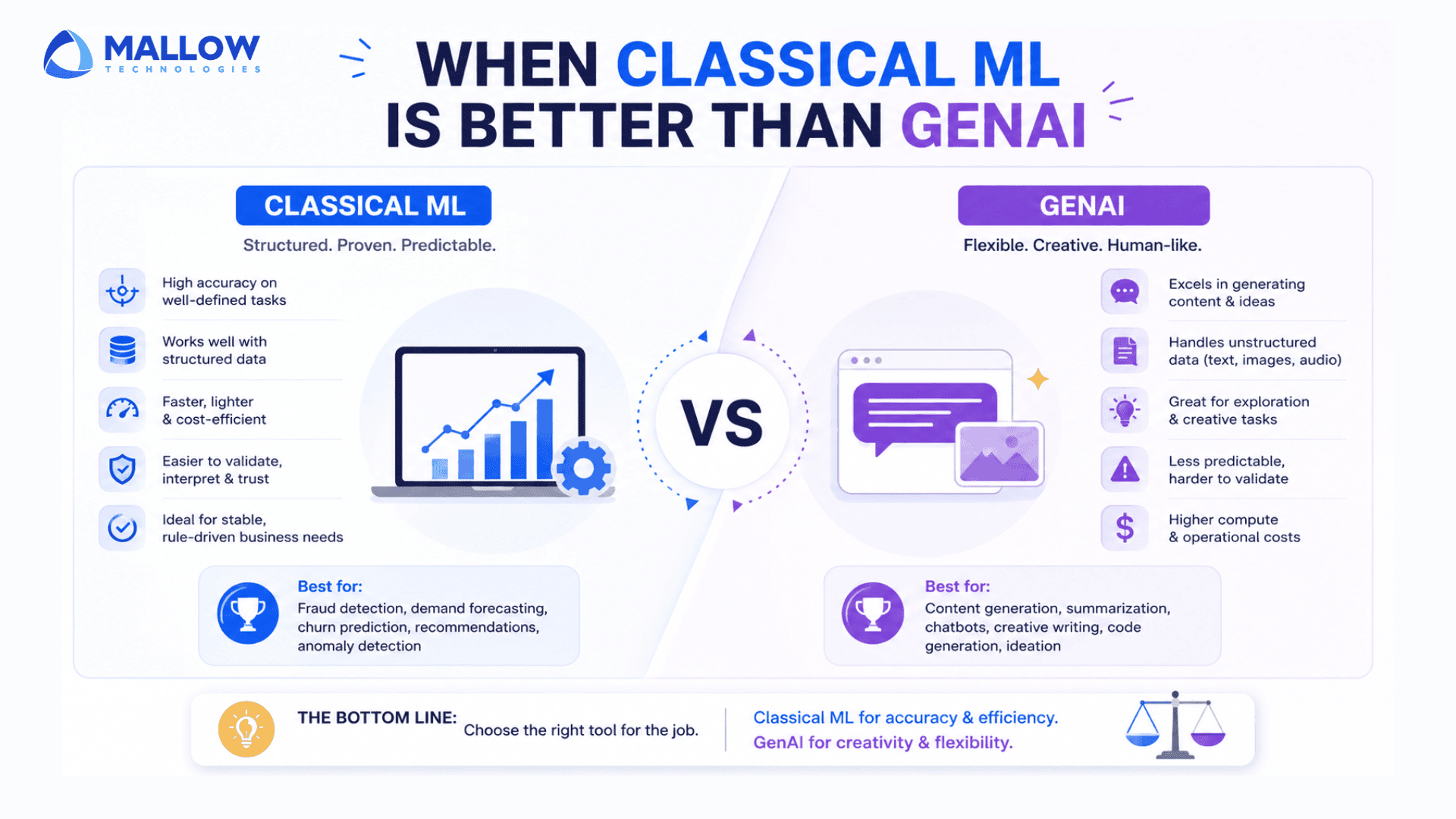
The table above makes the decision concrete. On inference cost, explainability, training data requirements, hallucination risk, and regulatory compliance, classical ML has a structural advantage for structured business problems. GenAI has the advantage on data type flexibility and language understanding. Best use case is the clearest dividing line: if your problem involves structured data and a defined output type, classical ML is almost always the right starting point.
Six real-world scenarios and which tool wins each one

The scenarios above cover the most common AI decisions product teams face. Three go to classical ML – churn prediction, fraud detection, and lead scoring. All three involve structured tabular data, defined output types, and high prediction volumes where cost matters. Three go to GenAI – customer service chatbots, marketing copy generation, and contract summarisation. All three involve natural language, unstructured input, and tasks where language understanding is the core requirement.
The pattern is consistent. If the task involves reading or generating language, GenAI is the right tool. If the task involves finding a pattern in structured data and making a decision, classical ML is the right tool.
The real cost of choosing GenAI when classical ML fits
The cost difference is not marginal. It is structural and compounds with scale.

A classical model running on standard cloud infrastructure handles millions of predictions per day at near-zero marginal cost. An LLM API call costs roughly $1 to $5 per thousand tokens depending on the model and provider. For a SaaS product running ten thousand predictions per day, that difference is the gap between a negligible infrastructure line item and a significant monthly operating cost that grows with every new customer.
Beyond inference cost, the setup and maintenance cost differs substantially. A gradient boosting model can be trained, evaluated, and deployed in days. Getting an LLM-based system to production-grade reliability, including prompt engineering, output validation, hallucination mitigation, and latency optimisation, takes weeks to months.
According to the AI Index 2024 Report published by Stanford University’s Institute for Human-Centered Artificial Intelligence, which tracks AI cost trends, capability benchmarks, and adoption patterns globally, the cost per unit of AI inference has dropped dramatically across both classical and generative approaches, but the ratio between them remains significant for high-volume structured prediction tasks.
Five questions to pick the right tool for your problem

These five questions cut through most of the confusion. If your data is structured and tabular, start with classical ML. If explainability is a compliance requirement, classical ML is the answer. If inference volume is high, the cost argument for classical ML becomes decisive. If the task involves natural language, GenAI earns consideration. If you need to ship in days, classical ML is the faster path.
Most product teams find that answering these five questions honestly eliminates the ambiguity before a line of code is written.
Four signals that GenAI is the wrong choice right now

These four scenarios come up repeatedly in real projects and each one points back to classical ML as the correct tool.
Your data is a spreadsheet or database export. An LLM does not understand the relationship between rows and columns the way a trained model does. Feeding structured data to an LLM produces worse results than a properly trained gradient boosting model trained on the same data, at a fraction of the cost.
You need the same answer every time for the same input. A churn probability that changes between calls is not a churn probability. It is noise. Classical models are deterministic. Same input, same output, every time.
A regulator or auditor will ask why the system made a decision. This is not a future risk for fintech, healthtech, or HR technology. It is a current requirement. A decision tree path can be explained in one sentence. An LLM’s reasoning cannot be traced at the token level in a compliance report.
You are running more than ten thousand predictions per day. At this volume, the cost difference between an LLM API and a classical model is substantial and grows with every new customer you add. Classical ML at scale is effectively free from an inference cost perspective. GenAI at scale is a line item that demands budget justification.
The rule that simplifies the entire decision
If your data has rows and columns, start with classical ML. If your data is words, images, or audio, start with GenAI. That rule handles ninety percent of decisions correctly.
The remaining ten percent involves problems that have both structured and unstructured components, or problems where you need language understanding combined with structured data processing. Those hybrid architectures are real and worth discussing, but they are not where most SaaS teams should start.
Start with the simplest approach that answers your question. Classical ML is almost always simpler, faster, cheaper, and more explainable than GenAI for structured business problems. The burden of proof is on the more complex tool, not the simpler one.
If you are evaluating AI for your product and want clarity on which approach fits your business, connect with Mallow’s engineering team. We help SaaS teams choose practical AI architectures based on their data, scalability needs, operational constraints, and long-term product goals.
Your queries, our answers
No. Generative AI is more capable for tasks involving natural language understanding and generation. For structured, tabular data tasks such as prediction, classification, and forecasting, classical ML models consistently outperform LLMs on accuracy, cost, speed, and explainability. Power is task relative, not absolute.
Yes, and this is increasingly common. A product might use a classical ML model to score leads or flag risks, and a GenAI layer to generate personalised messages based on those scores. The structured prediction task goes to classical ML. The language generation task goes to GenAI. Each tool does what it was designed for.
The ratio depends on model, volume, and infrastructure, but the difference is typically several orders of magnitude for inference cost. A classical model running on a standard server handles millions of predictions per day at near-zero marginal cost. An LLM API at comparable volume can cost thousands of dollars per month depending on the provider and model size.
Partly because GenAI is what is being discussed in the market. Partly because LLM demos are impressive and easy to show stakeholders. Partly because the structured ML option requires someone to define the problem, label the data, and build the training pipeline, which is less immediately visible than prompting a model and getting a response. The GenAI path feels faster to start. The classical ML path is usually faster to finish and cheaper to run.
For binary classification and prediction tasks on structured data, a few thousand labelled examples is typically enough to train a model that produces useful signals. The model improves with more data but does not require the scale that deep learning or LLM fine-tuning demands. If you have historical data with at least one outcome you want to predict, you likely have enough to start.
Not necessarily. It requires someone who understands the problem well enough to define the outcome, clean the data, and evaluate the model's performance. That can be a data analyst with ML experience, a backend engineer who has worked with scikit-learn, or a product engineer with enough statistical literacy to run an evaluation properly. The tooling for classical ML is mature and accessible in a way that LLM fine-tuning is not.
What happens after you fill-up the form?
Request a consultation
By completely filling out the form, you'll be able to book a meeting at a time that suits you. After booking the meeting, you'll receive two emails - a booking confirmation email and an email from the member of our team you'll be meeting that will help you prepare for the call.
Speak with our experts
During the consultation, we will listen to your questions and challenges, and provide personalised guidance and actionable recommendations to address your specific needs.

Author
SathishPrabhu
Sathish is an accomplished Project Manager at Mallow, leveraging his exceptional business analysis skills to drive success. With over 8 years of experience in the field, he brings a wealth of expertise to his role, consistently delivering outstanding results. Known for his meticulous attention to detail and strategic thinking, Sathish has successfully spearheaded numerous projects, ensuring timely completion and exceeding client expectations. Outside of work, he cherishes his time with family, often seen embarking on exciting travels together.