You have the budget approved. The board is excited. Someone on the team has already built a demo over a weekend that looked convincing enough to get everyone nodding. Now the pressure is on to turn that demo into a real feature inside your product, and the quiet worry sitting underneath the excitement is the one nobody says out loud: what if we spend three months and a large chunk of runway on this, and it never works the way the demo promised?
That worry is rational. The gap between a promising prototype and a reliable production feature is where most AI ambition quietly dies. And the reasons it dies are almost never the reasons teams expect. It is rarely the model. It is the data that was messier than anyone admitted, the success metric nobody defined, the edge cases that only show up with real users, the compliance question that surfaces a week before launch. These are not engineering problems. They are decisions, and most of them get made, or skipped, before a single line of production code exists.
This is the part of an AI project that good consulting actually addresses. Not the slide deck, not the strategy retainer that produces a PDF you never open again. The pre-build phase that pressure-tests whether the thing you are about to fund is the thing you should be building, and reshapes it before the expensive part starts. This article walks through what that phase looks like in practice, the specific risks it catches, and how it changes the build that follows so you can decide whether it is worth doing for your own product.
Why most AI risk is decided before anyone writes code
There is a comforting story teams tell themselves: that AI risk lives in the model. Pick the right approach, tune it well, and the rest follows. The data does not support that story. According to McKinsey’s 2025 State of AI survey, which found that 51% of organizations using AI had already experienced at least one negative consequence from it, the problems organizations actually run into cluster around inaccuracy, compliance, and unclear value. Those are not failures of model architecture. They are failures of framing.
Think about what that means for sequencing. A model can be retrained. A prompt can be rewritten. But the choice of which problem to solve, what data you are willing to use, what counts as good enough, and who is accountable when the system is wrong, all of that is set early, and it is what determines whether the project survives contact with reality. The cost of changing those decisions climbs steeply the further you get into the build. Reframing the problem in week one costs a conversation. Reframing it in month three costs the build.
This is the uncomfortable logic of AI projects. The cheapest moment to be wrong is the moment before you start. A consulting phase exists to spend that cheap moment deliberately, instead of discovering the same lessons later at full price.
What "consulting" actually means here, and what it does not
The word carries baggage, so it is worth being precise. A pre-build AI consulting phase is not a generic transformation engagement, and it is not a sales motion disguised as advice. It is a short, focused piece of work whose only job is to reduce the uncertainty around a specific build before that build is committed.
In practice it means sitting with the actual problem, the actual data, and the actual constraints, and producing answers that change what gets built. It looks more like technical due diligence than strategy. The people doing it should be able to read your schema, reason about your inference costs, and tell you honestly when the simplest answer is not AI at all. That last point matters more than it sounds. A consulting phase worth paying for is one that is willing to talk you out of the project, or out of the most expensive version of it, when that is the right call.
It also has to be grounded in what is realistically possible to build and run. The scope here is wider than people assume. Reducing risk before development might mean evaluating a retrieval setup for a knowledge product, the orchestration logic for an agentic workflow, a fine-tuning plan, the data pipeline and MLOps footprint a model will need once it is live, or how any of this fits inside the web and mobile platform you already run. The point of the phase is to make those choices with eyes open, not to default to whatever was trendy in the demo.
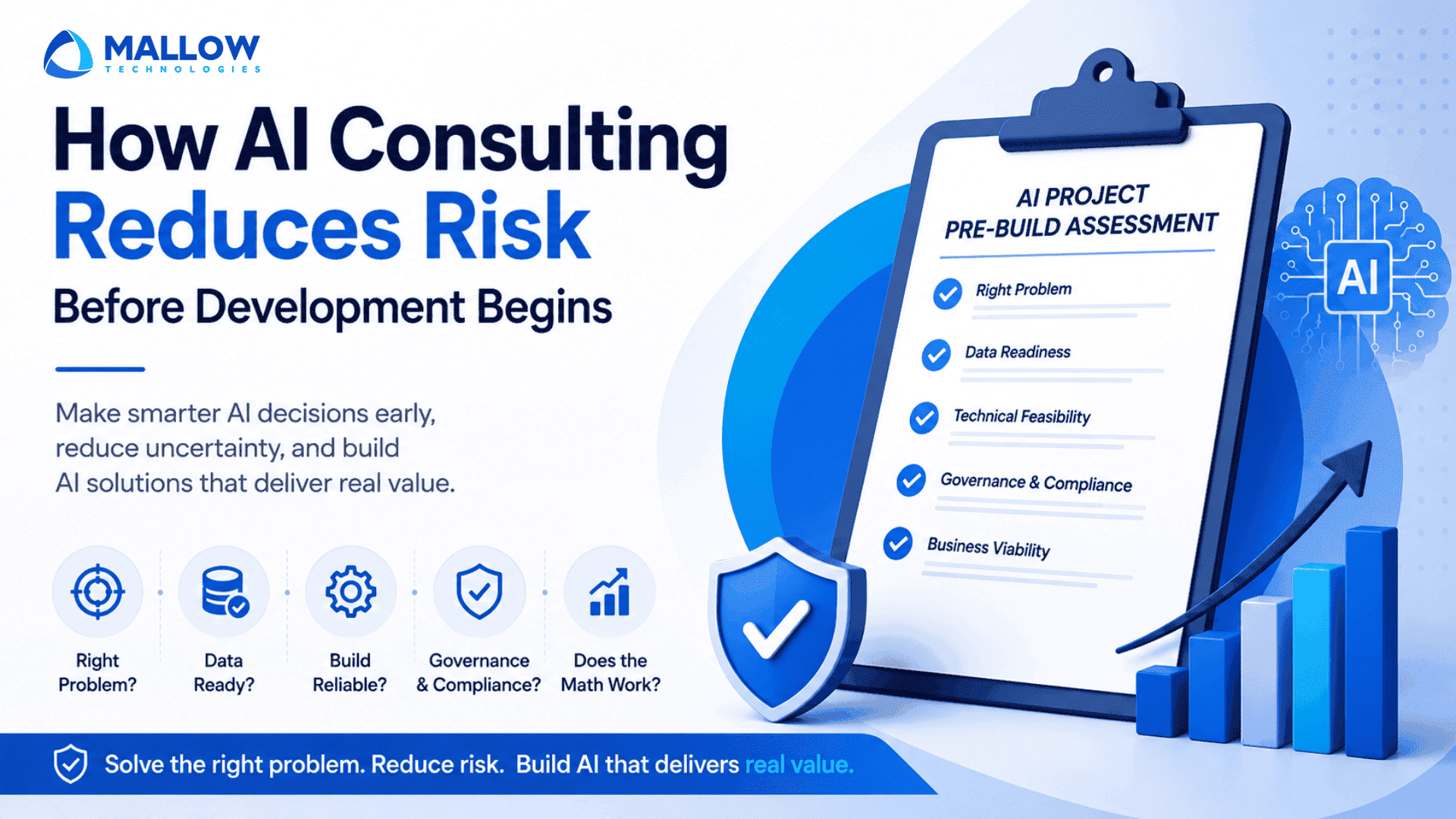
The five questions a pre-build assessment forces you to answer
Most of the value comes from refusing to skip questions that are easy to wave away when everyone is excited. Five of them do the heavy lifting.
Is AI the right tool for this problem?
The most expensive AI project is the one that should have been a rules engine, a better query, or a small workflow change. A serious assessment starts by trying to solve the problem without AI, and only reaches for it when the simpler path genuinely falls short. This single question prevents a surprising share of failures, because it catches the projects that were never going to justify their cost before they consume any.
Is your data actually ready?
Almost every team overestimates the state of its data. The assessment asks the unglamorous questions. Do you have enough of it. Is it labeled, or will labeling be a project of its own. Is it clean, consistent, and legally usable for this purpose. Where are the gaps you will only notice in production. Data readiness is the quiet determinant of whether an AI feature works, and it is far better understood now than discovered halfway through the build.
Can it be built reliably?
Feasibility is not a yes or no. It is a question of how reliably, at what accuracy, at what latency, and at what cost per call. An honest feasibility check models the realistic accuracy you can expect, the failure modes when the system is wrong, and what reliable looks like for your specific use. A feature that is right 70% of the time is excellent for some jobs and dangerous for others. Knowing which one you have, before launch, is the difference between a useful tool and a liability.
Who owns governance and compliance?
This is the question that surfaces late and hurts most when it does. What happens when the system makes a wrong call. Who is accountable. What rules apply to the data and the decisions, especially in regulated work. Structuring this against an established reference such as NIST’s AI Risk Management Framework, which organizes AI risk into govern, map, measure, and manage functions, turns a vague anxiety into a concrete checklist you can actually close out before you ship rather than after an incident.
Does the math work?
Finally, the part that gets skipped in the excitement. What does this cost to build, and more importantly what does it cost to run at the volume you are hoping for. Inference, monitoring, retraining, and the human review some systems need are recurring costs, not one-time ones. An assessment that puts real numbers against the expected outcome is what keeps a project from being approved on optimism and abandoned on the first invoice.
How an assessment changes the build that follows
The output of this phase is not a report that sits in a drive. It is a build that looks different. The scope is narrower and sharper, because the assessment usually reveals that the valuable part of the idea is smaller than the original pitch. The success metric is defined before work starts, so the team knows what they are aiming at and when they have hit it. The riskiest assumptions get tested first, in days, rather than discovered last, in months.
That reordering is the whole point. Teams that redesign their approach before committing to a build consistently get more out of what they ship, because the hard thinking happened while it was still free to change their minds. The build becomes an act of execution against decisions already made, instead of a long argument conducted in code.
When you can skip it, and when you really cannot
To be fair, not every project needs this. If the use case is small, well understood, reversible, and low stakes, the assessment can be a single conversation rather than a phase. The cost of being wrong is low, so the cost of being careful should be too.
The projects that truly cannot skip it are the ones with the opposite profile. High spend, real users, regulated data, decisions the system makes that are hard to walk back, or a board that approved the budget on a number nobody has stress-tested. If two or three of those are true, the pre-build phase is not overhead. It is the cheapest insurance available against the failure modes that the data says are the most common ones.
The instinct when AI excitement is high is to move fast and prove value quickly. That instinct is not wrong, but speed without a clear-eyed look at the problem, the data, and the cost is how teams end up moving fast in the wrong direction. The pre-build phase is not a brake on that momentum. It is what points the momentum somewhere worth going, while the steering is still cheap.
If you would like an assessment of your AI initiative before committing budget and development resources, click here to talk to one of our experts to explore the risks, opportunities, and practical next steps.
Your queries, our answers
AI consulting focuses on evaluating opportunities, risks, data readiness, feasibility, compliance, and business value before development begins. AI development is the process of building, integrating, testing, and deploying the solution. Consulting helps ensure you are investing in the right solution before committing significant time and budget.
A pre-build assessment helps identify potential issues early, including poor data quality, unclear success metrics, compliance concerns, unrealistic expectations, and hidden operational costs. Addressing these challenges before development is significantly less expensive than fixing them later.
The best approach is to start with the business challenge, not the technology. A proper assessment evaluates whether AI is genuinely needed or whether a simpler solution, such as process improvements, automation, analytics, or rule based systems, can deliver the desired outcome more effectively and at a lower cost.
Key considerations include data quality, consistency, completeness, accessibility, labeling requirements, legal permissions, and whether the available data accurately represents real-world scenarios. Data readiness is one of the strongest indicators of AI project success.
Projects involving large budgets, customer facing applications, regulated or sensitive data, high impact business decisions, or long term operational commitments benefit most from a structured assessment. In these cases, AI consulting helps reduce financial, technical, and compliance risks before development starts.
What happens after you fill-up the form?
Request a consultation
By completely filling out the form, you'll be able to book a meeting at a time that suits you. After booking the meeting, you'll receive two emails - a booking confirmation email and an email from the member of our team you'll be meeting that will help you prepare for the call.
Speak with our experts
During the consultation, we will listen to your questions and challenges, and provide personalised guidance and actionable recommendations to address your specific needs.

Author
SathishPrabhu
Sathish is an accomplished Project Manager at Mallow, leveraging his exceptional business analysis skills to drive success. With over 8 years of experience in the field, he brings a wealth of expertise to his role, consistently delivering outstanding results. Known for his meticulous attention to detail and strategic thinking, Sathish has successfully spearheaded numerous projects, ensuring timely completion and exceeding client expectations. Outside of work, he cherishes his time with family, often seen embarking on exciting travels together.