Every product team building an AI agent that takes real action eventually asks the same question – is this agent trustworthy enough to act on a user’s behalf without a human checking every step?
The instinct is to answer that question with reassurance. Add a confirmation dialog. Add a disclaimer. Add more hedging language to the agent’s responses. None of that actually answers the question, because trust in an agent is not a feeling you create through wording. It is a set of structural properties the agent either has or does not have.
This article defines those properties. Not as abstract principles, but as a concrete checklist a product team can use to evaluate whether a specific agent, for a specific action, in a specific context, is ready to act autonomously.
Trust is not a feeling. It is a set of properties.
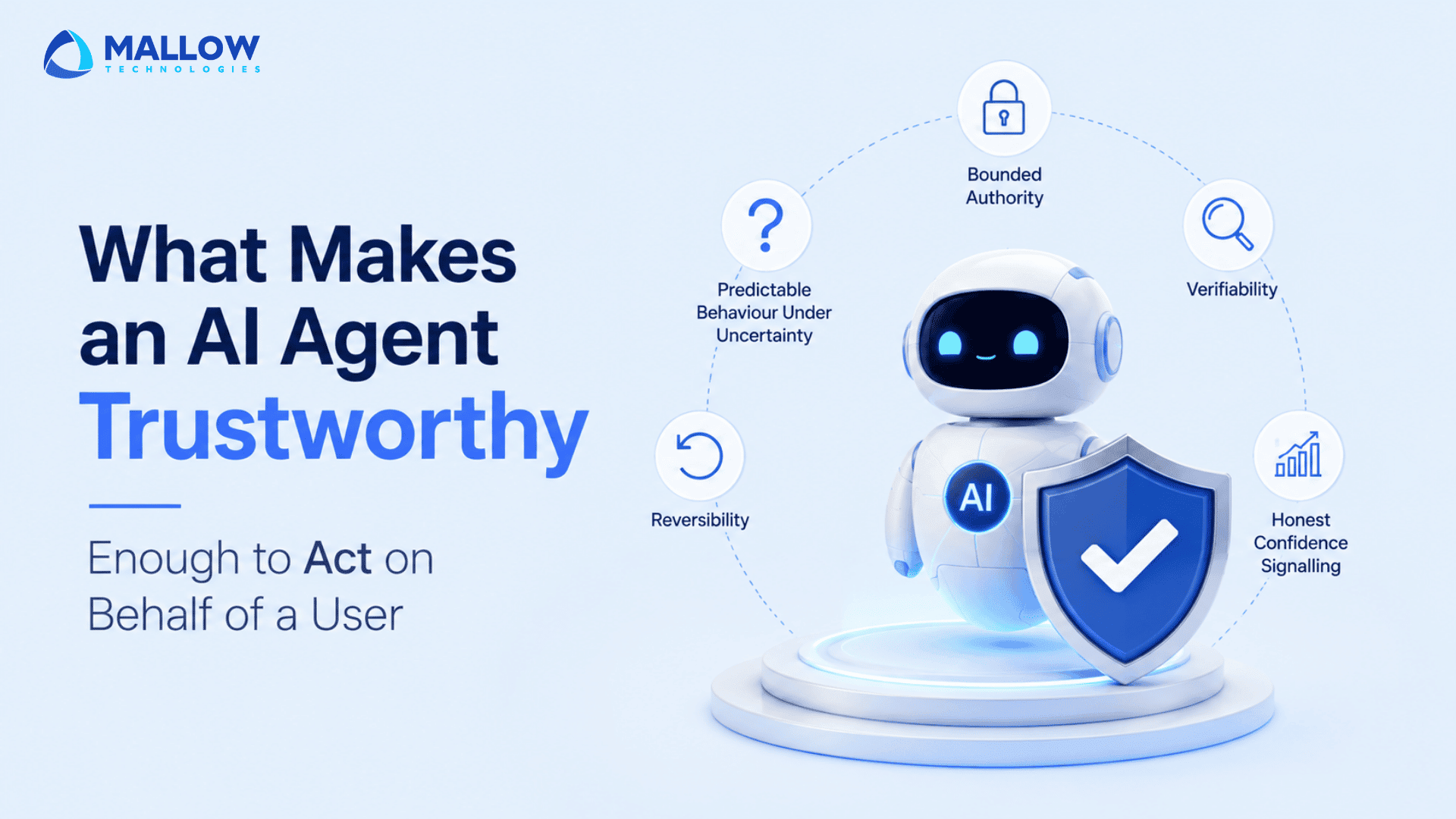
When a person trusts another person to act on their behalf, that trust is built on specific, learnable evidence – this person has clear limits on what they will do without asking, they behave predictably in unfamiliar situations, mistakes can usually be undone, you can verify what they actually did, and they tell you honestly when they are unsure.
These same five properties apply to AI agents, and they are the actual determinants of whether an agent is trustworthy enough to act autonomously. They are not soft or philosophical. Each one can be designed for, tested, and verified. An agent that is missing one of these properties is not ready for autonomous action in that domain, regardless of how capable its underlying model is.
Property 1 - Bounded authority
A trustworthy agent operates within an explicitly defined scope, and that scope is enforced at the system level, not just suggested through prompting.
This means the agent’s permitted actions are defined as a concrete, enumerable set – which functions it can call, which data it can read or write, which thresholds it can act within without escalation. A refund agent might be authorised to process refunds up to a defined amount, for orders within a defined time window, for specific cancellation reasons. Anything outside that boundary requires human approval.
The critical distinction is between bounded authority and prompted caution. Telling a model “only process refunds you are confident about” through a system prompt is not a boundary. It is a suggestion the model may or may not follow correctly, especially under unusual inputs or adversarial conditions. A genuine boundary is enforced in code – the refund function itself rejects requests above the threshold, regardless of what the model decides to attempt.
Bounded authority is the property most teams underweight because it requires real engineering work, whereas prompted caution can be added in a single line of text. The boundary is also what makes every other trust property meaningful. Reversibility matters less if the agent’s authority is already capped at a low-risk threshold. Verifiability matters less if there are only a small number of possible actions to verify.

Property 2 - Predictable behaviour under uncertainty
A trustworthy agent behaves consistently when it encounters a situation it was not specifically designed to handle. The test is not how the agent performs on the cases you anticipated. It is how the agent performs on the cases you did not.
The most dangerous failure pattern in autonomous agents is confident extrapolation – the agent encounters an ambiguous or unfamiliar situation and, rather than recognising the ambiguity, produces a confident response based on a superficial pattern match to something it has seen before. This is the agent equivalent of a person who, faced with an unfamiliar situation, guesses with full conviction rather than saying “I am not sure.”
Predictable behaviour under uncertainty means the agent has a defined, tested response to ambiguity – escalate, ask a clarifying question, or decline to act. That response needs to be the default behaviour when the agent’s confidence in its interpretation of the situation falls below a defined threshold, not an occasional behaviour that emerges if the prompting happens to produce it.
Testing for this property requires deliberately constructing inputs at the edges of the agent’s intended scope and verifying it responds with appropriate caution rather than confident execution. Most teams test agents against the cases they expect. Trustworthy agents are tested against the cases they do not.
Property 3 - Reversibility
A trustworthy agent’s actions can be undone, or the consequences of an incorrect action are bounded and recoverable. This property matters more than almost any other because it determines the actual cost of an agent’s mistake.
Reversibility exists on a spectrum. Some actions are fully reversible – a calendar event can be deleted, a draft email can be discarded before sending. Some are partially reversible – a sent email cannot be unsent, but a follow-up correction can be sent immediately. Some are effectively irreversible – a payment sent to the wrong account, a customer record permanently deleted, a public-facing action taken in a company’s name.
The design principle that follows from this is straightforward – the level of autonomous authority an agent is given for an action should be inversely related to that action’s position on the reversibility spectrum. Fully reversible actions are reasonable candidates for full autonomy. Partially reversible actions warrant a confirmation step or a short delay window before execution, giving the user or system a chance to catch and reverse a mistake before it has consequences. Effectively irreversible actions should not be delegated to autonomous agent execution without human approval, regardless of how confident the agent is.
This is the property most commonly violated by teams eager to demonstrate full automation. The appeal of an agent that handles everything without human involvement is obvious. The cost of that appeal, applied to an irreversible action, is a mistake that cannot be undone.

Property 4 - Verifiability
A trustworthy agent’s actions and reasoning can be inspected after the fact. This is not the same as the agent explaining itself in natural language, which can be persuasive without being accurate. Verifiability means there is a structured, reliable record of what the agent observed, what it decided, what action it took, and why.
This record needs to exist independently of whether anything goes wrong. The purpose is not solely incident investigation. It is the mechanism by which a team builds confidence in an agent’s behaviour over time, by being able to audit a sample of its decisions and verify they were sound. Without this, trust in an agent can only be based on outcomes you happened to notice, which is a much weaker basis than systematic verification.
For products operating in regulated contexts, verifiability is not optional. The EU AI Act’s provisions on transparency and record-keeping for high-risk AI systems establish a baseline expectation that automated decision-making must be explainable and auditable. Even outside regulated contexts, the discipline of building verifiable agents tends to produce better-designed agents overall, because the requirement to log structured reasoning forces clearer boundaries on what the agent is actually deciding.
Property 5 - Honest confidence signalling
A trustworthy agent communicates its actual confidence level, not a uniformly confident tone regardless of the underlying certainty. This property addresses a specific and common failure – language models are fluent by default, and fluency is easily mistaken for certainty. An agent that is genuinely unsure can still produce a response that reads as authoritative, because that is simply how the underlying model generates text.
Honest confidence signalling requires the agent’s confidence assessment to be a structural part of its output, not an afterthought. This can take the form of explicit confidence scores attached to actions, clear differentiation between “I completed this” and “I attempted this and believe it succeeded,” or visible flagging when an action relied on an assumption that was not explicitly confirmed by the user.
The absence of this property creates a particular kind of risk – users extend trust based on the agent’s tone rather than its actual track record, and that trust is calibrated incorrectly. An agent that sounds equally confident whether it is certain or guessing trains its users to either over-trust it or, once they catch it being wrong while sounding certain, to distrust it entirely. Neither outcome is what a well-designed trust relationship should produce.
The trust gradient - Matching autonomy to stakes
These five properties are not a binary pass or fail gate for an entire agent. They are a framework for calibrating how much autonomous authority a specific agent should have for a specific action, given the stakes involved.
Low stakes, highly reversible actions such as drafting a document for review, suggesting a calendar slot, or summarising a thread warrant full autonomy with minimal trust requirements because the cost of an error is low and easily corrected.
Medium stakes actions with partial reversibility, such as sending a routine customer communication, updating a non critical record, or scheduling a meeting, warrant bounded authority, predictable escalation behaviour, and a verifiable action log, but not necessarily a human approval step for every instance.
High stakes, low reversibility actions such as financial transactions, irreversible data deletion, public communications, or anything with legal or contractual consequences warrant all five properties at a high standard. In most cases, they should still require human approval before execution, regardless of how strong the other four properties are.
The mistake many teams make is applying a single trust standard across an entire agent, rather than calibrating it for each action based on where that action falls on this gradient. An agent can reasonably have full autonomy for ninety percent of what it does and require human approval for the ten percent that carries real consequences. That distinction is the actual design work of building a trustworthy agent.

What erodes trust fastest
Inconsistency between stated boundaries and actual behaviour. If a product communicates that an agent “always asks before doing X” and a user discovers an instance where it did not, the trust cost is disproportionate to the single incident. Users update their model of the agent’s reliability based on the worst case they have observed, not the average case.
Confident failure. An agent that fails while sounding certain erodes trust faster than an agent that fails while signalling uncertainty. The first teaches the user that the agent’s confidence is not a reliable signal. The second preserves the value of the agent’s confidence signal for future interactions, even though this specific interaction failed.
Opaque correction. When an agent’s mistake is corrected silently, without the user understanding what went wrong or why, the user is left unable to calibrate their trust appropriately. Transparent correction, even when the underlying mistake is embarrassing, preserves more long-term trust than a quiet fix.
Authority creep. An agent that starts with a narrow, well-justified scope and gradually has its permissions expanded without the same rigour applied to the new scope erodes trust the moment the expanded authority produces a visible mistake. The trust properties need to be re-evaluated at every expansion of scope, not just at initial launch.

Building trust into AI agents from the start
An agent is not trustworthy because it sounds confident, because the company building it says it can be trusted, or because the underlying model is state of the art. It is trustworthy because its authority is bounded and enforced, its behaviour under uncertainty is predictable, its actions are reversible or their consequences are bounded, what it did can be verified after the fact, and its stated confidence reflects its actual confidence.
These five properties are not abstract design philosophy. They are a practical checklist that product teams can use to determine where each agent capability belongs on the autonomy spectrum. If you are planning to build AI agents that can safely take action on behalf of your users, discuss your AI agent requirements with our experts to determine the right level of autonomy for every workflow.
The work of building a trustworthy agent is the work of being honest about where each specific action falls on this checklist and resisting the temptation to grant more autonomy than the properties actually support. At Mallow, we help businesses build AI agents with trust, governance, and human oversight built into the architecture from day one.
Your queries, our answers
No. Requiring approval for every action defeats the purpose of an autonomous agent and creates approval fatigue, where users start clicking through confirmations without actually evaluating them. The right design asks for approval at the points on the trust gradient where the stakes genuinely warrant it, and acts autonomously everywhere else. The skill is in correctly identifying which actions belong in which category, not in defaulting to either extreme.
Attempt to make the agent take actions outside its intended scope through adversarial or edge-case inputs, and verify that the system-level enforcement, not just the prompt, prevents the action. If the only thing stopping an out-of-scope action is the model choosing not to attempt it, the authority is not actually bounded. The test should be performed at the code level: can the underlying function be called with parameters outside the intended range, independent of what the model is asked to do.
Explainability is the agent's ability to describe its reasoning in natural language, which can be generated after the fact and is not guaranteed to reflect what actually happened internally. Verifiability is a structured, reliable record of the agent's actual inputs, decision points, and outputs that exists independent of any natural language explanation. Verifiability is the stronger and more reliable property. Explainability is useful for user-facing communication but should not be the basis for auditing agent behaviour.
Yes, for both trust and regulatory reasons. Beyond the ethical case, several jurisdictions are moving toward disclosure requirements for AI-driven interactions, particularly where the agent is taking actions with real consequences. Beyond compliance, disclosure also calibrates user expectations correctly - a user interacting knowingly with an agent will phrase requests differently and scrutinise unusual outputs more carefully than a user who believes they are talking to a human.
In principle, a strong track record should allow for a gradual expansion of autonomous authority. In practice, this expansion should be done deliberately and incrementally, with the same evaluation rigour applied to the newly granted authority as was applied to the original scope. A common mistake is treating a good track record in the original narrow scope as evidence the agent is ready for a much broader scope, without re-testing the new territory specifically.
No. Capability and trustworthiness are different properties. A highly capable model with no enforced boundaries, no reversibility safeguards, and no verifiable action log is not more trustworthy than a less capable model with all of those properties in place. It may even be less trustworthy, because its fluency makes confident failures more convincing. Trustworthiness is a property of the system the model is embedded in, not of the model alone.
What happens after you fill-up the form?
Request a consultation
By completely filling out the form, you'll be able to book a meeting at a time that suits you. After booking the meeting, you'll receive two emails - a booking confirmation email and an email from the member of our team you'll be meeting that will help you prepare for the call.
Speak with our experts
During the consultation, we will listen to your questions and challenges, and provide personalised guidance and actionable recommendations to address your specific needs.

Author
SathishPrabhu
Sathish is an accomplished Project Manager at Mallow, leveraging his exceptional business analysis skills to drive success. With over 8 years of experience in the field, he brings a wealth of expertise to his role, consistently delivering outstanding results. Known for his meticulous attention to detail and strategic thinking, Sathish has successfully spearheaded numerous projects, ensuring timely completion and exceeding client expectations. Outside of work, he cherishes his time with family, often seen embarking on exciting travels together.