The demo worked perfectly.
The vendor showed you agents handing tasks off to each other, a context layer that seemed to remember everything, and a governance dashboard that made the whole thing look controllable.
You came away impressed. You are probably ready to sign.
That is exactly the moment to slow down.
Multi-agent AI systems are genuinely different from the software you have procured before. A poorly architected system can run flawlessly in a demo environment, against prepared data, with none of the edge cases your real users will generate on day one. And unlike a conventional application that breaks with a visible error, a badly governed agent system tends to fail quietly, making subtly wrong decisions, accumulating context drift, and running up costs in retry loops before anyone notices.
Gartner’s March 2026 data and analytics predictions state that by 2030, 50% of AI agent deployment failures will be attributed to insufficient AI governance platform runtime enforcement. That number is not a projection about future technology. It is a warning about how procurement is happening today.
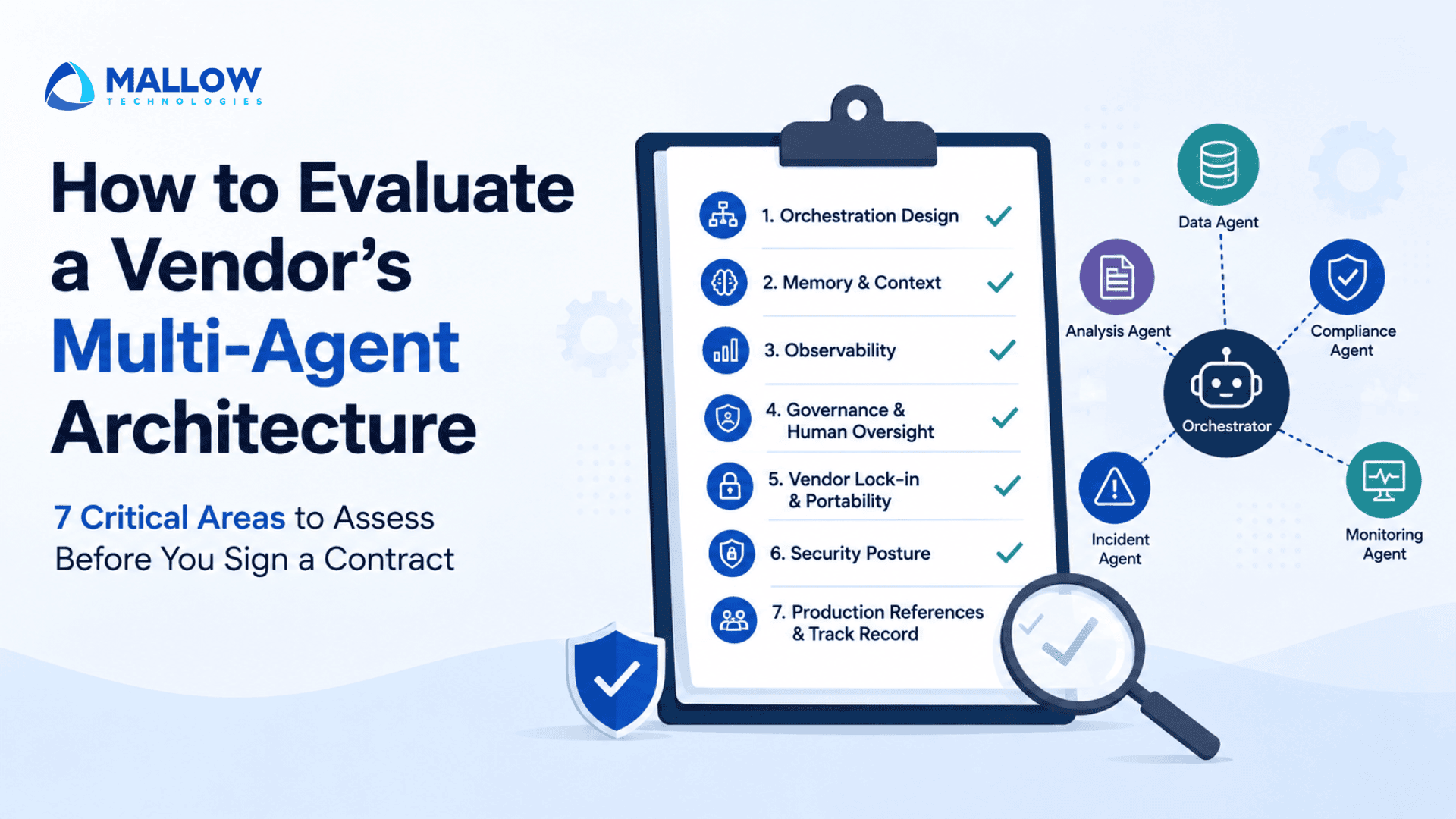
This article gives you a structured framework to evaluate a vendor’s multi-agent architecture before you commit. It covers seven areas that reveal whether a vendor’s architecture is genuinely production-ready – orchestration design, memory and context management, observability, governance and human oversight, vendor lock-in risk, security posture, and production references. By the end, you will have the questions to ask, the answers that should concern you, and a clear sense of what a well-built system actually looks like under examination.
Why the demo environment is not the architecture
The most important thing to understand before you start evaluating a vendor is that demo environments are optimised for success, not resilience. Tasks are scoped to what the system handles well. Data is clean. Edge cases are absent. The agent chain that looked fluid in the presentation often depends on a manually tuned set of conditions that will not exist in your production environment.
The real architecture only becomes visible when you push it. Test the vendor’s system using your own sandbox data, unfamiliar inputs, edge cases, and failure scenarios rather than relying solely on the prepared demo environment. This is where you can determine whether the system is genuinely autonomous, how it handles unexpected conditions, and whether its orchestration and governance mechanisms work as described.
This is not a fraud story. It is a design story. The vendor probably did not deliberately misrepresent their system. They demonstrated what it does well, in the environment it was built for. Your job during evaluation is to find out what it does when conditions are not ideal, because your users will generate those conditions every day.
Seven areas to evaluate multi-agent AI vendors before contract

Area 1 - Orchestration design and task routing
The orchestration layer is the central nervous system of a multi-agent system. It decides which agent handles which task, manages sequencing, and routes outputs between agents. How a vendor has designed this layer tells you more about the system’s maturity than almost anything else.
What to ask:
Ask the vendor to explain how the orchestrator decides which agent handles a given task. A mature answer involves explicit routing logic – defined agent capabilities, task classification criteria, and documented handoff protocols. A concerning answer involves phrases like “the model figures it out” or “it routes intelligently” without any specifics.
Ask what happens when an agent in the chain fails mid-task. A well-built system has graceful degradation logic – partial results are preserved, the user receives a meaningful response, and the failure is logged with enough detail for diagnosis. A poorly built system either crashes visibly or silently returns incomplete output with no indication that something went wrong.
Ask whether the orchestration layer is stateless or stateful. For multi-step workflows that span sessions, a stateless orchestrator will lose context between calls. If the vendor has not thought through state management, your users will experience this as the system forgetting what they told it.
What good looks like:
The vendor can describe their routing logic in plain terms, name the framework they are using (LangGraph, CrewAI, or a custom layer), explain why they chose it for your use case, and demonstrate what failure looks like in their test environment.
Area 2 - Memory and context management
Memory architecture in a production multi-agent system

What to ask:
Ask how context is passed between agents within a single workflow. The answer should describe a specific mechanism – a shared memory store, an explicit context object, or a defined handoff schema. If the answer is “the agents share context naturally,” push for the technical specifics.
Ask how the system handles context window overflow. In long workflows, an agent’s working memory can fill up, causing it to drop earlier context and produce incoherent decisions mid-task. A mature system has overflow handling built in – summarisation, selective retention, or explicit prioritisation of which context survives.
Ask where long-term memory is stored and who owns it. If customer-specific context, past interaction history, or learned preferences are stored in the vendor’s proprietary memory infrastructure, you need to understand what happens to that data if you change vendors, and whether it can be exported in a usable format.
What good looks like:
The vendor distinguishes between memory types, explains the persistence layer (typically a combination of Redis for short-term and a vector database for episodic retrieval), and has a documented answer for what happens to stored context when a session ends, when a user deletes data, and when the contract terminates.
Area 3 - Observability and traceability
You cannot govern what you cannot observe. This principle applies to every production system, but it matters most in multi-agent AI because agent failures are often not immediately visible. AI agent observability means being able to see, understand, and explain what enterprise AI agents are doing across systems with enough detail to debug issues, enforce guardrails, and prove compliance, specifically answering “why did the agent do that?” before regulators, auditors, or end users have to ask.
What to ask:
Ask what the vendor’s observability stack produces. At minimum, you should expect traces for every agent action, tool call, and reasoning step; token usage and cost per workflow run; error rates per agent; and latency distributions by step. If the observability dashboard only shows whether the system is “up” or “down,” that is not observability for a multi-agent system.
Ask whether telemetry exports to your existing stack. OpenTelemetry has emerged as the standard for vendor-neutral observability, with its core advantage being portability – traces emitted once can go to any compatible backend without re-instrumenting code. If the vendor’s observability data is locked inside their own console, you have created a monitoring silo and a compliance problem simultaneously.
Ask about silent model updates. This is one of the most common production complaints in agentic systems. When the vendor updates the underlying model, agent behaviour can change without any code change on your side. Ask whether they offer version pinning, provide advance notice of model updates, and have SLA provisions covering quality degradation after an update you did not initiate.
What good looks like:
The vendor has an OpenTelemetry-compatible export, can show you a real production trace with reasoning steps and tool calls visible, and has contractual provisions around model update notification periods.
Area 4 - Governance and human oversight
Governance gaps can derail autonomous AI initiatives when organisations treat agent governance as binary, either locking systems down completely or giving them too much autonomy without appropriate controls.
Governance in multi-agent systems is not a dashboard feature. It is an architectural decision about how much autonomy each agent class has, under what conditions human approval is required, and what audit evidence the system produces.

What to ask:
Ask how the vendor classifies agents by autonomy level. A useful reference is a four-level governance model that distinguishes between agents that observe, such as read-only systems that summarise information; agents that advise, such as systems that recommend or draft; agents that act with approval, such as systems that write or send only after explicit human sign-off; and agents that act autonomously, such as systems that execute without human review. A vendor who has not thought through this classification has not thought through governance.
Ask about the EU AI Act implications for your use case. As of August 2026, most high-risk AI system rules under the EU AI Act are in effect, covering conformity assessment, technical documentation, risk management, data governance, human oversight, accuracy, and robustness. If your SaaS product operates in the EU and your agent system influences employment screening, credit decisions, or customer communications, your vendor needs to have thought through compliance architecture, not just mentioned it in a slide.
What good looks like:
The vendor can classify each agent in your proposed architecture by autonomy level, show you the approval workflow for action-class agents, produce a sample audit log from a production environment, and answer questions about how their system handles the EU AI Act’s human oversight requirements.
Area 5 - Vendor lock-in and portability
This is the area most SaaS buyers underestimate at signature and most regret at renewal. Multi-agent systems create lock-in at multiple layers simultaneously – the orchestration framework, the memory infrastructure, the observability tooling, and the underlying model. When those layers are all proprietary to the same vendor, migrating later is not a refactoring exercise; it is a rebuild.
Analysis of the enterprise agentic AI landscape in Q2 2026 found that enterprises building agentic workflows on proprietary orchestration layers embed their agent architecture into a vendor’s runtime, governance, and observability stack in ways that compound over time and become increasingly difficult to unwind, with lock-in risk growing at every layer of the stack.
What to ask:
Ask which components of the system rely on the vendor’s proprietary infrastructure versus open standards. MCP, now donated to the Linux Foundation’s Agentic AI Foundation, is an open standard for connecting AI agents to external tools, data sources, and APIs, and building on MCP-compatible infrastructure preserves interoperability across models and vendors. A vendor building on MCP for tool connectivity is a different risk profile from one using a proprietary tool-calling layer.
Ask what a migration scenario looks like. Ask the vendor directly – “If we decided to move this to a different provider in eighteen months, what would we need to rebuild from scratch?” A vendor with a well-architected system can answer this question calmly and specifically. A vendor whose architecture is difficult to exit from will either dodge the question or make migration sound more complicated than it needs to be.
Ask about data portability for memory and logs. Everything stored in the vendor’s memory layer, every agent decision log, every workflow trace, should be exportable in a standard format. If the vendor cannot commit to this contractually, factor the migration cost into your evaluation.
What good looks like:
The vendor uses open standards where possible (MCP for tool connectivity, OpenTelemetry for observability), builds on a framework whose output is portable, and can give a straight answer about what it would take to migrate.
Area 6 - Security posture
Multi-agent systems have a security profile that is meaningfully different from conventional software. Agents call external tools, access data sources, and pass information between components. Each of those connections is a surface for prompt injection, data leakage, or privilege escalation.
What to ask:
Ask how the system handles prompt injection. Prompt injection is the most common and most underestimated attack vector in agentic systems. It occurs when malicious content in a tool’s output or a retrieved document contains instructions that redirect the agent’s behaviour. Ask the vendor whether they sanitise tool outputs before feeding them back into the orchestrator, and what testing they have done against adversarial inputs.
Ask about agent identity and least-privilege access. Each agent in the system should have its own scoped identity with access only to the tools and data it needs to complete its specific task. Ask whether the vendor uses per-agent access tokens or a shared credential model. A shared credential model means that if any agent is compromised, all of the system’s access is compromised.
Ask how the system handles PII in agent memory. If a customer’s personal data is stored in the episodic memory layer to enable personalisation across sessions, that data needs to be namespaced per user, subject to deletion requests, and protected against cross-user leakage. Ask to see the data isolation model.
What good looks like:
The vendor has a documented approach to prompt injection testing, per-agent identity scoping, PII isolation in memory layers, and can point you to a security review or penetration test they have conducted against the system.
Area 7 - Production references and failure history
A vendor’s answers to technical questions tell you what they know. Their production reference customers tell you what they have actually built and maintained under real conditions.
Asking for reference customers who have run agents in production for over six months is a meaningful threshold. Everyone’s agent works in week one. Six months is the period over which context drift, model update surprises, and governance gaps become visible.
What to ask:
Ask for three reference customers in your industry and size band who have been running the system in production for at least six months. When you speak to those references, ask specifically about implementation surprises, actual uptime versus contracted SLA, and what they would do differently if starting again.
Ask the vendor to walk you through a real production failure. Not a hypothetical, but an actual incident. What triggered it, how the observability tools surfaced it, how long it took to diagnose, and what architectural change resulted from it. A vendor who has never had a production failure either has no production customers or is not being candid. A vendor who can describe a real failure in detail, including what the governance gap was and how they fixed it, is a vendor who understands their own system.
Ask about the total cost of ownership over twelve months, not just the contract value. Enterprise analysis of agentic AI deployments recommends modelling monthly operating costs across different usage tiers and estimating a realistic three-year TCO before signing, because organisations that define measurement criteria before deployment achieve significantly better cycle time outcomes than those that do not. Agent systems that use token-heavy models, that have retry loops without exit conditions, or that trigger frequent tool calls can generate costs that dwarf the implementation fee.
What good looks like:
The vendor provides references without hesitation, can walk through a real production incident with technical detail, and gives you a transparent model of how costs scale with usage volume, including what guardrails exist to prevent runaway costs.
Putting it together - a pre-signature checklist
Before you sign, confirm you have answers to these questions across all seven areas –

Orchestration – Can the vendor describe the routing logic in plain terms? Have you seen graceful failure in the test environment?
Memory – Does the vendor distinguish between memory types? Is stored context exportable?
Observability – Does telemetry export via OpenTelemetry or a compatible standard? Is there contractual provision for model update notification?
Governance – Has the vendor classified each agent by autonomy level? Have you seen the human approval workflow in the interface?
Lock-in – Which components use open standards? Can the vendor give a straight migration answer?
Security – Is there per-agent identity scoping? Has the system been tested against prompt injection?
Production references – Are there customers past the six-month mark in your industry? Has the vendor walked through a real failure with honesty?
No vendor will score perfectly on all seven. The point of the framework is not to find a perfect vendor; it is to understand which gaps you are accepting and at what risk level before the contract is signed, not after the first incident.
Evaluate the architecture before you sign
Choosing a multi-agent AI vendor should go beyond finding the most impressive demo. The right evaluation looks at whether the architecture can handle the conditions it will face in production, including real data, unexpected failures, governance requirements, security risks, observability needs, portability, and ongoing costs.
The seven areas covered in this guide give you a practical way to challenge the architecture before making a commitment. You do not need to find a vendor with zero weaknesses. You need to understand which risks you are accepting, how significant they are, and whether the vendor has a credible plan to manage them.
So before you sign, take the architecture out of the demo environment. Test it with your own scenarios, ask how it fails, understand how your data and context are handled, verify the governance and security controls, and speak to customers who have already taken the system into production.
The best time to discover an architectural risk is before it becomes your production problem.
If you are evaluating a multi-agent AI vendor and want an experienced team to assess the architecture, identify potential risks, and determine the right approach for your requirements, talk to our experts.
Your queries, our answers
Governance and observability are where the most expensive production failures occur. A system can look well-architected in a demo and still lack the audit trails, human approval workflows, and telemetry exports needed to operate safely at scale. These are the two areas where evaluation should be most rigorous.
Request access to a sandbox environment using your own data, not the vendor's prepared demo data. Ask to run the same task used in the demo but with an input the system has not been configured for. Ask to see what happens when one agent in the chain returns an error. The system's behaviour in these conditions is more informative than any feature list.
Lock-in occurs when your agent architecture becomes inseparable from a vendor's proprietary infrastructure: their orchestration framework, memory layer, observability tooling, and model access. When these are all proprietary to the same vendor, migrating to a different provider later requires rebuilding the system from scratch. Evaluating whether key components use open standards like MCP and OpenTelemetry is the most practical way to assess this risk before signing.
Ask which autonomy class the vendor places each agent in, whether the system has human oversight controls for action-taking agents, what the audit log structure looks like, and whether the vendor has a documented AI risk management process. For SaaS products operating in the EU, these questions have legal implications, not just technical ones.
You do not need to understand vector databases to ask the right questions. Ask: "What happens to the context from this conversation if the user comes back in three days?" Ask: "If a user asks you to delete their data, what gets deleted and what stays?" Ask: "If we move to a different vendor, can we take the stored context with us?" The quality of the answers tells you whether the vendor has thought this through.
Standard monitoring tells you whether a service is running and how fast it responds. Agent observability needs to tell you why an agent made a specific decision, what data it used to make that decision, which tool calls it made, and what the cost of the workflow was. Most standard monitoring tools do not capture this. Ask specifically whether the vendor's telemetry exports reasoning traces, tool call logs, and per-workflow cost breakdowns.
A thorough evaluation takes three to four weeks: one week for technical discovery questions and architecture review, one week for sandbox testing with your own data, one week for reference customer conversations, and one week for contract and SLA review with specific attention to model update policies and data portability clauses. Compressing this timeline is one of the most common reasons procurement decisions lead to expensive surprises in production.
What happens after you fill-up the form?
Request a consultation
By completely filling out the form, you'll be able to book a meeting at a time that suits you. After booking the meeting, you'll receive two emails - a booking confirmation email and an email from the member of our team you'll be meeting that will help you prepare for the call.
Speak with our experts
During the consultation, we will listen to your questions and challenges, and provide personalised guidance and actionable recommendations to address your specific needs.

Author
SathishPrabhu
Sathish is an accomplished Project Manager at Mallow, leveraging his exceptional business analysis skills to drive success. With over 8 years of experience in the field, he brings a wealth of expertise to his role, consistently delivering outstanding results. Known for his meticulous attention to detail and strategic thinking, Sathish has successfully spearheaded numerous projects, ensuring timely completion and exceeding client expectations. Outside of work, he cherishes his time with family, often seen embarking on exciting travels together.