Most teams evaluating AI right now are looking at the same shortlist – which model to use, which vendor to talk to, which feature to build first. It’s a reasonable starting point, and it’s also the wrong one. The conversation about AI capability tends to dominate the room because it’s visible and easy to compare. What’s harder to see, and almost always undervalued, is what the AI will actually run on. Internal knowledge – the support conversations your team has had, the product decisions that got documented somewhere, the onboarding materials, the runbooks, the post-mortems, the tribal knowledge sitting in Slack threads and inside the heads of your three most senior engineers. That’s the actual differentiator. The model is available to everyone. What you already know isn’t.
This article is about why internal knowledge is the AI asset most SaaS teams never formally think about, and what it takes to start treating it like one.
The problem hiding in your tool stack
When a company decides to add AI to its product or internal workflows, the first question is usually, “Which tool?” That question makes sense when you’re evaluating something like a payment processor or a deployment pipeline, where the tool itself is most of the value. AI doesn’t work that way. The output of an AI feature is only as good as the context it can draw on, and for anything involving your company’s specific domain, that context has to come from you.
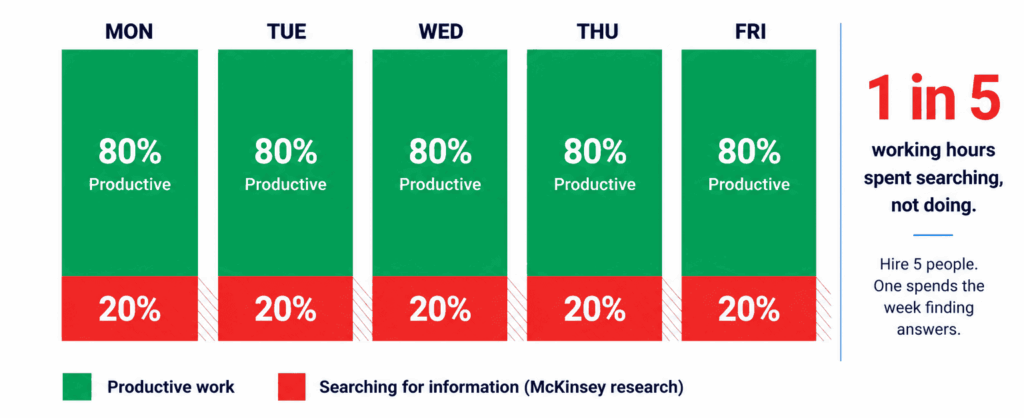
According to McKinsey research on knowledge workers and information search, employees spend close to 20% of their working week searching for internal information.
That’s not a search engine problem. It’s a knowledge architecture problem. The right information exists somewhere inside the organisation, but it’s not in a form the person asking for it can actually reach. When you bolt an AI tool on top of that same fragmented knowledge state, you get a faster version of the same problem. The AI searches your documentation, can’t find a reliable answer because the content is inconsistent or incomplete, and either hallucinates or hedges. The tool didn’t fail. The data layer did.
What "internal knowledge" actually means in this context
It’s worth being specific, because “internal knowledge” can sound abstract.
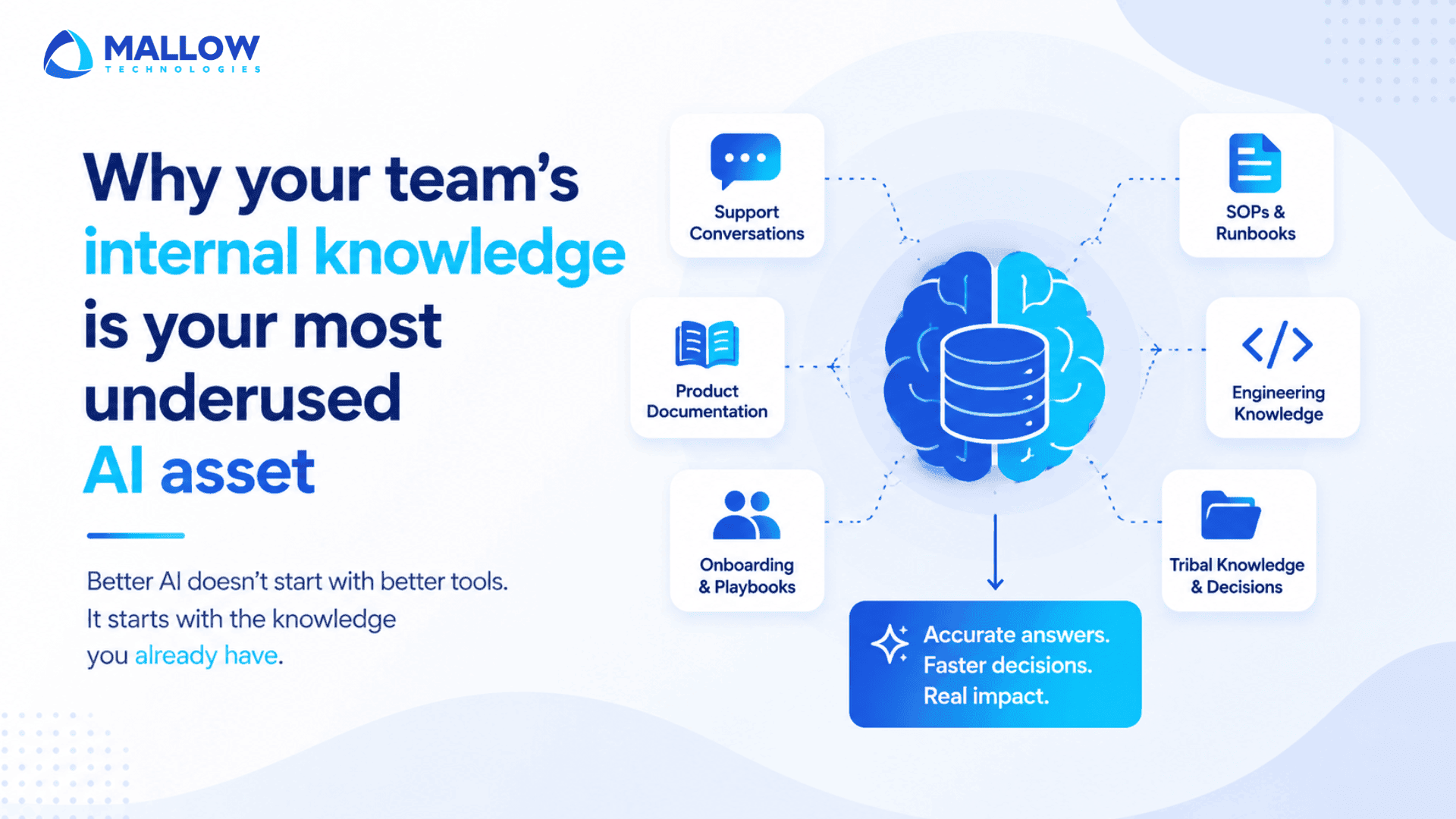
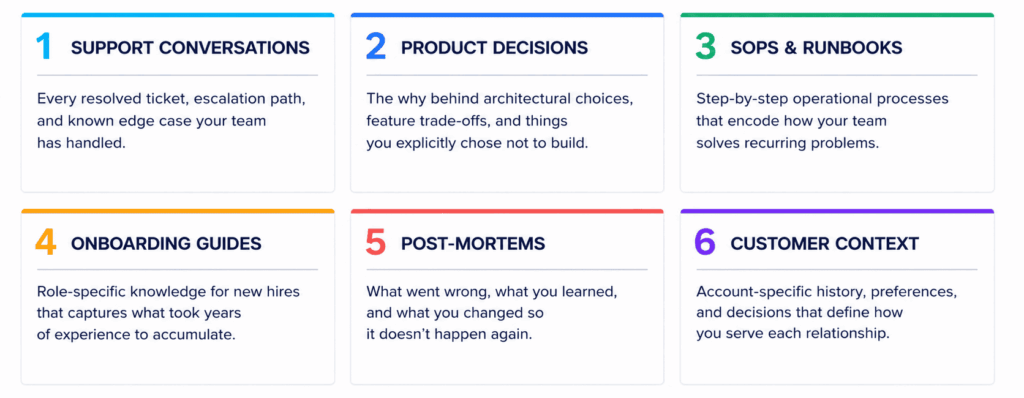
In practical terms, it includes – your product documentation and help content; past support conversations and their resolutions; onboarding guides, sales playbooks, and process SOPs; architectural decision records and post-mortems; historical RFP responses, proposal templates, and customer-specific context; and the accumulated expertise of your team that has never been formally written down anywhere.
That last category is the one that costs the most when people leave and the one that AI can help capture before it walks out the door.
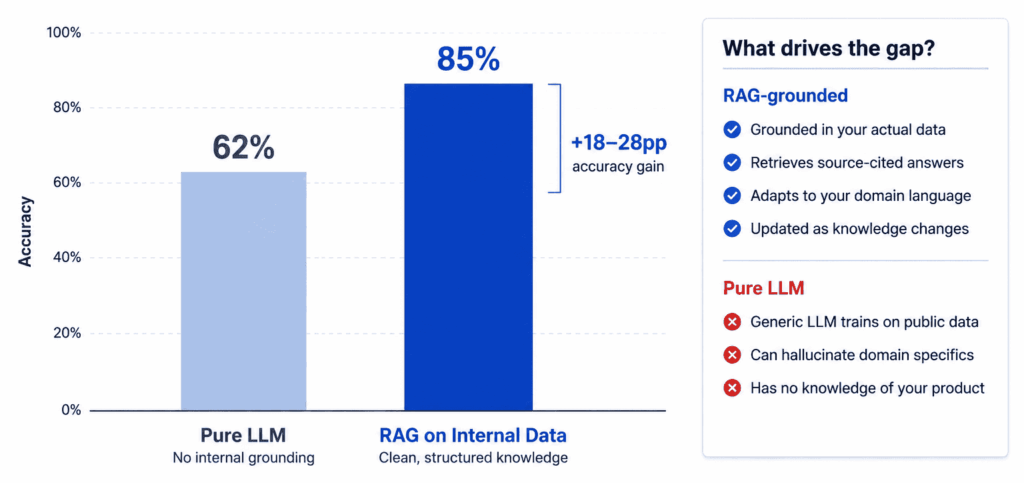
A peer-reviewed systematic review of 63 enterprise RAG deployments, published in Applied Sciences in December 2025, found that retrieval-augmented systems improved accuracy on domain-specific question-answering by 18–28 percentage points compared to pure LLM approaches, but only when the underlying knowledge was structured, clean, and well-maintained. The architecture matters less than the data it retrieves from.
Why this asset is undervalued
Three things make internal knowledge easy to ignore when evaluating AI.
First, it doesn’t have a price tag. When you’re comparing AI vendors or models, there are numbers attached to everything – token costs, seats, API limits. Internal knowledge doesn’t show up on a pricing page, which makes it psychologically invisible in a comparison exercise.
Second, its current form feels like a liability, not an asset. A Confluence wiki that nobody has updated in eight months, support tickets that live in three different systems depending on when the customer signed up, an onboarding doc that contradicts the current product – when you look at internal knowledge as it actually exists in most SaaS companies, “asset” is not the first word that comes to mind. That perception is accurate but reversible. The same material that looks like a mess on day one is, after curation, the exact corpus that makes an AI agent genuinely useful rather than generically adequate.
Third, getting it ready takes real effort before anything looks impressive. There’s no demo you can show a board while your team is still consolidating five years of support tickets. That delay makes it easy to defer. Most teams end up prioritising the parts of AI that produce visible outputs quickly and treating data quality as something to fix later, which is roughly the same approach as buying a restaurant and planning to figure out the kitchen setup next quarter.
The practical question founders miss
The right question to ask before any AI investment is not, “Which model should we use?” It’s, “What does the model need to know in order to be useful to our customers or our team, and do we have that written down in a place it can actually reach?”
For a SaaS product with a support function, that means asking: Are our most common support resolutions documented in a way that’s findable by a retrieval system, not just by a human who already knows roughly where to look? For an internal tool, it means asking: If a new engineer joins and asks the AI a question about how we handle a specific edge case in billing, does the answer actually exist in a structured, retrievable form?
In most companies, the honest answer is: sometimes, in some places, for some topics. That’s not a failure. It’s a starting point. But it requires treating knowledge curation as an engineering task, not a documentation chore someone does when they have time.
Many organisations are beginning to use AI to proactively surface relevant knowledge to employees instead of waiting for them to search. That represents a shift in how knowledge flows across an organisation. The companies moving in that direction are not starting with better AI tools. They are starting with better organised knowledge and then using AI to make that knowledge easier to access and apply.
What this means for building AI features
If you’re a SaaS founder thinking about which AI feature to build first, the internal knowledge question changes the sequencing.
The features that will feel the most differentiated to your customers are the ones that know something about their specific context with you – their history, their configuration, their edge cases, their previous conversations with your support team. A generic AI layer that can answer general questions is already available everywhere. An AI layer that can answer questions specific to this customer’s account, based on everything you’ve learned about them, is not.
Building toward that requires treating your customer data, your support history, and your product documentation as the actual product, not as the content that feeds the product. The model is the engine. What you know is the fuel. Most teams are buying better engines when they haven’t yet figured out the fuel supply.
The data quality trap
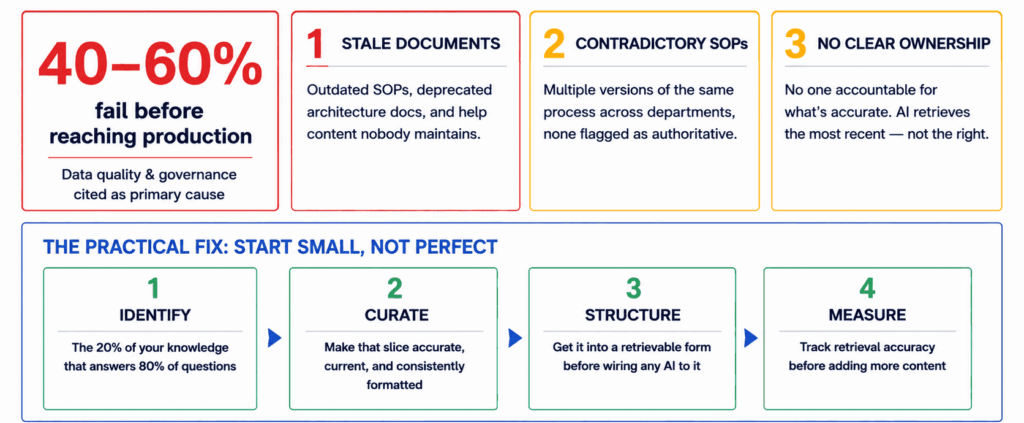
One thing worth naming – the single biggest reason RAG implementations fail to reach production is not retrieval architecture or model selection. Analysis of enterprise RAG deployments puts the failure rate before reaching production at 40–60%, with data quality and governance gaps cited as the primary cause. Outdated documents, contradictory SOPs, knowledge split across incompatible formats, and no clear ownership of what’s accurate – these are the problems that kill knowledge AI projects, not the technology stack.
For a Seed-to-Series B team, the implication is practical rather than discouraging. You don’t need to boil the ocean before you start. You need to identify the highest-value slice of your internal knowledge, the 20% that would answer 80% of the questions your customers or your team actually ask, and get that slice into a clean, structured, retrievable state. That’s a much smaller problem than “fix all our documentation,” and it’s the one that produces real output.
Ready to turn your internal knowledge into an AI advantage?
The AI tools available today are genuinely capable. But capable tools pointed at disorganised knowledge produce capable-looking outputs that are wrong in ways that are hard to catch. The teams that build AI features customers truly trust are the ones that treat their internal knowledge as an engineering asset, not an administrative backlog. That shift does not require a larger model. It starts with understanding what knowledge your business already has, where it lives, and whether it is structured well enough to power reliable AI experiences.
If you are exploring AI for your business and want to make sure you are building on the right foundation, book a call with our team. We will help you assess your current knowledge, identify opportunities, and define a practical path forward.
Your queries, our answers
No. The same logic applies to internal tools: AI assistants for engineering teams, knowledge bases for support agents, or onboarding systems for new hires. In each case, the quality of the output depends on the quality of the internal knowledge the system can retrieve.
Start with the content that answers the most frequently asked questions, whether from customers, from new team members, or from the support team. High-frequency, high-clarity content delivers the fastest return when made retrievable.
Less than most teams assume. A focused, well-structured knowledge base covering the core use cases of a product can outperform a large but messy corpus. Quality beats volume at every stage of retrieval.
Not in most cases. Retrieval-augmented approaches let you ground a foundation model in your internal knowledge without training a custom model from scratch. The investment goes into structuring the data, not into model development.
Audit what you already have. Map the questions your customers and team ask most often, find where the answers currently live, and assess whether those answers are accurate, current, and in a form a retrieval system could use. That audit tells you exactly where to start.
What happens after you fill-up the form?
Request a consultation
By completely filling out the form, you'll be able to book a meeting at a time that suits you. After booking the meeting, you'll receive two emails - a booking confirmation email and an email from the member of our team you'll be meeting that will help you prepare for the call.
Speak with our experts
During the consultation, we will listen to your questions and challenges, and provide personalised guidance and actionable recommendations to address your specific needs.
Author
SathishPrabhu
Sathish is an accomplished Project Manager at Mallow, leveraging his exceptional business analysis skills to drive success. With over 8 years of experience in the field, he brings a wealth of expertise to his role, consistently delivering outstanding results. Known for his meticulous attention to detail and strategic thinking, Sathish has successfully spearheaded numerous projects, ensuring timely completion and exceeding client expectations. Outside of work, he cherishes his time with family, often seen embarking on exciting travels together.