Most SaaS teams celebrate when their model hits target accuracy. They tune hyperparameters, run evaluation passes, review the confusion matrix, and ship. That moment feels like the finish line.
It is not. It is the beginning of a completely different set of engineering problems, and most early-stage teams are not set up to handle them.
This article is for the technical founder or CTO who has an AI feature in production and is starting to wonder – how do we actually know this thing is still working?
Why does model training feel easy compared to production?
Training is a controlled problem. You define the dataset, set the objective, iterate until the metrics look right, and stop. The environment does not change while you are working.
Production is the opposite. The real world feeds your model inputs it has never seen. User behaviour shifts. Data pipelines break silently. Business logic changes. And the model keeps running, returning predictions nobody is questioning, until something bad enough happens that someone notices.
Google’s official engineering guide, Rules of Machine Learning, makes this point directly – the real cost of an ML system is not training. It is the hidden technical debt that accumulates in the infrastructure surrounding the model. Monitoring, retraining, serving, and integration are where teams spend the majority of their long-term effort. Product teams building operational AI systems can also check our article on how production AI increasingly behaves like infrastructure rather than isolated model deployment.

What does MLOps actually cover in a production environment?
MLOps is the discipline of running machine learning reliably in production. It borrows from DevOps but adds complexity specific to statistical systems – the code does not just need to run correctly, the model needs to make good predictions over time, against data that was not there when it was trained.
For a SaaS product, that breaks down into four concrete problem areas.
Model monitoring and drift detection
A model that performed well at training time will degrade. This is not a pessimistic assumption. It is a known property of any system that learns from historical data when the world keeps moving.
Drift comes in three forms. Data drift happens when the statistical distribution of incoming inputs shifts away from your training data. A fraud detection model trained on 2023 transaction patterns will struggle with 2025 spending behaviours without retraining. Concept drift happens when the relationship between inputs and the correct output changes. Prediction drift, often the most overlooked, is when the model’s output distribution shifts even though each individual prediction looks plausible.

Evidently AI provides open-source infrastructure for tracking all three drift types with pre-built reports and monitoring dashboards. AWS SageMaker Model Monitor covers the same ground for teams running on AWS infrastructure with managed alerting built in. The tooling exists. The gap is almost always that nobody owns it.
Retraining pipelines
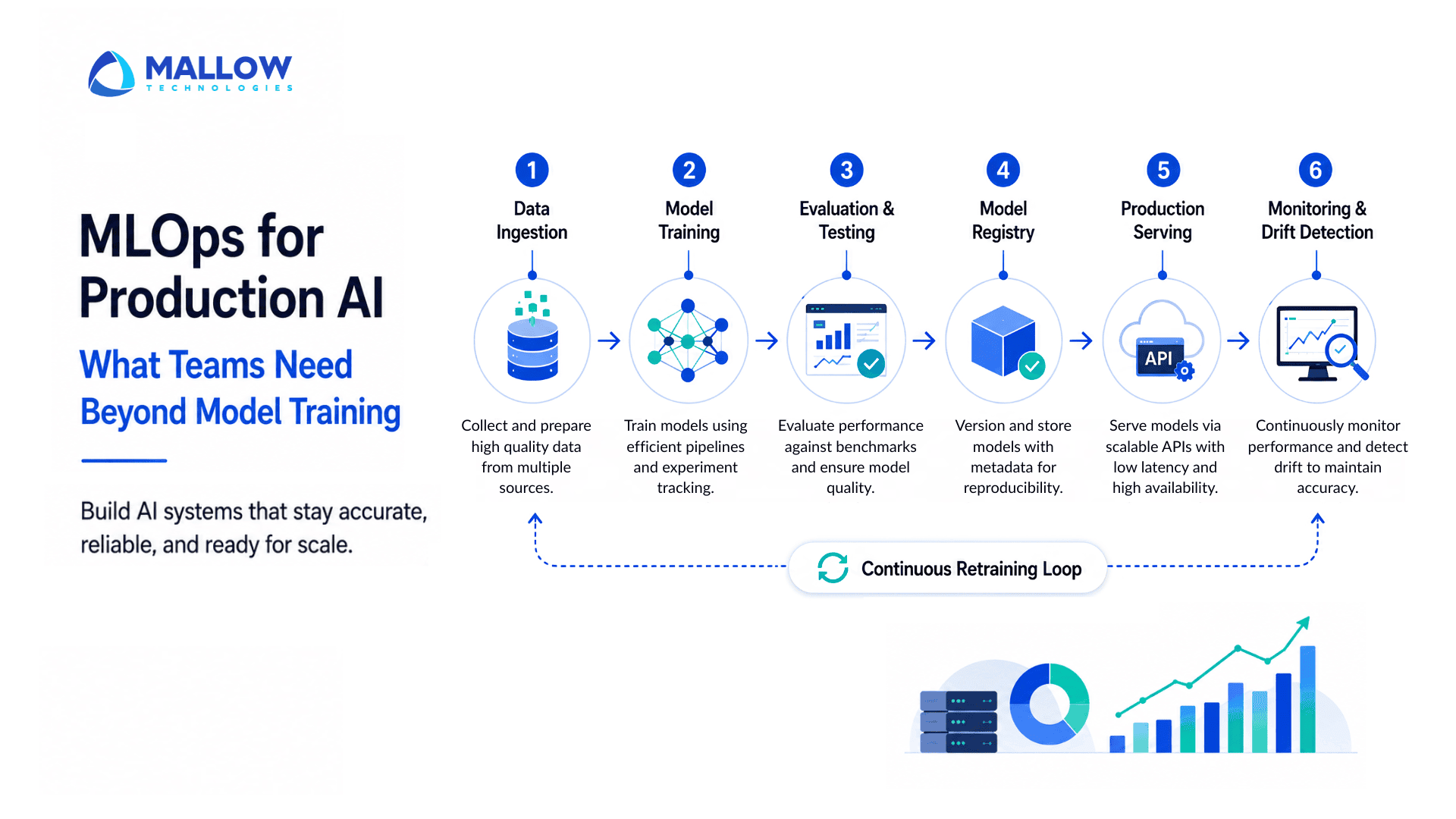
Detecting drift without acting on it is just a more detailed way of watching a slow failure. Organizations measuring enterprise AI success can also explore our guide on evaluating operational outcomes and long-term ROI from AI investments. A production retraining pipeline needs to pull fresh labelled data reliably, retrain without touching the live model, evaluate against held-out data before promotion, deploy with a rollback mechanism, and log everything for auditability.
For Rails or Laravel backends, this typically means connecting your application’s job queue (Sidekiq for Rails, Laravel Horizon for Laravel) with a Python-based training environment, coordinating through object storage like S3 or Google Cloud Storage, and using a model registry to track what is in production.
MLflow is the most widely adopted open-source model registry. It handles experiment tracking, model versioning, and promotion workflows from a single interface. For teams already on AWS, SageMaker Model Registry integrates tightly with the rest of the AWS deployment ecosystem.

Inference cost management
Running a model in production costs money at a rate that surprises most founders who built the first version on a laptop. The variables that compound fast – calling a large model synchronously on every user request when batch processing would work, hosting an oversized model when a fine-tuned smaller version performs equally well on your specific task, no caching layer for repeated or near-identical queries, and auto-scaling configured for throughput without accounting for GPU cold-start latency.
The right inference architecture depends on your product’s latency tolerance and request volume. The decision needs to be made deliberately, not discovered when the AWS bill arrives.
Prediction logging and auditability
Enterprise customers, regulated industries, and increasingly end users want to know why an AI system made a specific decision. For SaaS products in fintech, healthtech, or HR, this is a sales requirement as much as a compliance one.
Production MLOps requires logging at the prediction level – what input arrived, what the model returned, which model version was active, and what business logic converted that prediction into a product action. Without this, debugging a customer complaint or responding to an auditor becomes guesswork.
What usually breaks first when AI hits production?
In practice, the first failure is almost never dramatic. It is quiet.
A recommendation model starts surfacing results that used to be relevant but no longer quite fit. A classification model’s confidence scores shift slightly lower across the board. A churn prediction tool starts missing customers who are about to leave, because the usage patterns that predicted churn six months ago are no longer reliable signals today.
Nobody notices because nobody is watching. Businesses operationalizing AI systems can also read our article on the difference between experimental AI deployments and operational AI environments built around continuous observability and workflow reliability. The model is still running. The API is still returning 200s. The dashboard shows no errors. And the product is slowly getting worse in a way that is hard to attribute until someone digs into the numbers.
The teams that catch this early have invested in ML observability before they needed it. The teams that catch it late do so through a customer complaint, a drop in a product KPI, or an audit.
If your AI infrastructure is something you think about only when something goes wrong, it is already behind.
How should a SaaS team structure its MLOps ownership?
This is where most Seed-to-Series B teams have a structural gap. The data scientist who trained the model is not usually the right person to own production infrastructure. The backend engineering team knows how to run reliable services but may not know how to instrument a statistical system. DevOps owns the deployment pipeline but was not involved in the model decisions.
MLOps sits between all three, and without an explicit owner it falls between all three.
The practical answer at early stage is to assign clear ownership of each of the four areas – monitoring, retraining, inference, and logging. It does not require a dedicated MLOps engineer on day one. It does require that someone on the team is accountable for each area and that the accountability is written down, not implied.
What tools do production AI teams actually use?
The MLOps tooling landscape is large. The CNCF landscape maps the full ecosystem across monitoring, serving, orchestration, and experiment tracking categories. For a Seed-to-Series B SaaS team, the practical shortlist is –
- Monitoring and drift – Evidently AI (open source), Arize, or WhyLabs
- Model registry and versioning – MLflow (open source), Weights and Biases, or SageMaker Model Registry
- Orchestration – Prefect, Airflow, or Metaflow for pipeline scheduling
- Serving – BentoML or Ray Serve depending on scale and latency requirements
- Experiment tracking – MLflow or Weights and Biases
The right stack depends on your existing infrastructure, team familiarity, and scale. Choosing tools before defining the problems they need to solve is one of the more expensive mistakes early teams make.
What does good MLOps integration look like inside a Rails or Laravel backend?
Most SaaS products using AI are not building a model-first product. They have a Rails or Laravel application that handles the product logic, and they have added an AI component at one or more points in the user flow.
That architecture has a clean integration path for MLOps. The application backend handles data collection, prediction logging, and business logic. The model serving layer handles inference. The training pipeline runs separately, coordinated through object storage and a model registry.
The key integration points are the job queue (for triggering retraining jobs), the database or data warehouse (for pulling training data), the model registry (for knowing which version is in production), and the logging layer (for capturing prediction-level data).
If you are adding AI to an existing product and are not sure how to structure the MLOps layer, it is worth having a conversation before the model is in production and the gaps are harder to close.
Is your AI infrastructure production-ready?
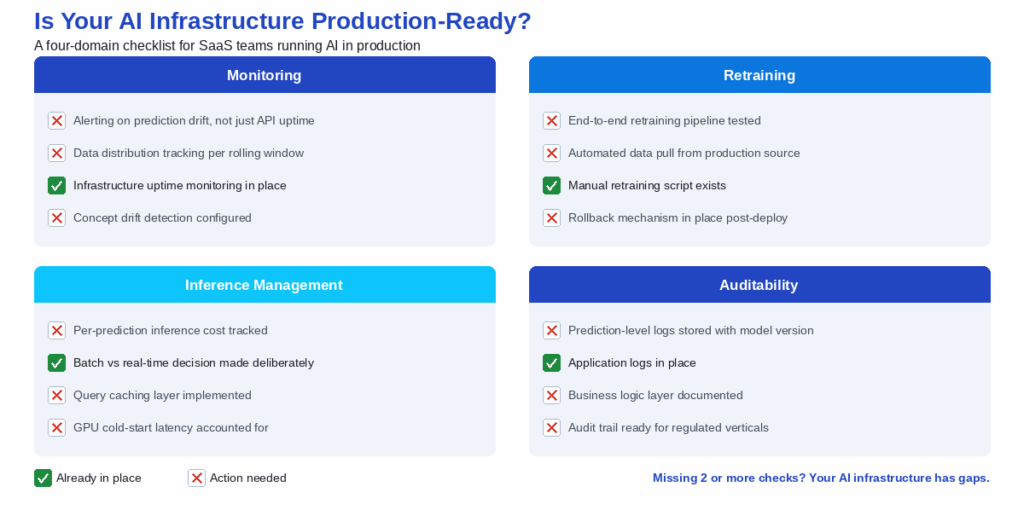
Run through this before your next deployment –
- Do you have alerting on model prediction drift, not just API uptime?
- Do you have a tested retraining pipeline, not just a training script?
- Do you know your per-prediction inference cost and is it within budget?
- Do you have prediction-level logs with model version attached?
- Do you have a rollback mechanism for newly deployed models?
- Does someone on your team explicitly own each of the four MLOps areas?
- Can you answer a customer asking why the system made a specific decision?
If two or more answers are “no” or “not sure,” your AI infrastructure has gaps that will surface at the worst possible time. If you are evaluating how to make your production AI stack more reliable, scalable, and production-ready, connect with us to discuss your current MLOps architecture, deployment workflows, and operational challenges.
Your queries, our answers
DevOps handles the deployment and operation of software. MLOps extends that to cover the additional complexity of statistical systems: models degrade over time, require retraining as data shifts, and need prediction-level observability that standard application monitoring does not provide. The tooling and processes overlap significantly, but the ML-specific concerns around drift, retraining, and model versioning require additional infrastructure.
Before the model goes to production. The most expensive time to add MLOps infrastructure is after a model has been live for six months and nobody has been monitoring it. The minimum viable MLOps setup, including prediction logging, a basic drift check, and a manual retraining process, can be in place before launch and expanded as the product scales.
Not at Seed or Series A stage. What it requires is clear ownership of the four core areas: monitoring, retraining, inference management, and logging. At early stage this can be distributed across an existing data scientist and backend engineer, with explicit accountability for each area. A dedicated role becomes worth considering when managing multiple models in production starts pulling significant engineering time.
Quietly and gradually. A recommendation feature starts surfacing less relevant results. A classification feature's accuracy drops across a customer segment. A prediction feature starts missing signals it used to catch. In most cases there is no error, no alert, and no obvious incident. The product just gets slightly worse over time until a metric drop or a customer complaint triggers an investigation.
A model registry is the system of record for which model version is in production. It tracks experiments, stores trained model artefacts, handles version promotion from staging to production, and provides the rollback path if a newly deployed model underperforms. Tools like MLflow and Weights and Biases offer this as open source. AWS SageMaker Model Registry provides it as a managed service. Without a registry, model versioning tends to be handled through naming conventions and tribal knowledge, which breaks under team growth.
What happens after you fill-up the form?
Request a consultation
By completely filling out the form, you'll be able to book a meeting at a time that suits you. After booking the meeting, you'll receive two emails - a booking confirmation email and an email from the member of our team you'll be meeting that will help you prepare for the call.
Speak with our experts
During the consultation, we will listen to your questions and challenges, and provide personalised guidance and actionable recommendations to address your specific needs.

Author
Jayaprakash
Jayaprakash is an accomplished technical manager at Mallow, with a passion for software development and a penchant for delivering exceptional results. With several years of experience in the industry, Jayaprakash has honed his skills in leading cross-functional teams, driving technical innovation, and delivering high-quality solutions to clients. As a technical manager, Jayaprakash is known for his exceptional leadership qualities and his ability to inspire and motivate his team members. He excels at fostering a collaborative and innovative work environment, empowering individuals to reach their full potential and achieve collective goals. During his leisure time, he finds joy in cherishing moments with his kids and indulging in Netflix entertainment.