Most conversations about AI agents in SaaS circle around the same question – what can it automate? That is a reasonable starting point, but it is the wrong frame for the more significant shift that agents introduce.
The deeper change is not about speed or task reduction. It is about the definition of a completed outcome. SaaS products were built on a specific assumption – a human is in the loop. A human makes a decision, clicks a button, fills a form, reviews a result, or takes an action. The product’s job was to organize the information and interface that made those human actions possible. “Done” meant a human had done something.
AI agents challenge that assumption structurally. Not in every workflow, and not overnight. But the products being built now that take agents seriously are being designed around a different definition of what it means for a unit of work to be finished.
Understanding that shift is not optional for founders building in 2026. It determines how you design your workflows, where you put your interfaces, and what you ask your users to do.
What "done" meant before
In a conventional SaaS product, a workflow is a sequence of human-facing steps. The product presents information, a human interprets it, makes a decision, and records an action. The system captures what the human did and moves the work to the next state.
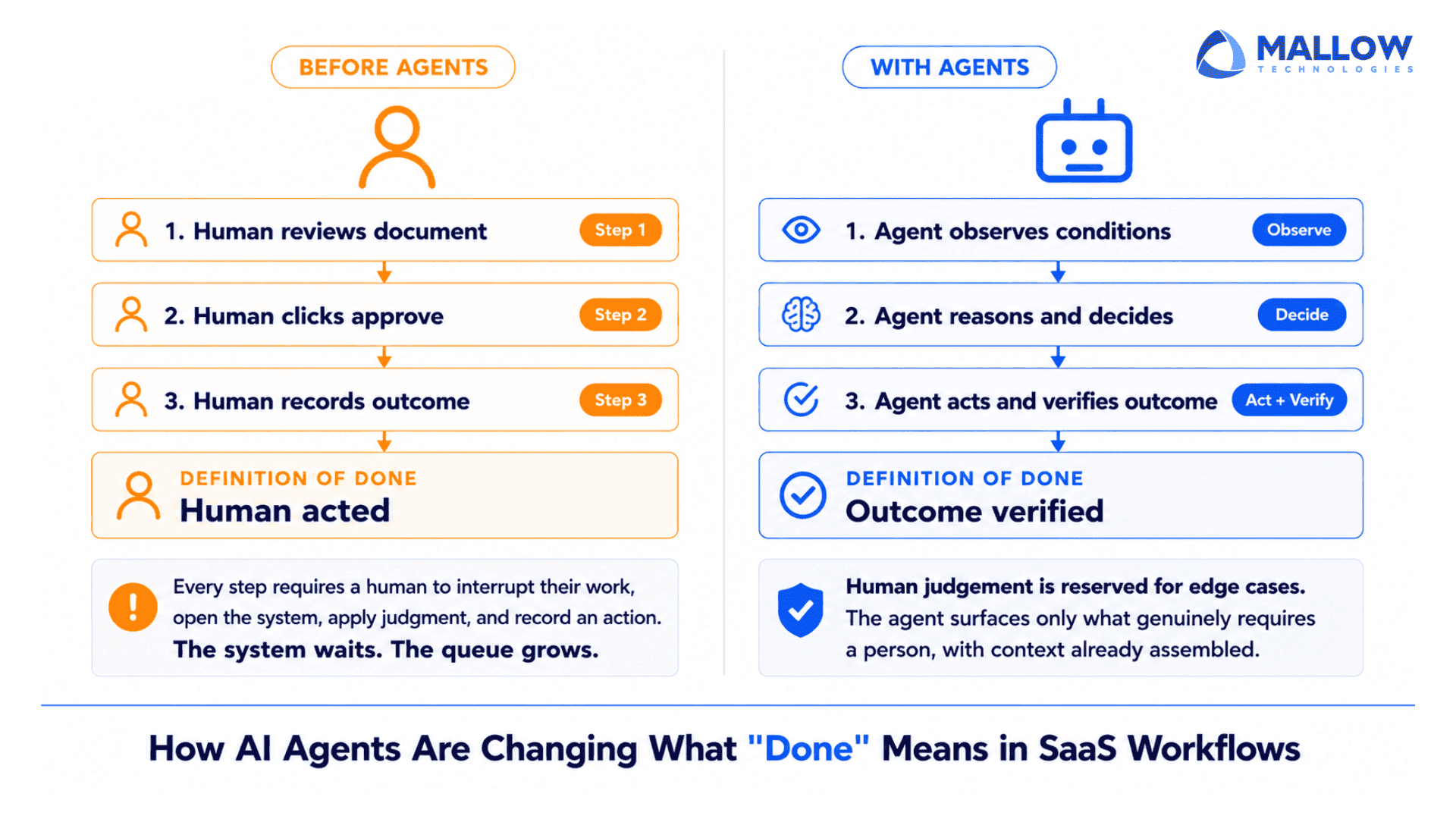
Consider a standard approval workflow in a project management or finance product. A document is created. It moves to a reviewer. The reviewer opens it, reads it, adds a comment, clicks approve or reject, and the system sends a notification. “Done” is defined as – the human has taken the required action, the system has recorded it, and the next step has been triggered.
The human is not optional. They are the mechanism by which work moves from one state to the next. The product’s job is to present the right information at the right moment so the human can do their job effectively. Everything is designed around that moment of human decision.
This model has been the foundation of enterprise SaaS for two decades. It is so ingrained that most product teams do not think of it as a design choice. It is just how products work.
What changes when an agent enters the workflow
An AI agent is not a smarter notification system or a better search function. It is a component that can observe, reason, decide, and act across a sequence of steps without requiring a human to move between them.
When an agent enters a workflow, the definition of done does not have to anchor to a human action anymore. It can anchor to a verified outcome.
Consider the same approval workflow. Without agents, the reviewer must be interrupted, must open the document, must apply their judgment, must record a decision. With an agent designed for that workflow, the agent can read the document, apply the relevant criteria, check it against policy, identify edge cases, and in straightforward cases, complete the review and record the decision with no human interruption. In complex cases, it can surface only what actually requires human judgment, with the context already assembled.
The critical word is verified. An agent that takes an action and moves on is not an improvement over a broken human workflow, it is a liability. The defining characteristic of a well-designed agentic workflow is that the agent confirms the outcome matches the intent before marking work as complete. That confirmation loop is what makes the agent-defined “done” trustworthy rather than simply fast.
This does not eliminate human involvement. It relocates it. Instead of humans completing every step, they are involved where their judgment is genuinely irreducible, in edge cases, in high-stakes decisions, in places where the cost of a wrong answer is too high to delegate. Everywhere the work is routine, bounded, and verifiable, the agent can own it.
Three workflow patterns that look different with agents

Pattern 1 - Monitored completion
In a conventional SaaS product, a task is assigned to a human and sits in their queue until they act on it. The product has no opinion about whether the task should still exist, it just holds the state.
With agents, monitored completion becomes possible. An agent can watch the conditions that made a task necessary. If those conditions resolve before the human acts, because a related ticket was closed, because a dependency was fulfilled, because an external system updated, the agent can close the task, log the reason, and remove it from the queue without human intervention. The human is spared an action that no longer needs to happen.
“Done” is no longer defined by human action. It is defined by the condition being resolved, regardless of how.
Pattern 2 - Outcome verified execution
A conventional workflow executes a step and assumes the outcome is correct. An agent-driven workflow executes a step, then verifies the outcome before marking it complete.
In a billing workflow, a conventional system sends an invoice and records the event. An agent can send the invoice, monitor delivery status, check payment gateway response, confirm the amount recorded matches what was sent, and only mark the billing cycle as complete when all of those conditions confirm. If any check fails, the agent flags it for human review with the relevant context already assembled.
The unit of completion is not the action. It is the confirmed outcome.
Pattern 3 - Conditional escalation
In a conventional product, escalation is either manual (a human decides to escalate) or rule-based (if X then route to Y). Both require the escalation logic to be defined in advance and maintained as conditions change.
An agent can apply contextual judgment to escalation in real time. It can monitor a customer’s behaviour across multiple touchpoints, detect a pattern that signals churn risk, cross-reference it against the customer’s tier and contract value, and decide whether to escalate to a customer success team, not because a rule was triggered but because the agent assessed the situation and concluded escalation was warranted.
“Done” in this context is not a rule firing. It is a judgment being made and acted on, with a traceable record of the reasoning.
The new design question - Where does human judgment actually belong?

The question that changes when you start building with agents is not “what can we automate?” It is – where in this workflow does human judgment actually add irreducible value?
For most SaaS products, the honest answer to that question reveals that a significant portion of what humans currently do is not judgment, it is routing. Humans move work from one state to another, confirm that conditions are met, and record what happened. None of that requires human intelligence. It requires the information to be in the right place at the right time so a human can do the mechanical part of the job.
Agents can own the routing. What they cannot own is the decision that carries genuine business risk, legal consequence, or relational nuance. A contract approval on a standard template in a known scenario; agent. A contract approval where the terms are materially unusual or the relationship is sensitive to human, but with the agent having already prepared everything the human needs to decide quickly.
The product design implication is significant. If you are building workflows where agents handle the mechanical steps and humans handle the genuine decision points, your interface design changes. You are no longer building a series of forms for humans to fill. You are building a surface for human review of agent-prepared outputs, with clear escalation paths for the cases that fall outside the agent’s confidence threshold.
What this means for your product architecture

Moving from a human-step workflow to an agent-driven workflow is not a matter of adding an AI layer on top of your existing product. It requires rethinking the workflow model at the level of state transitions, data access, and completion criteria.
Three things have to change architecturally.
First, completion criteria need to become explicit. In a human workflow, completion is implicit. A human acted, therefore the step is done. In an agent workflow, completion must be defined as a testable condition. The agent needs to know what verified success looks like, not just what action was taken. This means your data model needs to capture outcome state, not just action state.
Second, escalation paths must be designed for transparency. When an agent encounters something outside its confidence boundary, the handoff to a human must carry all of the context the agent accumulated, including what it observed, what it tried, and why it stopped. A human receiving an escalated item cold, with no context, defeats the purpose of having an agent in the workflow. The escalation surface is as important as the agent itself.
Third, audit and explainability are not optional. In any workflow that touches business critical data, the agent’s decision trail must be accessible and interpretable. Not just for compliance, though that matters, but because the humans who own the workflow need to be able to trust what the agent did and verify that it did it correctly. An agent that acts in a black box will be disabled by the first person who cannot explain what it did.
The risks of getting this wrong
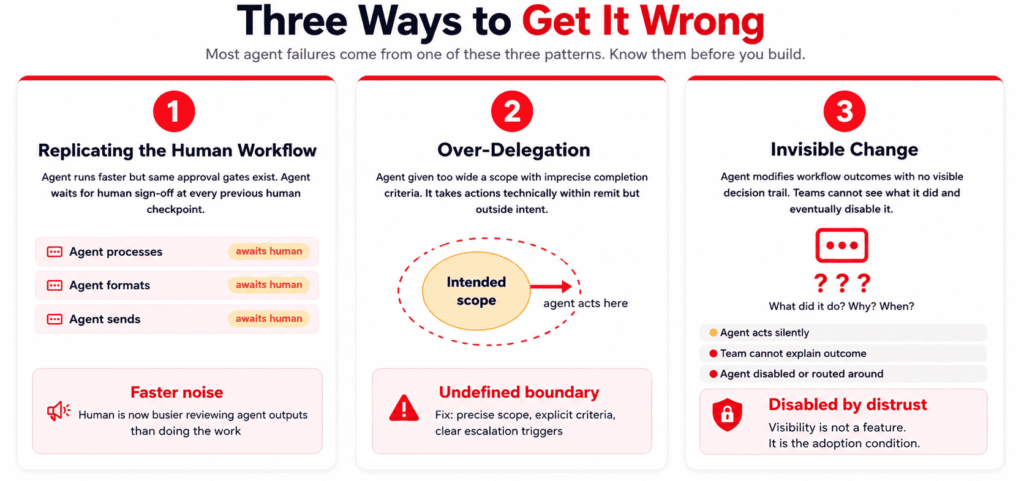
The most common failure pattern when organisations introduce agents into SaaS workflows is replicating the human workflow at agent speed. The automation runs faster, but the same assumptions are in place. The agent is still waiting for human approval at every step that previously had human approval, still surfacing every item that previously appeared in a human queue, still sending every notification that a human previously sent.
The result is faster noise, not genuinely different outcomes. The human is now busier reviewing agent-generated outputs than they were doing the work manually, because the agent has removed the friction that was also the signal.
The second failure pattern is over-delegation. An agent that is given authority over too wide a scope, with insufficiently precise completion criteria, will take actions that are technically within its remit but outside the intent. The answer to this is not less delegation, it is better-defined boundaries. Precise scope, explicit completion conditions, and clear escalation triggers are not constraints on the agent. They are the mechanism by which the agent earns the authority it needs.
The third failure pattern is invisible change. An agent that silently modifies workflow outcomes without surfacing a traceable record creates a trust problem that compounds over time. Teams who cannot see what the agent did will eventually disable it or route around it. Visibility into agent behaviour is not a nice-to-have feature. It is the condition under which agents are adopted at all.
As organisations rethink what “done” means in an agent driven world, success depends on more than adding AI to existing processes. It requires carefully designed workflows, clear decision boundaries, and transparent execution models. If you are evaluating how AI agents can fit into your SaaS product or operational workflows, feel free to contact us to discuss the right approach for your business.
Your queries, our answers
Traditional automation executes a defined sequence of steps when triggered by a rule. It does not observe, evaluate context, or make decisions. It follows a script. An AI agent can evaluate the state of a situation, reason about what action is appropriate given the current context, take that action, and verify the outcome. The distinction is the presence of judgment within the execution loop, not just execution.
A well-designed agent has explicit boundaries, including a defined scope of situations it is authorised to handle autonomously and a clear escalation path for anything outside that scope. The agent does not attempt to resolve what it cannot confidently handle. It surfaces the situation to a human with the context it has gathered and stops. The quality of that escalation surface is a major factor in how much the agent is trusted over time.
No, they change the composition of what humans review. Instead of humans completing every step of every workflow, they review agent-prepared outputs for items that fall outside the agent's confidence boundary. The volume of human review decreases significantly for routine work. The quality of human attention on genuinely complex items increases, because the context is already assembled.
Workflows with high volume and repeatable structure, where completion can be verified against testable conditions, and where the cost of an occasional error is manageable with a human escalation path. Document review, billing reconciliation, customer health scoring, support ticket routing, and internal approval chains on standard templates are strong candidates. Workflows involving legal consequence, novel business situations, or deeply relational decisions are better suited to agent-assisted rather than agent-driven approaches.
The right metrics are not speed or volume processed. They are - what percentage of escalations result in a human agreeing with the agent's pre-work, how often the agent correctly identifies when to stop and escalate, and whether the completion rate of items touched by the agent is higher or lower than before. If agents are creating more human work rather than less, the scope or completion criteria are wrong.
AI agents are most effective when they operate within well-defined workflows. If completion criteria are unclear, escalation paths are inconsistent, or data quality is poor, agents will simply execute those issues faster and at greater scale. Successful adoption starts with improving the workflow itself before introducing agent-driven automation.
The real shift is not efficiency but how completion is defined. Work no longer ends when a human performs an action; it ends when the desired outcome is verified. If you are exploring how agentic workflows can fit into your product strategy, talk to our AI experts to discuss the right approach for your business.
What happens after you fill-up the form?
Request a consultation
By completely filling out the form, you'll be able to book a meeting at a time that suits you. After booking the meeting, you'll receive two emails - a booking confirmation email and an email from the member of our team you'll be meeting that will help you prepare for the call.
Speak with our experts
During the consultation, we will listen to your questions and challenges, and provide personalised guidance and actionable recommendations to address your specific needs.

Author
SathishPrabhu
Sathish is an accomplished Project Manager at Mallow, leveraging his exceptional business analysis skills to drive success. With over 8 years of experience in the field, he brings a wealth of expertise to his role, consistently delivering outstanding results. Known for his meticulous attention to detail and strategic thinking, Sathish has successfully spearheaded numerous projects, ensuring timely completion and exceeding client expectations. Outside of work, he cherishes his time with family, often seen embarking on exciting travels together.