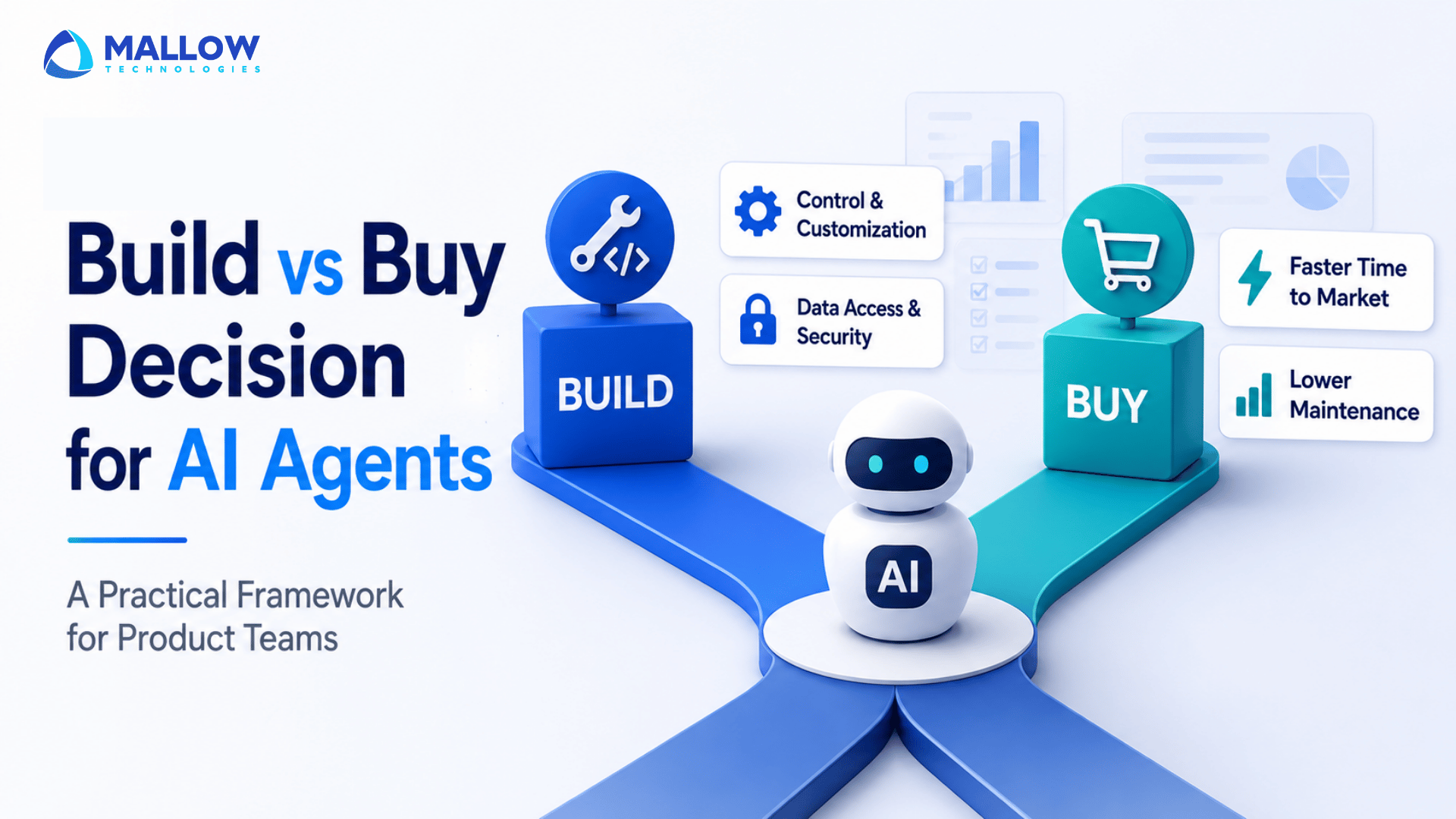
The standard advice for build vs buy decisions in SaaS is well-worn – buy commoditised infrastructure, build what differentiates you. Use Stripe for payments, Twilio for messaging, Auth0 for authentication. Build your core product workflow. Everyone broadly agrees on this, and it works for most decisions.
AI agents break it.
Not because the principle is wrong, but because agents do not sit cleanly in either category. They are not infrastructure. They are not just processing payments or sending messages. They operate inside your core product workflow, make decisions that affect your customers, and need to behave in ways that are specific to your product’s context. At the same time, they are not pure product differentiation either. The underlying reasoning models and execution frameworks are genuinely commoditising, fast.
The result is that most product teams applying the standard heuristic end up in one of two places – they buy a platform that cannot be adapted to their actual workflow requirements, or they build from scratch what they did not need to build. Both are expensive mistakes.
This article is a framework for making the decision correctly. Four variables. A scoring method. The traps to avoid.
Why the standard build vs buy heuristic breaks down
The classic heuristic works when the thing you are evaluating sits at a clear distance from your core product. Payments are infrastructure – every SaaS company needs to accept money, the differentiation is nil, buy Stripe. Your pricing model is product – it determines your unit economics and your positioning, build it.
Agents sit in the middle, and the middle is where the heuristic fails. An AI agent in your product is not like a payment processor that runs in the background. It is a participant in your user’s workflow. It touches your data, speaks in your product’s voice, makes decisions that carry your product’s authority, and interacts with your customers in ways that reflect directly on the experience you are building.
That means the decision is not simply “will this differentiate us?” It is a more granular question about where in the agent’s behaviour the differentiation actually lives, and whether a bought solution can be shaped to fit that zone or whether it cannot.
The second reason the heuristic breaks down is the pace of change. The underlying components of AI agent systems (reasoning models, orchestration frameworks, tool-calling protocols) are developing faster than most SaaS product cycles. What you build today may be rebuilt entirely in eighteen months. What you buy today may be superseded by a better platform before your contract expires. This dynamic introduces a maintenance variable that does not exist in the same way for payment processors or authentication systems.
The four decision variables that actually matter

The framework is built on four variables. For each one, you score your situation on a scale from 0 to 3. A higher score on a variable means a stronger case for building. A lower score means a stronger case for buying. At the end, you sum the scores and use the total to guide the decision.
The four variables are – workflow proximity to core product, data ownership and access requirements, differentiation surface, and maintenance and iteration velocity.
Variable 1 - Workflow proximity to core product
Score 0 – The agent operates entirely outside your core product workflow. It is a support function, a back-office operation, or an internal tool that does not affect the product experience your customers see.
Score 1 – The agent touches the edges of your core product workflow. It processes inputs or outputs but does not participate in the main sequence of actions your customers take.
Score 2 – The agent is embedded within your core product workflow. It makes decisions or takes actions that are visible to your customers and affect the experience they have.
Score 3 – The agent is the core product workflow. The agent is what the product does. Its behaviour, voice, decision logic, and failure modes are your product’s behaviour, voice, decision logic, and failure modes.
The higher the workflow proximity, the harder it becomes for a bought platform to fit. Bought platforms make assumptions about how agents should behave, what signals they should respond to, and what handoffs should look like. Those assumptions may be reasonable for generic cases. They will rarely be right for a workflow that is central to your product’s promise.
Variable 2 - Data ownership and access requirements
Score 0 – The agent operates on generic, publicly available information. No proprietary data. No sensitive customer information. No data that lives exclusively in your product.
Score 1 – The agent needs read access to some product data but the data is relatively generic and the access requirements are straightforward through standard APIs.
Score 2 – The agent needs access to proprietary customer data, behavioural history, or account-specific context that requires non-trivial integration work and carries data governance implications.
Score 3 – The agent needs real-time access to sensitive, proprietary data that is deeply tied to your product’s data model. Sharing this data with a third-party platform raises security, compliance, or contractual concerns that make an external vendor problematic or impossible.
Data access is often the decisive variable for products operating in regulated industries, handling high-sensitivity customer information, or where proprietary data is itself the product’s competitive asset. If your agents need to reason over data that you cannot or should not share with a vendor, the build case becomes very strong regardless of the other variables.
Variable 3 - Differentiation surface
Score 0 – How the agent behaves is not a source of differentiation for your product. Users will not notice or care whether the agent was built in-house or running on a visible platform. The agent is plumbing.
Score 1 – The agent’s behaviour contributes marginally to the product experience but is not a primary differentiator. Users would notice if it were poor but would not cite it as a reason they chose or stayed with the product.
Score 2 – The agent’s behaviour is a meaningful part of the product experience. Users interact with it directly and their perception of the product is shaped by how well the agent performs.
Score 3 – The agent’s behaviour is the primary differentiator. How it reasons, what it says, how it handles edge cases, and how it adapts to the user’s context is the reason users choose and stay with the product. Any visible limitations from a generic platform would directly undermine your value proposition.
The differentiation surface score is closely related to the workflow proximity score, but they are not the same. An agent can be embedded in the core workflow (high proximity) without being a differentiation driver if the market is undifferentiated on that dimension. Conversely, an agent that sits at the edges of your workflow can still be a significant differentiator if the competitive advantage of your product is specifically in that zone.
Variable 4 - Maintenance and iteration velocity
Score 0 – The agent’s behaviour is expected to be stable. Once it works, it should continue to work without material changes for a long time. Slow iteration is acceptable. Vendor dependency on release schedules is manageable.
Score 1 – The agent needs moderate iteration. New capabilities or improvements are expected quarterly. Some vendor dependency is acceptable if the vendor ships updates on a consistent cadence.
Score 2 – The agent needs fast iteration. Your ability to improve, retrain, or redeploy the agent is directly tied to product velocity. Waiting for a vendor’s roadmap or working within a vendor’s constraints would materially slow you down.
Score 3 – The agent’s improvement loop is continuous and central to your product’s competitive advantage. You need to be able to change agent behaviour in response to user signals, market feedback, or product learning at the speed your product team moves. Any external dependency on that loop is a competitive liability.
The maintenance variable is the one most teams underweight. It is easy to get an agent working on day one using a bought platform. The question is what your velocity looks like in month six and month eighteen when you have learned what users actually need and you are racing to close the gap.
The decision matrix

Sum your four variable scores.
0 to 4 – Buy clearly. Your agent requirements are relatively generic, data access is straightforward, the differentiation surface is low, and iteration velocity is not a competitive factor. Buy a platform, integrate it, and direct your engineering capacity elsewhere. Do not over-engineer this decision.
5 to 7 – Buy with customisation layer. A bought platform is the right foundation but you will need a meaningful customisation layer on top of it – custom prompting, fine-tuned behaviour, purpose-built integrations. Choose your platform with the customisation requirements in mind. The platform should expose enough control for your customisation needs. Avoid platforms that lock the critical control surfaces behind proprietary abstractions.
8 to 10 – Hybrid architecture. Some components should be bought – the underlying model, standard orchestration tooling, commodity infrastructure. Core workflow logic, data access patterns, and the agent’s decision-making layer should be built. This architecture gives you control where it matters while avoiding unnecessary reinvention. It requires clear technical scoping of what is bought and what is built, and explicit interfaces between those layers.

11 to 12 – Build clearly. The agent is your product, or close to it. Your data requirements make vendor dependency a genuine risk. Your differentiation lives in the agent’s behaviour. You need iteration velocity the vendor’s roadmap cannot provide. Build the agent, use open-source models and frameworks where the components are genuinely commoditised, and treat the agent architecture as a core engineering investment.
Common build vs buy traps for AI agents

- Trap 1 – Buying because it is faster to start. The time to build the first working version is not the relevant metric. The relevant metric is total cost of ownership over eighteen months, including integration debt, customisation constraints, and the cost of migrating if the platform does not meet your needs. Many teams buy for speed and spend more time working around platform limitations than they would have spent building directly.
- Trap 2 – Building because it feels like differentiation. Not everything an agent does is differentiation. The orchestration layer that sequences tool calls, the memory layer that persists session state, the retrieval layer that pulls documents. These are increasingly commoditised. Building them from scratch when open-source alternatives exist is engineering capacity spent on infrastructure, not product. Build what differentiates. Buy or use open source for the rest.
- Trap 3 – Evaluating on current requirements only. The right question is not “does this platform meet our current agent requirements?” It is “will this platform be able to meet our agent requirements in eighteen months, and what does our exit path look like if it cannot?” Platforms that look right today sometimes reveal their constraints only when you need to do the thing that matters most.
- Trap 4 – Ignoring data governance. Teams in a hurry to ship sometimes sign vendor contracts before fully understanding what data will flow to the vendor’s infrastructure. For products in regulated industries or with high-sensitivity customer data, this can create compliance problems that are expensive and slow to unwind. Understand the data flow before the contract is signed.
- Trap 5 – Treating the decision as permanent. Build vs buy for AI agents is not a one-time decision. As the platform market matures, as your product’s requirements become clearer, and as the competitive dynamics in your space evolve, the right answer may shift. Treat it as a decision to revisit at meaningful milestones. Build in seams that make migration or architecture change manageable.
Build vs buy decisions should evolve as your product evolves
Build vs buy for AI agents is not a one-time decision. As the platform market matures, as your product’s requirements become clearer, and as the competitive dynamics in your space evolve, the right answer may shift. Treat it as a decision to revisit at meaningful milestones. Build in seams that make migration or architecture change manageable.
If you’re evaluating whether to build, buy, or adopt a hybrid approach for AI agents in your product, an external perspective can help uncover trade-offs that are easy to miss. Schedule a call with our team to assess your requirements, identify the right architecture, and create a roadmap that balances speed, flexibility, and long-term ownership.
Your queries, our answers
Run a proof of concept that simulates the actual workflow you need the agent to handle, not a toy example. Specifically test the customisation boundaries that matter for your product. Can you change the decision logic in the ways you need? Can you connect to the data sources you require? Can you meet your data governance requirements? Evaluate the vendor's release cadence and the responsiveness of their support for non-standard use cases.
For a well-scoped agent handling a specific workflow, a team with relevant experience should be able to build, test, and deploy a production-ready agent in six to twelve weeks. The range depends on integration complexity, data pipeline readiness, and the quality of the conversation design work. Agents that try to handle too broad a scope take disproportionately longer and perform worse.
Early-stage products should default to buy unless they score high on the differentiation surface variable. The reason is simple: agent requirements become clear from user behaviour, not from product assumptions. Buying a platform at the early stage lets you learn what your agent actually needs to do before committing significant engineering capacity to an architecture. The risk of building the wrong thing is higher early than it is at Series A or B.
This is the migration problem and it is the most underweighted risk in the buy decision. The answer is to evaluate the migration cost before you sign the contract. What does your data look like when you export it? How tightly is your product logic coupled to the platform's proprietary abstractions? Is there a standard format for agent definitions that would allow you to move to a different runtime? The platforms with clean migration paths should be preferred over those with proprietary lock-in, all else being equal.
Yes. For teams scoring in the 8 to 12 range where build is indicated, open-source agent frameworks such as LangChain and LlamaIndex provide the orchestration and tooling layer without vendor dependency. The trade-off is that open-source requires more engineering effort to maintain, upgrade, and integrate than a managed platform. For teams with the engineering capacity, it is often the right foundation for agents that score high on differentiation surface and iteration velocity.
The build vs. buy decision for AI agents depends on your product, data requirements, competitive landscape, and long term goals. A structured evaluation helps you avoid overinvesting in custom development or becoming constrained by platform limitations.
By assessing workflow proximity, data ownership, differentiation, and iteration needs, you can choose the right path with confidence. If you're evaluating AI agent architecture for your product, talk to our experts to explore the approach that best balances speed, flexibility, and long term value.
What happens after you fill-up the form?
Request a consultation
By completely filling out the form, you'll be able to book a meeting at a time that suits you. After booking the meeting, you'll receive two emails - a booking confirmation email and an email from the member of our team you'll be meeting that will help you prepare for the call.
Speak with our experts
During the consultation, we will listen to your questions and challenges, and provide personalised guidance and actionable recommendations to address your specific needs.

Author
SathishPrabhu
Sathish is an accomplished Project Manager at Mallow, leveraging his exceptional business analysis skills to drive success. With over 8 years of experience in the field, he brings a wealth of expertise to his role, consistently delivering outstanding results. Known for his meticulous attention to detail and strategic thinking, Sathish has successfully spearheaded numerous projects, ensuring timely completion and exceeding client expectations. Outside of work, he cherishes his time with family, often seen embarking on exciting travels together.