You have sat through three AI demos this quarter. Two of them involved GPT. One involved a neural network diagram nobody in the room fully understood. And somewhere in all of it, your team is trying to answer a very practical question – which customers are most likely to churn next month?
That question does not need a large language model. It never did. It needs a well-trained gradient boosting model, your own customer data, and someone who knows how to put the two together correctly.
This is the gap this article addresses. Not because classical ML is underrated in academic circles, but because it is underused in boardrooms where the real AI decisions are being made right now.
Why this matters more than most AI content you are reading
Most AI content is written for engineers. It assumes you know what a transformer is, what fine-tuning means, and why attention mechanisms matter. If you are a founder or product leader, that content is not for you, and you know it.
The decisions you are being asked to make are different. Should we build this feature with ML? What kind? How long will it take? How much will it cost to run? Can we explain it to a regulator? These questions have answers, and classical ML is the correct answer to most of them more often than the current AI conversation suggests.
According to research from McKinsey’s State of AI report, the majority of enterprise AI use cases that deliver measurable business value are built on structured data with well-understood algorithms. The headline models get the attention. The workhorse models get the results.
What is classical machine learning, in plain language?
Classical machine learning refers to a family of algorithms that learn patterns from data without being explicitly programmed with rules. They are called “classical” to distinguish them from deep learning and large language models, which typically require significantly more data, computing power, and infrastructure to operate.
The key difference is not capability in the abstract. It is fit-for-purpose. Classical ML algorithms are designed for structured, tabular data. They train quickly, generate predictions in milliseconds, cost very little to run, and often provide clear reasoning behind their outputs. This makes them particularly valuable in business environments where transparency and accountability matter.
One of the biggest advantages of classical machine learning is explainability. Many models can show which factors influenced a prediction and how much each factor contributed to the outcome. This makes it easier for business teams to validate results, build trust in the system, and make informed decisions based on the model’s recommendations.
The algorithms your business probably already depends on
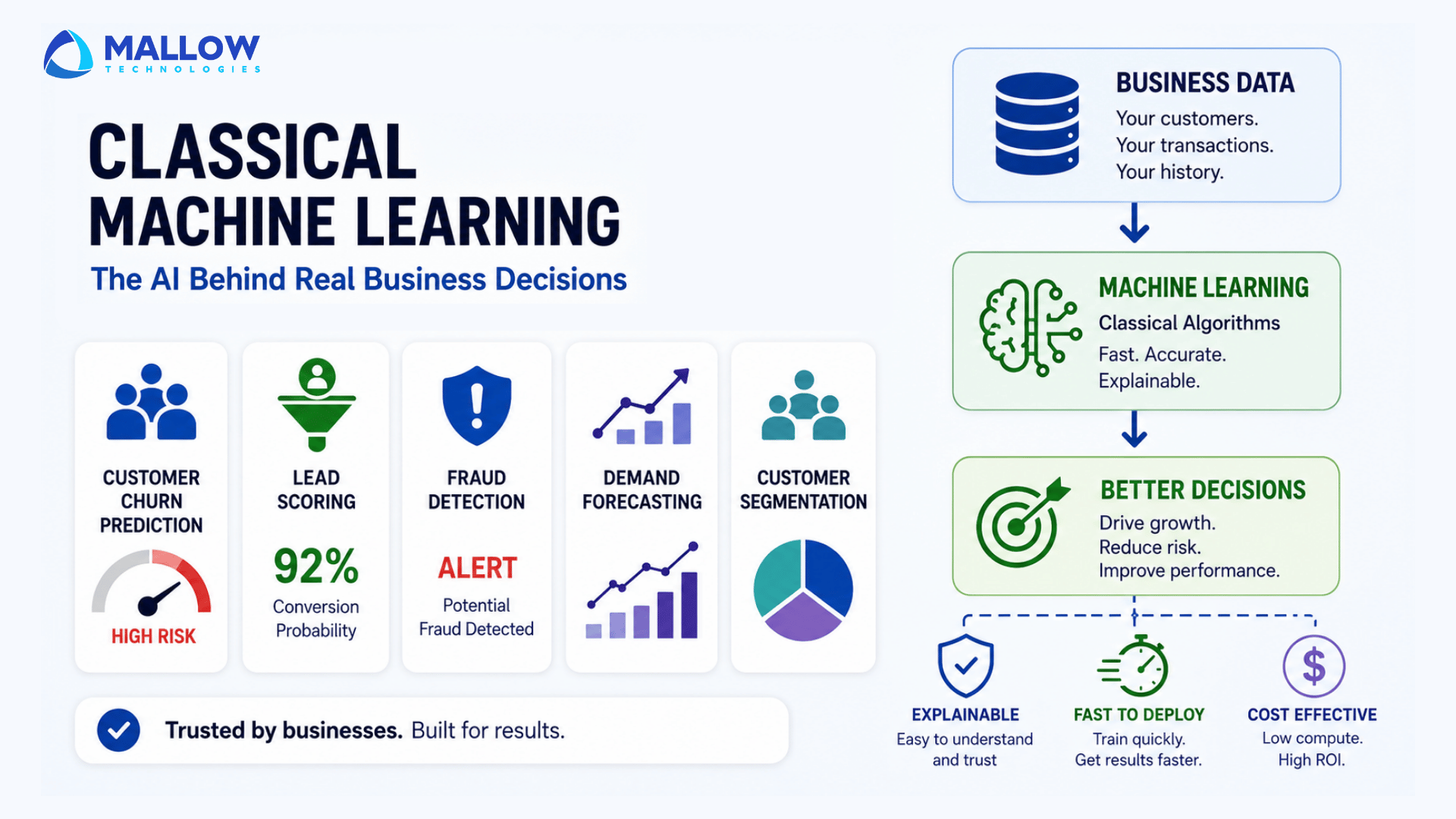
If your company uses any of the following, classical ML is already running somewhere in your stack, whether you labelled it that way or not – a churn prediction score, a lead quality ranking, a fraud flag, a demand forecast, a customer segment definition.

These six algorithms cover the vast majority of what business teams actually need from ML –
Linear regression takes a set of input variables and predicts a continuous number. Revenue forecasting, price modelling, demand planning. If your finance team has a spreadsheet model they trust, linear regression is a more rigorous version of the same idea.
Logistic regression takes the same inputs and predicts a probability between zero and one. Will this customer churn? Will this lead convert? Is this transaction suspicious? It is the most widely deployed classification algorithm in production business systems precisely because it is fast, interpretable, and reliable.
Decision trees make predictions by splitting data along a sequence of yes/no questions. They are the most human-readable ML model that exists. A compliance officer can follow the logic. An auditor can trace a decision. A non-technical executive can understand why a customer was flagged.
Random forests combine hundreds of decision trees, each trained on a slightly different sample of the data, and aggregate their votes. The result is significantly more accurate than a single tree while remaining explainable at the feature importance level.
Gradient boosting builds trees sequentially, with each new tree correcting the errors of the previous one. XGBoost and LightGBM, the most common implementations, consistently win structured data prediction competitions. If your business problem involves tabular data and you need the highest accuracy a classical model can give you, this is usually where you start.
K-means clustering groups data points by similarity without requiring labelled examples. Customer segmentation, inventory grouping, cohort analysis. If you have ever asked “who are our different types of customers,” K-means is often the first and best tool for answering it.
Classical ML vs deep learning - it is not a competition, it is a choice
The conversation your team is probably having is framed as “AI vs old ML.” That framing is not useful. The right question is – what does my problem actually require?

Deep learning and large language models are genuinely powerful for problems involving unstructured data at scale – images, audio, video, raw text, code. If you are building a product that summarises documents, generates content, transcribes speech, or analyses images, deep learning is probably the right tool.
But most business problems are not those problems. According to Stack Overflow’s 2024 Developer Survey, the most common data types in production ML systems are still structured tabular datasets from databases, CRMs, and operational tools. These datasets are exactly where classical ML was designed to operate and where it still outperforms more complex approaches on cost, speed, and explainability.
The choice is not ideological. It is practical. Match the tool to the data type and the business constraint, not to what was announced at the last AI conference.
Five signals that classical ML is the right fit for your problem
Run through these before your team commits to a more complex approach –
Your data is structured and tabular. Rows, columns, a database schema you can describe. This is the home environment for classical ML. If your data looks like this, starting with a neural network is choosing a sledgehammer for a precision task.
You need to explain every decision the model makes. A regulator, an enterprise customer, or an internal audit team will ask why a specific prediction was produced. Decision trees and logistic regression can answer that question. A deep learning model generally cannot, at least not without a separate explainability layer that adds complexity and cost.
Your dataset has fewer than 500,000 labelled examples. Deep learning needs data at a scale most SaaS companies do not have. Classical models generalise well on thousands of examples and continue improving through the tens and hundreds of thousands.
You need to ship in weeks, not quarters. No GPU infrastructure, no containerised training pipeline, no dedicated ML engineering team required. A gradient boosting model can be trained, evaluated, and deployed in a fraction of the time and cost of a deep learning system.
Inference cost is a real constraint. Running a classical model at scale costs fractions of a cent per prediction. Running an LLM API at scale for the same volume can cost orders of magnitude more. For any high-frequency prediction task, this difference compounds into a significant operational cost difference.
Real business questions classical ML already answers
This is where the abstract becomes concrete. These are the questions your business team is probably already asking.

Will this customer churn next month? Your product usage data, login frequency, support ticket history, and billing events contain the answer. A random forest or logistic regression trained on historical churn events will find it.
What price should we charge this segment? Historical pricing data, demand signals, and competitor positioning are structured inputs to a linear regression or gradient boosting model that can recommend price points with measurable confidence.
Which leads are most likely to convert? CRM data, email engagement metrics, and firmographic information are exactly what logistic regression and gradient boosting were built to process. The output is a ranked lead score your sales team can act on today.
Is this transaction fraudulent? Transaction amount, time, location, device fingerprint, and account history are tabular signals. Random forests and isolation forests are the standard approach for fraud detection at production scale.
How should we group our customers? K-means clustering on purchase history, frequency, recency, and average order value produces the customer segments your marketing and product teams can build strategies around.
Which support tickets need immediate escalation? Ticket category, historical resolution time, customer tier, and prior escalation history are structured signals. A decision tree or gradient boosting model trained on past escalation outcomes can triage incoming tickets in real time.
The four mistakes business teams make when choosing ML approaches

Assuming newer always means better. The model that was announced last month is not necessarily the model that will solve your problem. GPT-4 cannot predict your customer churn rate better than a well-tuned gradient boosting model trained on your own historical data. The novelty of the tool is irrelevant to whether it fits the task.
Starting with a complex model to impress stakeholders. A random forest your team can understand, monitor, and improve is worth more in production than a neural network nobody can explain when something goes wrong. Complexity has to be earned by a performance requirement that simpler models demonstrably cannot meet.
Ignoring explainability until a regulator asks. If your business operates in fintech, healthtech, insurance, or HR technology, explainability is not a nice-to-have. It is a compliance requirement. Classical models satisfy this requirement by design. Black-box models create legal and operational exposure that surfaces at the worst moment.
Treating classical ML as a stepping stone rather than a destination. The assumption that every ML system eventually needs to graduate to deep learning is wrong. Most production business ML systems are classical models that have been running reliably for years. That is not a failure. That is what good looks like.
What good looks like in practice
A business team that uses ML well has made deliberate choices at each step. They know what data they have. They know what question they are trying to answer. They chose the simplest model that answers it with sufficient accuracy. They can explain every prediction. They monitor the model in production and retrain it when it drifts.
That is not a description of a company that chose an LLM for everything. It is a description of a company that understood their problem well enough to pick the right tool for it.
Classical ML is not a consolation prize for teams that cannot afford the new thing. For the majority of structured business problems, it is the correct answer on every dimension that actually matters – cost, speed, explainability, and reliability in production.
If you are evaluating AI options for your product and want to discuss which approach best fits your business problem, you can connect with us for a detailed discussion.
Your queries, our answers
Yes, and not just relevant but dominant in most production business AI systems. The majority of ML models running in production across SaaS, fintech, healthtech, and e-commerce are classical models: gradient boosting, random forests, logistic regression, and decision trees. Large language models and deep learning get the press. Classical models get the work done.
Classical ML algorithms learn from structured, tabular data using mathematical relationships between input features and outputs. Deep learning uses multi-layered neural networks that learn representations from raw, unstructured data like images, text, and audio. The distinction matters because the right choice depends on your data type, not on which technology is newer.
You need someone who understands your data and the problem you are solving, and who can set up the training and evaluation pipeline correctly. That is often a data analyst with ML experience or a product engineer who has worked with ML libraries. The barrier to entry for classical ML is significantly lower than for deep learning or LLM fine-tuning.
Start with whether you have historical data where the outcome you want to predict has already happened. If you have records of past churn events, past conversions, past fraud cases, or past escalations, you have the foundation for a supervised learning model. If you do not have labelled historical data, you likely need a different approach, whether that is clustering, rule-based systems, or data collection before any modelling begins.
Gradient boosting is an ensemble algorithm that builds a sequence of decision trees, where each tree corrects the prediction errors of the tree before it. The result is a model that is highly accurate on structured data without requiring the scale of data or compute that deep learning needs. XGBoost and LightGBM, the two most common implementations, are the standard starting point for any structured data prediction task in production.
Yes, and in many cases they are preferred precisely because of the regulatory environment. Financial services, healthcare, and insurance often require that model decisions can be explained to an auditor or regulator. Decision trees, logistic regression, and rule-extraction from ensemble models satisfy this requirement far more easily than black-box neural networks.
What happens after you fill-up the form?
Request a consultation
By completely filling out the form, you'll be able to book a meeting at a time that suits you. After booking the meeting, you'll receive two emails - a booking confirmation email and an email from the member of our team you'll be meeting that will help you prepare for the call.
Speak with our experts
During the consultation, we will listen to your questions and challenges, and provide personalised guidance and actionable recommendations to address your specific needs.

Author
Jayaprakash
Jayaprakash is an accomplished technical manager at Mallow, with a passion for software development and a penchant for delivering exceptional results. With several years of experience in the industry, Jayaprakash has honed his skills in leading cross-functional teams, driving technical innovation, and delivering high-quality solutions to clients. As a technical manager, Jayaprakash is known for his exceptional leadership qualities and his ability to inspire and motivate his team members. He excels at fostering a collaborative and innovative work environment, empowering individuals to reach their full potential and achieve collective goals. During his leisure time, he finds joy in cherishing moments with his kids and indulging in Netflix entertainment.