The conversation in your last board meeting probably included the phrase “we need to be doing more with AI.” Your investors are asking about it. Your competitors are announcing it. And somewhere in the middle of all that, you are trying to figure out whether your organisation is actually in a position to build something that works.
The honest answer for most businesses at this moment is – probably not quite yet. And that is not a problem. It is a diagnosis. Readiness is a specific, assessable set of conditions. Most of the gaps are fixable in weeks, not months. But they need to be identified and addressed before any engineering investment is made, not during it.
This article gives you the framework to make that assessment honestly.
Why readiness matters more than ambition
The most common reason AI projects fail is not that the technology is wrong. It is that the organisation was not ready for it. The data was not labelled. The use case was not defined. The team was not equipped. And the leadership was not committed to acting on what the model produced.
According to McKinsey’s 2025 State of AI report, which tracks enterprise AI adoption and failure rates across industries globally, the primary barriers to AI value realisation are organisational and data-related, not technical. The models exist. The infrastructure is available. What most businesses are missing is the internal readiness to deploy AI in a way that actually changes how decisions are made.
Readiness assessment is the work that prevents expensive mistakes.
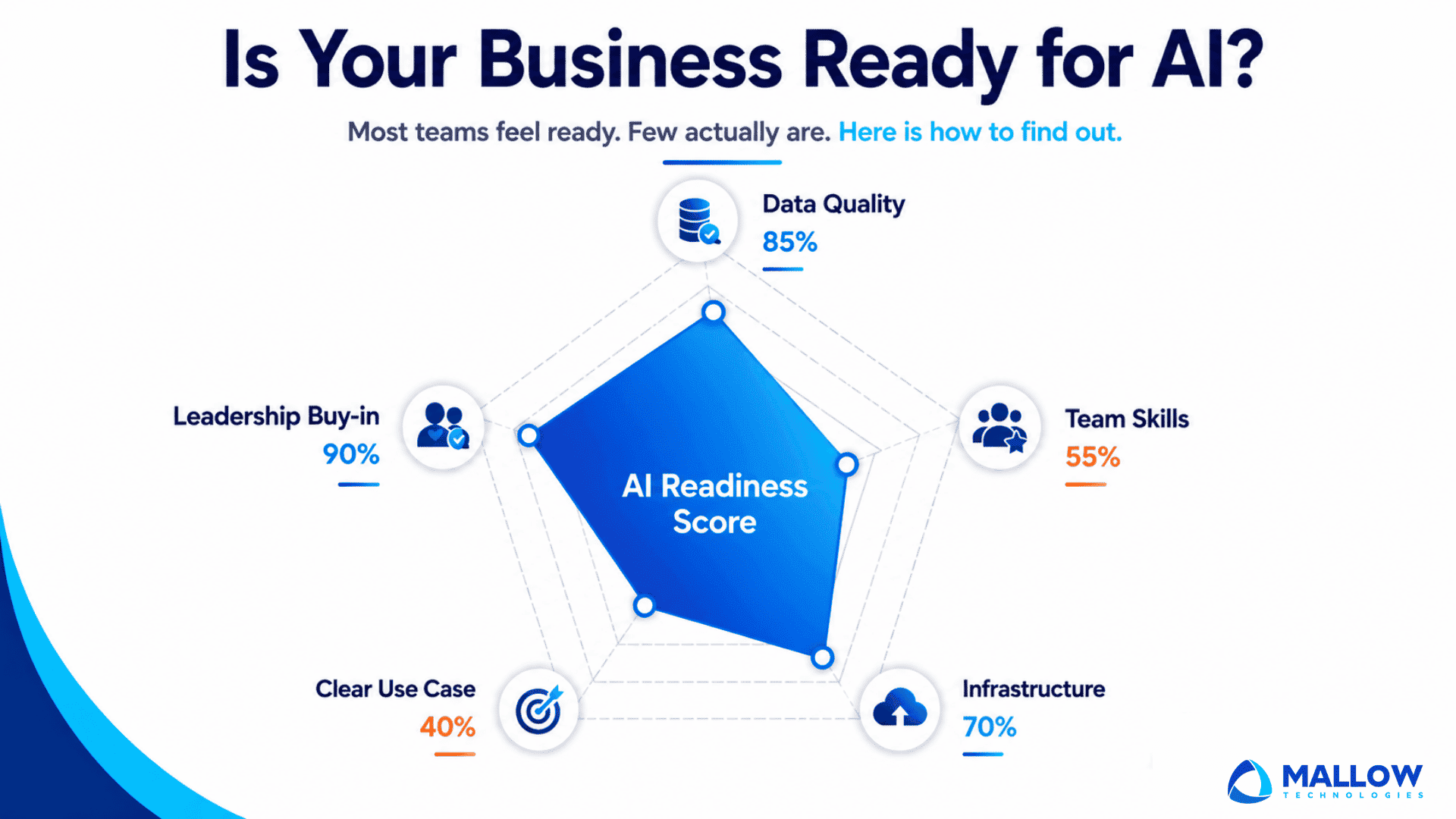
The 5 dimensions of AI readiness
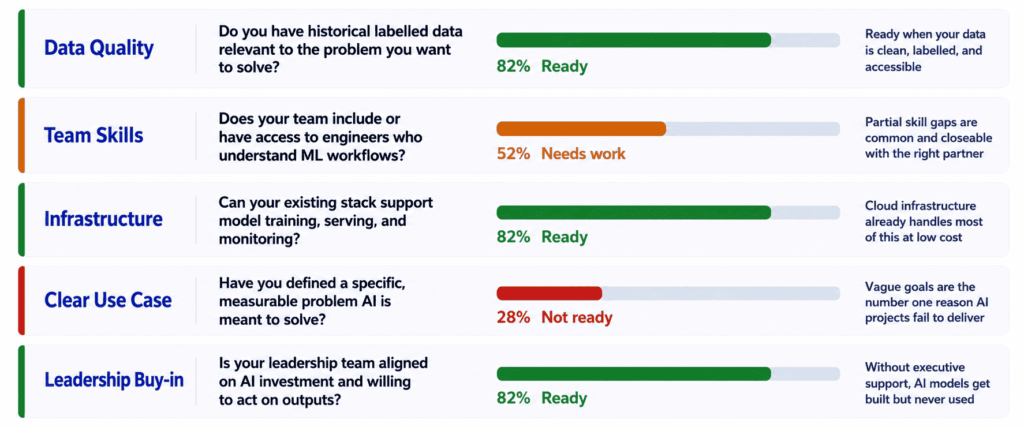
AI readiness is not a single yes or no. It is an honest score across five dimensions, each of which determines a different aspect of whether your AI initiative will succeed.
Data quality. This is the most important dimension and the most commonly overestimated. Most businesses have data. Very few have data that is clean, labelled, and structured in a way that ML can learn from. Having a CRM is not the same as having labelled training data. The question is not whether data exists — it is whether the data contains the historical outcome signal the model needs to learn from.
Team skills. Your team does not need to include a machine learning researcher. It needs to include, or have access to, engineers who understand the difference between training a model and deploying one, who know what data pipelines look like, and who can evaluate whether a model is performing correctly in production. This gap is closeable through hiring, upskilling, or partnerships.
Infrastructure. Most SaaS teams already have the cloud infrastructure that production ML requires. The gap is almost never raw compute. It is the tooling layer – prediction logging, a model registry, a monitoring setup, and a deployment pipeline that can version and roll back models. These are addable to most existing stacks without a rebuild.
Clear use case. This is the gap most businesses underestimate. “We want to use AI to improve customer experience” is not a use case. “We want to predict which accounts are likely to churn in the next 30 days so our customer success team can intervene before the renewal date” is a use case. The specificity of the problem definition is the single biggest predictor of whether the project delivers value.
Leadership buy-in. A model that produces correct outputs and nobody acts on delivers zero business value. Leadership buy-in means not just funding the initiative but committing to a specific action the business will take when the model fires. Without that commitment, the AI initiative produces a dashboard that gets reviewed in quarterly business reviews and changes nothing.
The three readiness levels and what each one means
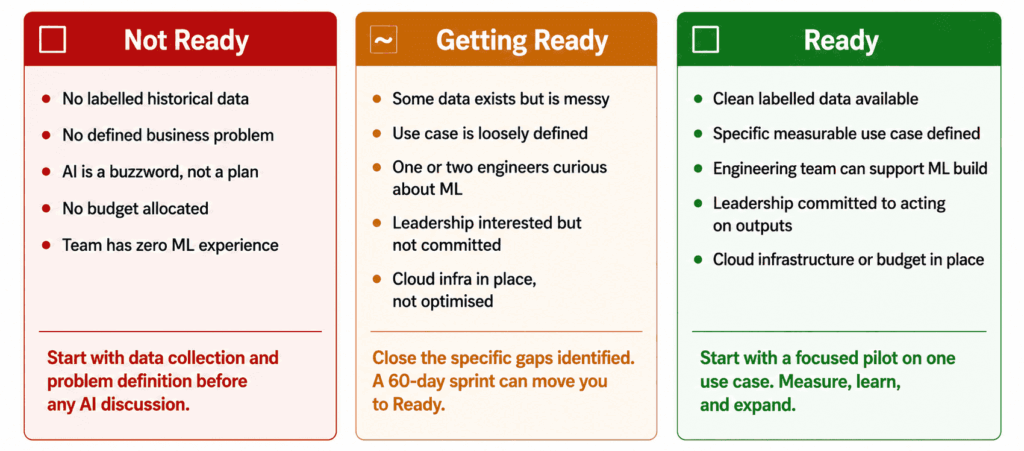
Every business assessment across these five dimensions will land in one of three profiles.
Not ready means the foundational gaps are too significant to start building. The data does not exist in a usable form, the use case is not defined, or the team has no ML capability. The right move here is not to start building. It is to spend 60 to 90 days closing the specific gaps that prevent the first project from succeeding.
Getting ready means the foundation is partially in place. Some data exists, the use case is roughly defined, and there is interest at the leadership level. The gaps are real but closeable. The right move here is a focused readiness sprint – resolve the two or three most critical gaps, appoint an initiative owner, and define the success metric before any technical work begins.
Ready means all five dimensions are in a workable state. The data is accessible and labelled, the use case is specific and measurable, the team can support the build, the infrastructure is in place or budgeted, and leadership is committed to acting on outputs. The right move here is to start with a single focused pilot rather than a broad initiative, and to measure rigorously from day one.
The 10-question self-assessment
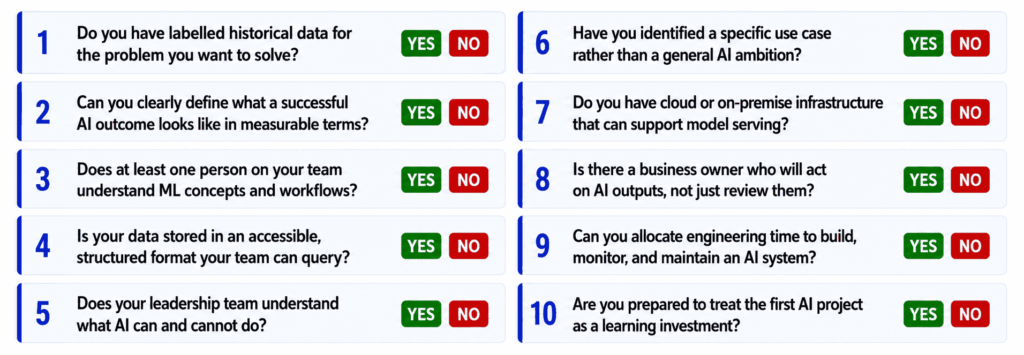
Count your yes answers when you are done. That number is your readiness score.
How to interpret your score
Zero to three yes answers – Stop before committing any engineering time. Focus the next 60 to 90 days on defining one specific use case, identifying what data you have and what is missing, and setting a concrete data collection goal. Come back to this assessment when those three things are in place.
Four to six yes answers – You have a foundation but material gaps remain. Identify the two or three no answers that represent the highest-risk gaps for your specific use case and close them before starting. Assign an initiative owner and get explicit leadership alignment on what a successful outcome looks like.
Seven to eight yes answers – You are close to ready. Run a tightly scoped pilot on one use case. Define the outcome metric and the action that will be taken when the model fires before any model training begins.
Nine to ten yes answers – Start with confidence. Build a focused production project with monitoring and logging in place from day one. Plan to measure, learn, and expand rather than trying to solve multiple problems simultaneously.
The 4 most common readiness gaps and how to close them
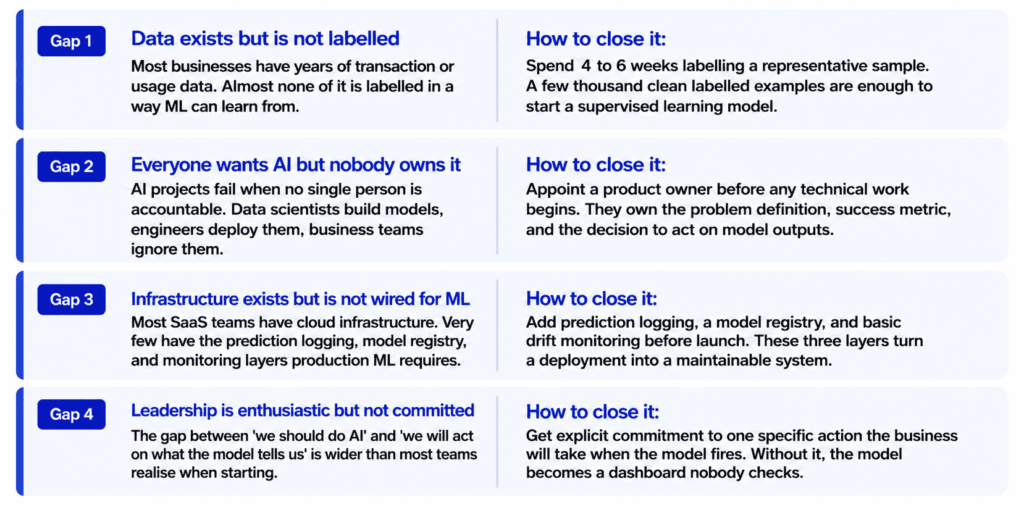
Everyone wants AI but nobody owns it. This is a structural gap that causes more project failures than any technical problem. The solution is to appoint a single product owner for the AI initiative before any engineering work starts. This person is accountable for the problem definition, the success metric, and the decision to act on model outputs. Without this, the initiative will drift.
Infrastructure exists but is not wired for ML. The gap is not compute. It is tooling. Prediction logging, a model registry, and a drift monitoring layer are the three additions that turn a one-time model deployment into a system that can be maintained and improved over time. These can be added to most existing cloud setups without rebuilding the application.
Leadership is enthusiastic but not committed. Enthusiasm and commitment are different things. Commitment means identifying in advance the specific action that will be taken when the model produces its output. A churn model that produces a probability score is useless unless someone on the customer success team is going to call the flagged accounts. That commitment needs to be explicit before the model is built, not after.
What to do next based on where you are
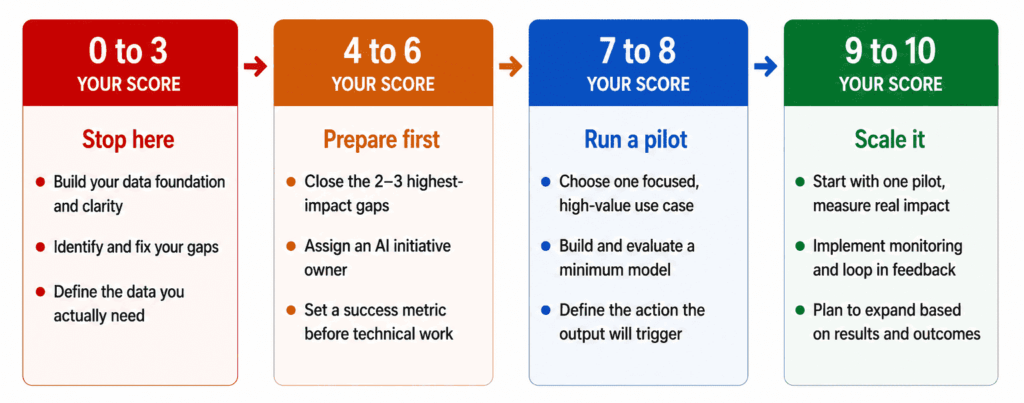
Action plan based on your readiness score
Your readiness score points to a specific next action. The framework above is designed to give you that action, not a vague direction.
- If you scored zero to three – do not start building yet. Start with the problem definition and the data inventory.
- If you scored four to six – run a readiness sprint before the engineering sprint. Close the gaps first.
- If you scored seven to eight – start a pilot. Keep it narrow, measure rigorously, and use the learning to justify the next investment.
- If you scored nine to ten – build with confidence. Monitor from day one, act on what the model tells you, and expand from there.
According to research from Stanford University’s 2026 AI Index, which tracks AI adoption patterns, investment ROI, and implementation challenges across global enterprises, organisations that invest in structured readiness assessment before AI initiatives see significantly higher rates of production deployment and measurable value delivery compared to those that begin with technology selection.
The businesses that get real value from AI are not the ones who were most excited about it. They are the ones who were most honest about where they started.
If you want to work through this assessment with your team or need help closing a specific gap, connect with our experts to move from assessment to action.
Your queries, our answers
For supervised learning on a structured business problem, churn prediction, lead scoring, fraud detection, a few thousand labelled historical examples is typically enough to build a baseline model that produces useful signals. The model improves with more data but you do not need years of it to start. The quality of the labelling matters more than the quantity of records at the early stage.
Yes, if the use case is well defined and the data is in good shape. The most dangerous combination is an ambitious use case, messy data, and no ML experience. The most viable combination for a small team is a narrow, specific use case, clean labelled data, and a clear success metric. Start there and expand as the team builds capability.
Choosing the technology before defining the problem. The conversation should not start with "should we use GPT or a classical model." It should start with "what specific outcome are we trying to produce, what data do we have, and what will the business do when the model fires." The technology choice follows from honest answers to those questions. Starting with the technology and working backward almost always produces a project that is impressive in demos and useless in production.
What happens after you fill-up the form?
Request a consultation
By completely filling out the form, you'll be able to book a meeting at a time that suits you. After booking the meeting, you'll receive two emails - a booking confirmation email and an email from the member of our team you'll be meeting that will help you prepare for the call.
Speak with our experts
During the consultation, we will listen to your questions and challenges, and provide personalised guidance and actionable recommendations to address your specific needs.

Author
SathishPrabhu
Sathish is an accomplished Project Manager at Mallow, leveraging his exceptional business analysis skills to drive success. With over 8 years of experience in the field, he brings a wealth of expertise to his role, consistently delivering outstanding results. Known for his meticulous attention to detail and strategic thinking, Sathish has successfully spearheaded numerous projects, ensuring timely completion and exceeding client expectations. Outside of work, he cherishes his time with family, often seen embarking on exciting travels together.