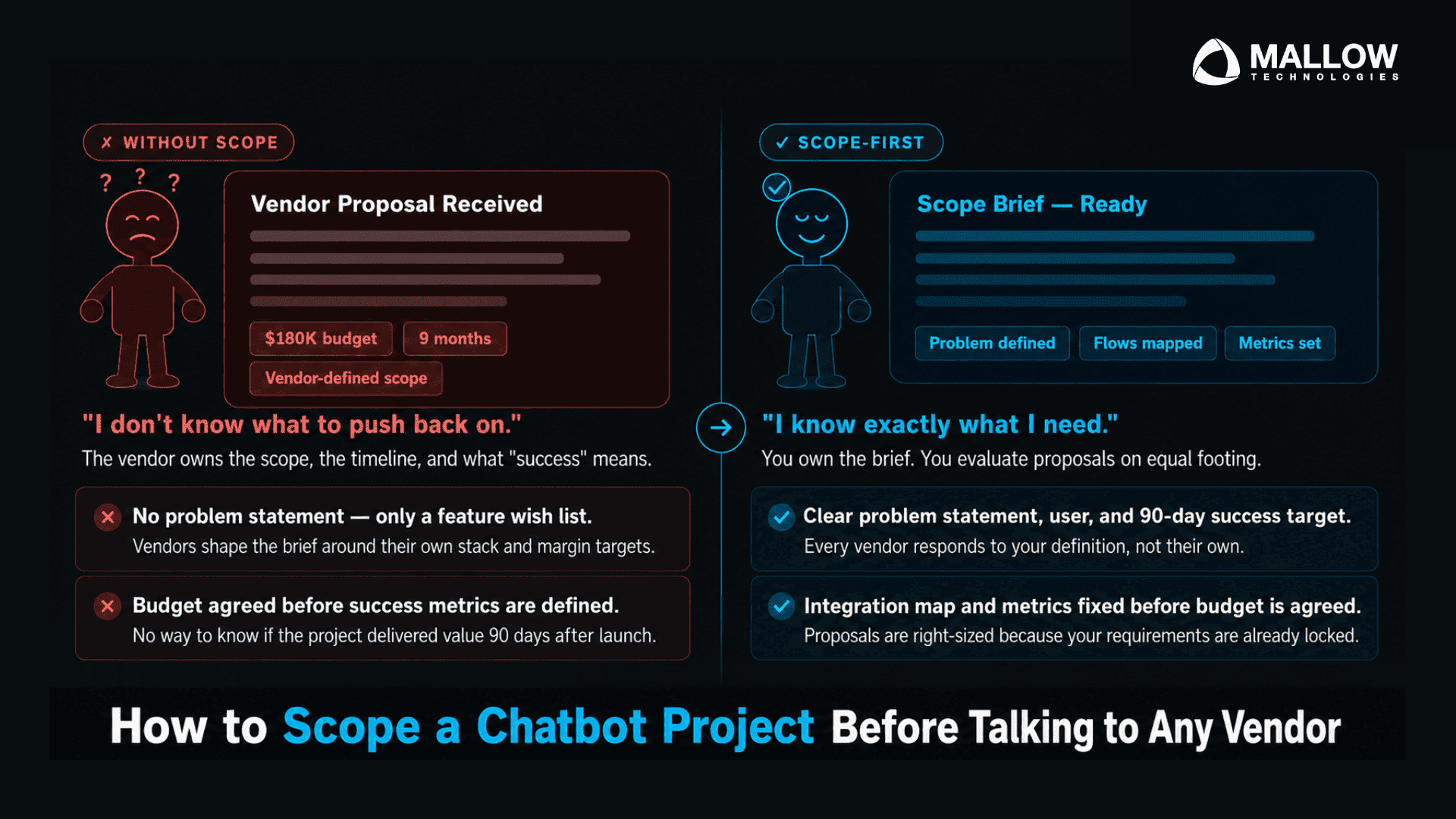
Most founders walk into their first vendor call for a chatbot project with a rough idea, a budget range, and a lot of optimism. They come out two weeks later with a proposal that costs twice what they expected, covers three times what they asked for, and includes a six-month timeline they do not fully understand.
It is not necessarily that the vendor did something wrong. It is that the founder handed over the scoping process along with the inquiry. When you do not own the scope going in, someone else will define it for you. And they will define it in their own interest.
This guide is for founders, CTOs, and product leads who want to fix that before the first meeting. Not so you can pretend to be an AI engineer in the room, but so you can walk in knowing what you actually need, why you need it, and what success looks like on your terms.
Why scoping is your responsibility, not the vendor's
This is not a knock on vendors. Good ones will push back, ask hard questions, and try to understand your context. But a vendor who scopes your project is also, inevitably, scoping their engagement. Their definition of what is “necessary” will be shaped by their team structure, their tooling preferences, and their margin targets.
That is not a conspiracy. It is just how services businesses work.
Your job before that conversation is to arrive with enough clarity that you can evaluate what a vendor is proposing against what you actually need. That requires doing some thinking before anyone has any commercial skin in the game.
The founders who get the best outcomes from chatbot builds are not the ones who come in with a perfect technical spec. They are the ones who come in with a clear problem statement, a defined user journey, and a set of constraints. That combination lets you compare proposals properly, spot padding, and push back when something does not make sense.
Start with the problem, not the feature

The most common mistake in scoping a chatbot project is starting with “I want a chatbot that can…” and then listing features. That is the wrong starting point.
Start with the problem you are trying to solve and for whom.
Ask yourself these questions –
What is breaking or underperforming right now? Is your support team spending 60% of their time answering the same five questions? Are users dropping off during onboarding because they cannot find answers fast enough? Is your sales team losing demos because prospects ghost after the free trial? Each of these calls for a fundamentally different chatbot.
Who is the primary user? A chatbot for your customer support queue behaves differently from an internal knowledge assistant for your ops team. The conversation design, the data it needs to access, and the integration points are all different. Mixing up the primary user in your brief creates confusion that compounds through the entire build.
What does a good outcome look like in 90 days? This is the question most people skip. If you cannot describe what success looks like three months after launch, you will have no way to evaluate whether the project delivered value. Vendors will not push you on this because it makes their engagement harder to measure. You should push yourself on it.
Once you can answer those three questions clearly, the scope starts to write itself.
Define the conversation flows before anyone writes a line of code

You do not need to be a conversational designer to map out your core flows. You need to understand your users well enough to sketch out the five to ten journeys that matter most.
Take a piece of paper or a whiteboard and map the following –
Entry points – How does a user start a conversation? Via a widget on your dashboard? A Slack message? A mobile app trigger? Define where the conversation starts.
Primary intents – What are users most likely to ask or want to do? Group these into three to five buckets. If you are building a support chatbot, those buckets might be billing questions, feature how-tos, bug reporting, account management, and escalation to a human.
Decision points – Where does the chatbot need to branch? If a user asks about refunds, does the chatbot need to check their subscription status first? Does it need to route different question types to different agents or knowledge bases?
Failure states – What happens when the chatbot does not know the answer? A well-scoped project includes a defined fallback behaviour, whether that is a graceful handoff to a human, a knowledge-base search result, or an honest “I do not have that information yet” response.
You do not need to design all of this in detail. You need enough to show a vendor where the complexity actually lives. That stops them from underscoping the hard parts and overscoping the easy ones.
Decide on integration points early

Nothing blows up a chatbot timeline faster than discovering integration requirements late in the build. A chatbot that only handles static FAQ responses is a different animal from one that needs to look up a customer’s order history, push data into your CRM, check a user’s subscription tier, or authenticate against your internal API.
Before you talk to any vendor, inventory the following –
Data sources the chatbot needs to read from. Your documentation, your knowledge base, your product database, your ticketing system. List them. Note whether they have existing APIs or whether they are locked in a format that requires extraction work.
Systems the chatbot needs to write to or trigger. Does it need to create support tickets? Update CRM records? Fire a Slack notification? Trigger a workflow in your backend? Each of these is a separate integration scope item.
Authentication requirements. If the chatbot will handle user-specific data, it will need to know who it is talking to. That often means integrating with your existing auth system. This is frequently underestimated.
Data privacy and compliance constraints. If you are operating in healthcare, fintech, or any regulated space, document your constraints upfront. These affect architecture decisions from the beginning, not as an afterthought.
A clean integration map does two things. It gives vendors the information they need to price accurately. And it protects you from discovering mid-build that a critical integration requires three extra weeks you did not budget for.
Set your success metrics before you set your budget

Budget conversations happen too early in most chatbot projects. Founders walk in asking “what will this cost?” before they have defined what they are buying. That hands the framing entirely to the vendor.
Flip it. Define what success looks like first. Then budget toward that outcome.
Concrete metrics look like this –
- Reduce support ticket volume for tier-1 queries by 35% within 60 days of launch
- Achieve a chatbot containment rate of 70% (meaning 7 out of 10 conversations resolved without human escalation) within the first quarter
- Cut average first-response time from 4 hours to under 2 minutes for common user queries
- Improve onboarding completion rate by 20% through contextual chatbot nudges
When you arrive with metrics like these, you change the conversation. Instead of a vendor telling you what they will build, you are telling them what the build needs to achieve. That shifts proposals toward outcomes rather than deliverables and makes it much easier to evaluate whether a scope is right-sized.
It also protects you post-launch. Vague success criteria lead to vague post-launch conversations about whether the project “worked.” Specific metrics create accountability for both sides.
What a solid scope document should actually contain
You do not need a formal requirements document. You need a clear brief that any serious vendor can read and respond to accurately. Here is what that brief should cover –
Problem statement (1 paragraph). What is the specific operational or product problem this chatbot solves? Who experiences it? What does it cost the business today?
Primary user and context (2 to 3 sentences). Who is the user, where do they interact with the chatbot, and what is the environment?
Core conversation flows (bullet list). The five to ten primary intents, mapped with entry point, key branch logic, and fallback behaviour.
Integration inventory (table). Every system the chatbot reads from or writes to, with notes on API availability and authentication requirements.
Success metrics (list). Three to five measurable outcomes with target values and timeframes.
Constraints and non-negotiables. Tech stack preferences, compliance requirements, existing vendor relationships, launch timeline, and anything else that limits the solution space.
Out of scope (short list). What this chatbot will not do in version one. This is as important as what it will do.
A brief this clear does three things. It filters out vendors who are not a fit. It gives serious vendors what they need to scope accurately. And it gives you a baseline to evaluate whether proposals are actually responding to your needs or to a generic template.
If you are planning a chatbot initiative and would like a second opinion on your scope, requirements, or implementation approach, feel free to reach out to us. A quick discussion can help validate your assumptions, identify potential gaps, and ensure you enter vendor conversations with clarity and confidence.
Your queries, our answers
For most SaaS products, a working brief takes two to three days of focused thinking. You do not need weeks. The goal is clarity on the problem, the flows, the integrations, and the success metrics. That is achievable in a short sprint with the right people in the room.
Not necessarily. A founder or product lead with a deep understanding of the user problem can write 80% of a useful brief. A technical co-founder or CTO helps with the integration inventory and architecture constraints, but the product thinking comes first.
Yes. A well-written scope document is not intellectual property. It is context. Sharing it with two or three vendors before you commit gives you comparable proposals and reveals which vendors actually read what you sent versus who is sending you a templated response.
That uncertainty is worth documenting. A brief that says "we believe we need a retrieval-augmented chatbot for customer support but want to explore whether an agent-based approach is better suited" is more useful than one that confidently states the wrong architecture. Good vendors will engage with that ambiguity and help you pressure-test the assumption.
An RFP (Request for Proposal) is a formal procurement document, usually used by enterprises. For most SaaS founders, a clear brief is faster and more effective. An RFP signals to vendors that they are in a long procurement process, which can filter out the more agile teams you actually want.
A vendor who rewrites your brief before understanding your business is a red flag. Strong chatbot projects start with a clear scope, defined flows, integrations, and success metrics. Most failures stem from vague requirements, not technology. Owning the scope helps ensure vendors build what your business actually needs.
What happens after you fill-up the form?
Request a consultation
By completely filling out the form, you'll be able to book a meeting at a time that suits you. After booking the meeting, you'll receive two emails - a booking confirmation email and an email from the member of our team you'll be meeting that will help you prepare for the call.
Speak with our experts
During the consultation, we will listen to your questions and challenges, and provide personalised guidance and actionable recommendations to address your specific needs.

Author
SathishPrabhu
Sathish is an accomplished Project Manager at Mallow, leveraging his exceptional business analysis skills to drive success. With over 8 years of experience in the field, he brings a wealth of expertise to his role, consistently delivering outstanding results. Known for his meticulous attention to detail and strategic thinking, Sathish has successfully spearheaded numerous projects, ensuring timely completion and exceeding client expectations. Outside of work, he cherishes his time with family, often seen embarking on exciting travels together.