Shipping an AI feature is not the same as shipping a standard software feature. A standard feature either works or it does not.
An AI feature can work perfectly from an engineering standpoint and still produce results that are wrong, expensive, or impossible to explain, without triggering a single error alert.
This is why AI systems need a dedicated production checklist. Not because the engineering is harder, but because the failure modes are different. They are statistical, gradual, and silent.
The checklist is how you make them visible.
Why AI systems need a dedicated production checklist
Standard production checklists cover things like uptime monitoring, error rate tracking, deployment pipelines, and rollback procedures. These still apply to AI systems. But AI adds four additional failure modes that a standard checklist will not catch.
Google’s Rules of Machine Learning describes this gap directly – the operational cost of an ML system is dominated not by the model itself but by the surrounding infrastructure required to keep it working correctly over time. A model that is not monitored for drift, not retrained when it degrades, and not logged at the prediction level is a system that will fail quietly and expensively.
A production checklist for AI systems closes that gap.
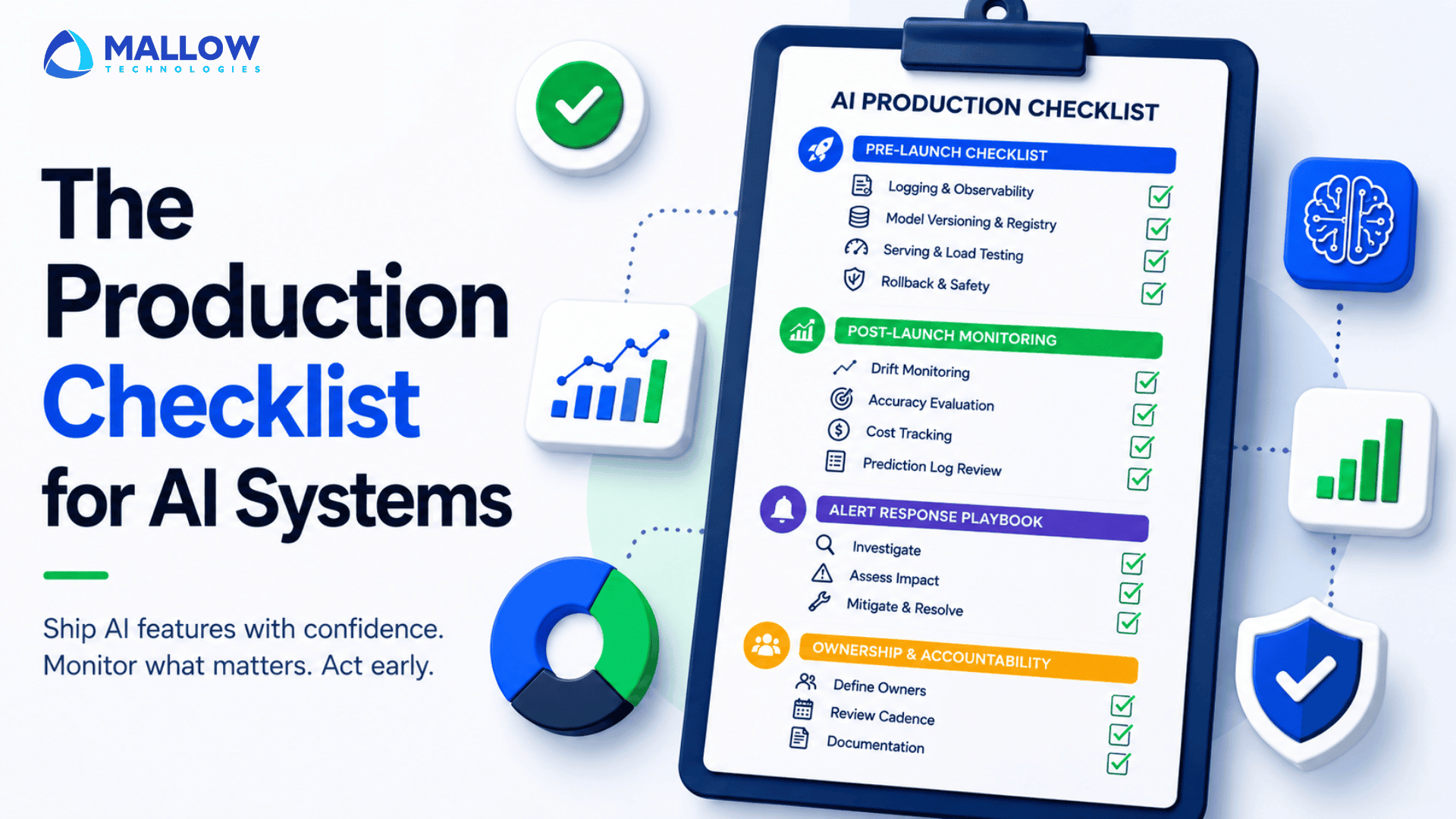
Part 1 - The pre-launch checklist
Before an AI feature goes live, six things must be in place. Not six things it would be nice to have. Six things that, if absent, will create problems that are expensive to fix after launch.

Logging and observability
Every prediction the model makes must be logged before the feature goes live. The log record needs to include the raw input the model received, the output it returned, a timestamp, and the model version that was active at the time of the prediction.
Without this, there is no way to answer a customer complaint, respond to a regulatory query, debug a degraded model, or understand what the model was doing at any point in the past. It is not optional infrastructure. It is the foundation everything else rests on.
Model versioning and registry
The model version in production must be stored in a registry before launch. Not in a filename. Not in a deployment note. In a registry that records the version identifier, when it was promoted to production, what evaluation metrics it passed, and what the previous version was.
MLflow is the most widely adopted open-source solution for this. It handles experiment tracking, model versioning, and promotion workflows. Without a registry, rolling back to a previous model after a bad update requires reconstructing a history that nobody documented.
Serving and load testing
The inference endpoint must be load tested at a minimum of two times expected peak traffic before launch. This is not a standard API load test. It needs to account for GPU cold-start latency, memory allocation for the model, and the difference between synchronous and batch inference behaviour under load.
A model that performs acceptably at average load can become the bottleneck for the entire product at peak load if this step is skipped.
Rollback and safety
A rollback procedure must be documented and tested before launch. Not written down somewhere and never run. Actually tested. The previous model version must be in the registry, the promotion command must be verified, and at least one person on the team must have run through the procedure end to end in a non-production environment.
The goal is that if a newly deployed model underperforms, reverting takes minutes, not hours.
Part 2 - The post-launch monitoring checklist
Going live is not the end of the checklist. It is the start of a different one. Production AI systems require active monitoring on two cadences – weekly and monthly.

Weekly checks
Review drift monitoring alerts and investigate any flags. A flag that is ignored for two weeks typically means the model has been underperforming for two weeks.
Check the per-prediction inference cost trend. Week-on-week cost increases that are not explained by traffic growth indicate an infrastructure problem that compounds over time.
Verify the retraining pipeline completed successfully if automated retraining is in place. A silent pipeline failure means the model is not being updated even when drift is detected.
Confirm prediction logs are being written correctly. Log failures are not always noisy. A configuration change elsewhere in the application can silently stop prediction records from being written.
Monthly checks
Evaluate model accuracy against held-out ground truth data. This is different from drift monitoring. Drift monitoring watches distributions. This check compares actual model outputs to actual correct answers on a labelled sample. It catches accuracy degradation that distribution monitoring can miss.
Review and update drift alert thresholds. Thresholds set at launch may not be appropriate six months later as the user base grows and product usage patterns evolve.
Audit prediction logs for completeness. Spot-check records against known user actions to confirm the logs are accurate, complete, and correctly structured for any audit or compliance requirement.
Review inference cost optimisation opportunities. As traffic grows, the inference architecture that was appropriate at launch may no longer be the most cost-efficient option.
Part 3 - The alert response playbook
Every alert in a production AI system needs a documented response. The worst time to figure out what to do when a drift alert fires is when a drift alert fires. The playbook should exist before any alert is possible.

Evidently AI and AWS SageMaker Model Monitor both provide alerting infrastructure. But the alert is only the start of the response. The four alerts that every production AI system should have, and the response procedure for each –
Drift alert – Pause any automated retraining that is already running. Pull a sample of the incoming data that triggered the alert and inspect it manually. Identify whether the root cause is a data pipeline issue (bad data coming in) or genuine distribution shift (the world has changed). If the latter, retrain with corrected or fresher data and re-evaluate before promoting.
Cost spike alert – Identify which prediction source is driving the spike. Check whether a synchronous inference path has been triggered where batch would have been more appropriate. Review whether the model size in production is still appropriate for the task. Apply caching if repeated or near-identical queries are being sent to the model.
Accuracy drop alert – Pull a fresh labelled sample from production data. Run evaluation against the current production model. If the gap versus baseline is confirmed, trigger a retraining cycle. Do not promote the new model until it passes the evaluation gate that was defined at launch.
Pipeline failure alert – Check the job queue logs for the failed retraining job. Identify which step failed – data pull, training, evaluation, or promotion. Fix the root cause, which is usually a data schema change or a configuration issue, and re-trigger the pipeline manually. Do not let the model continue running stale if the pipeline has been failing for more than one cycle.
Part 4 - The ownership checklist
Every item on every checklist above needs an owner. Ownership does not mean that person does all the work. It means they are accountable for the outcome and responsible for making sure it happens.

In a typical Seed-to-Series B SaaS team, the ownership breakdown across the four MLOps domains looks like this –
Drift monitoring is owned by the data scientist or ML engineer who understands what healthy distributions look like for this specific model. Backend and DevOps support by maintaining the infrastructure that feeds data to the monitoring tool.
The retraining pipeline is owned by the backend engineer who understands the data flow and job queue. The data scientist supports by defining the evaluation criteria and approving the retrained model. DevOps supports by maintaining the pipeline environment.
Inference management is owned by DevOps or infrastructure, who control the serving environment, scaling configuration, and cost visibility. Backend engineers support by making decisions about synchronous versus batch inference at the application level.
Prediction logging is owned by the backend engineer who builds and maintains the logging layer in the application. Everyone else depends on the logs being correct, which means this ownership needs to be explicit and unambiguous.
If any domain has no owner, that domain will be the first to fail.
What do you need to make a note of?
Each checklist item maps to a specific part of your application stack, regardless of what that stack is built on.
Prediction logging sits in the application layer. Every point where the application calls the model and receives a prediction is a logging event. In a Rails application this is typically a service object or concern. In a Laravel application it sits in a dedicated service class. In a Python-based backend it wraps the inference call as middleware or a structured logging decorator. Teams building production AI systems often underestimate how quickly missing prediction logs turn into debugging and compliance problems once usage scales.
Model versioning sits in the model registry. The application reads the current active version at startup or per-request, depending on your serving architecture. Without a proper versioning strategy, rollback and auditability become difficult as multiple models move through staging and production environments.
Drift monitoring runs as a background job on a schedule. For Rails and Laravel teams this is Sidekiq or Horizon. For Python teams it is Celery or a cloud-native scheduler like AWS EventBridge. As traffic patterns and user behaviour evolve, this monitoring layer becomes critical for identifying silent model degradation before it impacts customer experience or operational costs.
The retraining pipeline connects your job queue to your training environment. For DevOps-heavy teams using Kubernetes, AWS CodePipeline, or Bitbucket Pipelines, this integrates cleanly into existing CI/CD infrastructure. If your team is evaluating how to implement scalable AI monitoring, retraining workflows, or production-ready MLOps infrastructure, you can talk to one of our AI experts about the best approach for your application.
Your queries, our answers
Prediction logging. Everything else depends on it. Drift monitoring needs prediction data to compare. Accuracy evaluation needs prediction records to audit. Rollback decisions are informed by understanding what the current model has been producing. Without prediction logging in place before launch, the team is flying blind from day one.
There is no universal answer. The right retraining frequency depends on how quickly the input data distribution shifts for your specific use case and how sensitive the model is to that shift. The practical answer is - set up drift monitoring first, watch how quickly alerts fire, and use that to calibrate your retraining cadence. Some models need weekly retraining. Others are stable for months.
Drift monitoring watches the statistical distribution of inputs and outputs and alerts when they shift beyond a threshold. It does not require labelled ground truth data. Accuracy monitoring compares model predictions against known correct answers on a labelled sample. Drift monitoring is continuous and automated. Accuracy monitoring is periodic and requires labelled data. Both are necessary because each catches different failure modes that the other can miss.
Ownership should be split by domain, not held by one person. Drift monitoring has an owner. The retraining pipeline has an owner. Prediction logging has an owner. Inference management has an owner. If one person holds all four, those responsibilities will compete and some will be deprioritised. If nobody explicitly holds them, all four will eventually be deprioritised.
Partially. If the AI feature is powered by a third-party API (OpenAI, Anthropic, Google Gemini etc.), model drift and retraining are largely handled by the provider. But prediction logging, cost monitoring, rollback procedures for API version changes, and accuracy monitoring against ground truth are all still the SaaS team's responsibility and all still require the same infrastructure.
What happens after you fill-up the form?
Request a consultation
By completely filling out the form, you'll be able to book a meeting at a time that suits you. After booking the meeting, you'll receive two emails - a booking confirmation email and an email from the member of our team you'll be meeting that will help you prepare for the call.
Speak with our experts
During the consultation, we will listen to your questions and challenges, and provide personalised guidance and actionable recommendations to address your specific needs.

Author
Jayaprakash
Jayaprakash is an accomplished technical manager at Mallow, with a passion for software development and a penchant for delivering exceptional results. With several years of experience in the industry, Jayaprakash has honed his skills in leading cross-functional teams, driving technical innovation, and delivering high-quality solutions to clients. As a technical manager, Jayaprakash is known for his exceptional leadership qualities and his ability to inspire and motivate his team members. He excels at fostering a collaborative and innovative work environment, empowering individuals to reach their full potential and achieve collective goals. During his leisure time, he finds joy in cherishing moments with his kids and indulging in Netflix entertainment.