Most SaaS founders who deploy a chatbot are solving a volume problem. The support queue is full of the same questions. The tier-one team is spending most of its time on things that should not require a human. A chatbot that deflects those queries frees the team to work on what actually needs them.
That is a real problem and chatbots solve it well. Where things go wrong is when the same tool gets asked to handle something it was never designed for.
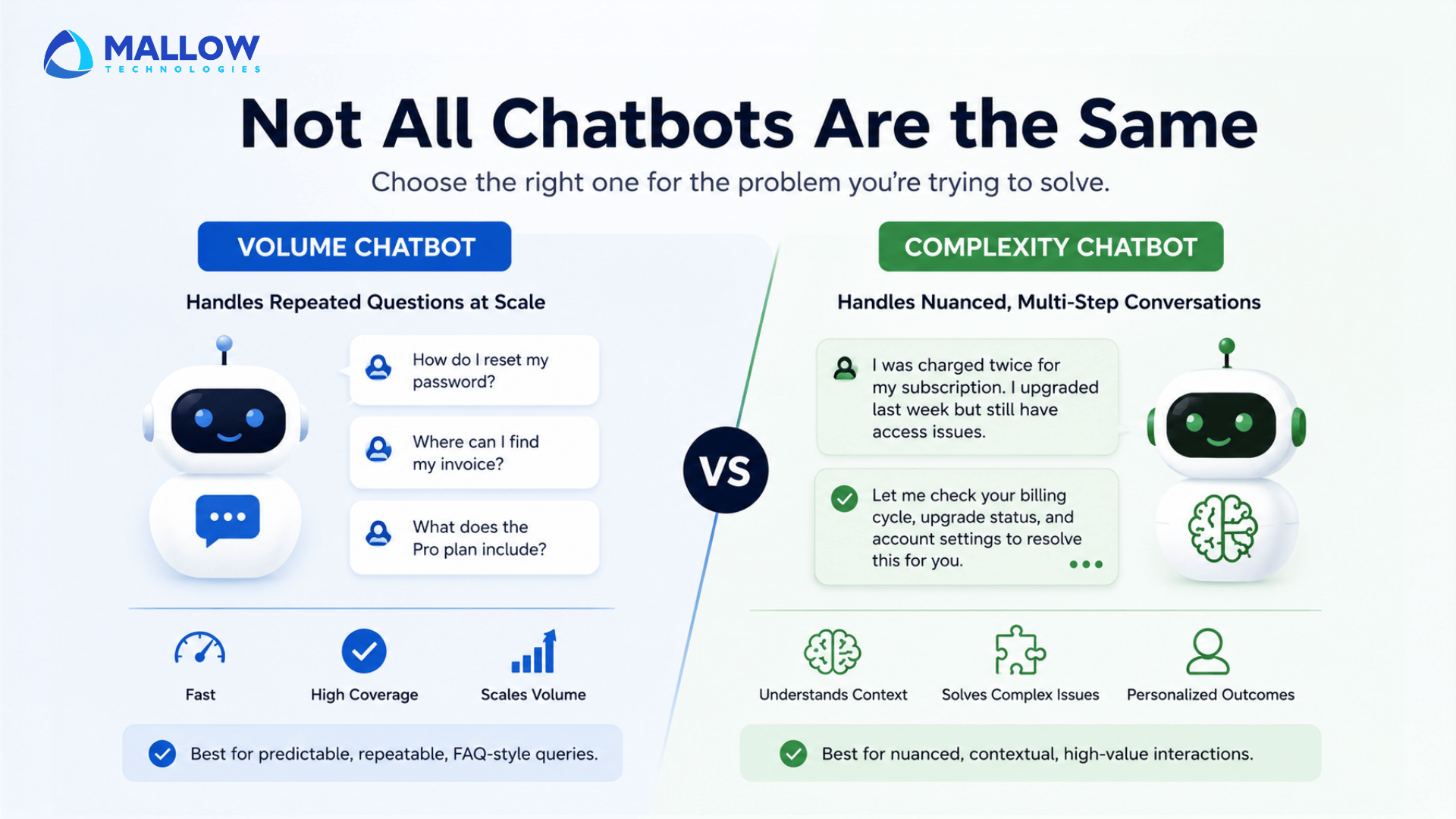
A volume chatbot and a complexity chatbot are fundamentally different systems. They are built differently, trained differently, and measured differently. The fact that both are called chatbots is one of the more misleading conventions in the AI tooling market.
This article is about that distinction. By the end of it, you should have a clear picture of which one your product needs, what each actually requires to work, and why deploying the wrong one creates more support problems than it solves.
Two products that share a name
The word chatbot describes anything from a simple FAQ widget to a reasoning agent that can interpret regulatory documents, cross-reference user account history, and produce a personalised resolution path in real time. The gap between those two things is enormous. Most chatbot deployments live somewhere on that spectrum, but founders rarely start by asking where on the spectrum their problem actually sits.
A volume chatbot operates on pattern matching and retrieval. A user sends a message. The system identifies the most likely intent. It retrieves the most relevant answer. If confidence is high enough, it returns the answer. If not, it escalates. The system is fast, reliable, and highly effective within its coverage zone. It does not reason. It does not adapt. It does not make decisions under ambiguity. It finds the closest match.
A complexity chatbot does something categorically different. It interprets context. It holds state across multiple exchanges and uses what it learned in exchange two to inform what it does in exchange five. It can recognise when a single query contains multiple intents. It can apply rules conditionally based on user attributes. It can navigate situations where there is no clear correct answer and the right response depends on factors that have to be weighed against each other.
These are not degrees of the same thing. They are different architectural choices built for different jobs.
What a volume chatbot is actually good at
Volume chatbots are excellent tools when they are applied correctly. The use cases they serve best share a common profile.
The queries are predictable. Users ask roughly the same set of questions, in roughly similar ways, and the answer does not depend heavily on who is asking. How do I reset my password? What does the Pro plan include? Where can I find my invoice? These questions have deterministic answers that do not change based on subscription tier, account history, or user context. A volume chatbot handles them well because the retrieval problem is stable.
The resolution is contained. A good answer completes the interaction. The user does not need to come back with a follow-up that builds on the first response. There is no accumulated context to track. Each conversation is essentially stateless.
The escalation path is clear. When the chatbot does not know the answer, it says so and routes to a human. Because the coverage zone is well-defined, the escalation rate is predictable and manageable. The human team knows what kinds of queries to expect after a bot handoff.
Volume chatbots also perform well on onboarding flows where the steps are structured and sequential, on status-check queries where the answer is a database lookup, and on documentation navigation where the user is trying to find a specific piece of information in a large knowledge base.
None of these use cases require reasoning. They require good retrieval, accurate intent classification, and a clean escalation mechanism. A volume chatbot built to those standards will handle them reliably.
What complexity looks like in a support context
Complexity in a support context is not simply difficult questions. It is queries where the right answer depends on conditional factors, where the conversation has to do meaningful work before a resolution is possible, or where the user’s situation requires the chatbot to hold and use context across multiple exchanges.
Some concrete examples from SaaS support contexts.
A user contacts support about an unexpected charge. The answer depends on their billing cycle, their plan tier, whether they upgraded recently, whether there is a known billing error in their account, and what their contractual terms say about proration. The chatbot cannot answer correctly until it has gathered and cross-referenced several pieces of information. Retrieving the most common billing FAQ is not a useful response.
A user reports that a feature is not working. The root cause could be a browser compatibility issue, a plan-gating issue, a misconfigured setting, or an active service incident. The correct diagnostic path depends on which combination of factors is present. A volume chatbot will return the most popular troubleshooting article. A complexity chatbot will ask the right questions in the right sequence to narrow down to the actual cause.
A user asks whether they can do something that is on the edge of your terms of service. The answer is not in an FAQ. It requires interpretation of policy, consideration of the user’s specific use case, and often a degree of judgment that the chatbot has to apply based on context.
In each of these cases, the failure mode of a volume chatbot is not escalation. It is confident, wrong responses. The query looks like something the chatbot has seen before. It matches on a similar pattern and returns an answer that is technically related but does not actually address the user’s situation. This is the confident-wrong failure and it is more damaging than a simple “I don’t know.”
Why volume chatbots fail on complex queries
The failure is architectural, not a matter of training quality. Volume chatbots use retrieval-based or intent-classification-based approaches that are optimised for single-turn, pattern-matched resolution. When a query requires multi-turn reasoning, conditional logic, or integration of information across multiple data sources, these approaches break down in predictable ways.
Pattern matching over-retrieves. The chatbot finds something that looks similar and returns it with high confidence even when the match is superficial. A billing question about proration returns the standard billing FAQ. A permissions question returns the generic roles documentation. The answer is adjacent to what the user needs but does not actually address the nuance.
Single-turn resolution fails on compound queries. A user who asks “why was I charged twice and will it happen again?” is asking two related but distinct questions. A volume chatbot typically handles the first pattern it recognises and ignores the second, or merges both into a generic billing response.
Statelessness breaks multi-turn resolution. If the user comes back in exchange three with “but my plan shouldn’t allow that,” the volume chatbot does not have the context from exchanges one and two to understand what “that” refers to. Each exchange is fresh. The conversation cannot build on itself.
Confidence calibration is wrong for ambiguous queries. Volume chatbots are tuned to return answers when confidence exceeds a threshold. In high-ambiguity situations, that confidence measure is unreliable because the system was not trained on the kind of reasoning required to handle them. It returns a high-confidence wrong answer because the surface patterns match.
What a complexity chatbot requires to work
A complexity chatbot is not simply a more powerful volume chatbot. It requires a different architecture, different training data, and a different approach to integration.
Multi-turn conversation management. The system needs to hold session state, track what has been established in the conversation, and use that context to shape subsequent responses. This requires a conversation memory layer that persists across exchanges within a session and, in some implementations, across sessions.
Conditional routing logic. Different user attributes trigger different conversation paths. A Pro plan user asking about a billing discrepancy follows a different path than a free tier user asking the same question. The routing logic has to be built explicitly, which means the conversation design work is significantly more complex than mapping FAQs to intents.
Integration with live data. Because the correct answer depends on the user’s specific situation, the chatbot needs to read live data from the product database and potentially other systems in order to personalise the response. Static knowledge base content is not sufficient.
Confidence management under ambiguity. A complexity chatbot needs to recognise when it does not have enough information to give a reliable answer and ask for clarification rather than guess. The fallback behaviour has to be calibrated differently because the cost of a confident-wrong answer in a complex scenario is higher than in a simple one.
Higher-quality training data. Training a complexity chatbot requires examples of complex, multi-step support interactions where the resolution path varies based on user context. This data rarely exists in clean form and often has to be constructed deliberately from historical support ticket analysis.
The diagnostic - Which one does your product need
The answer comes from a structured look at your current support queue, not from the capabilities list of any particular tool.
Start with your top twenty most common support query categories. For each one, ask two questions. First, does the correct answer depend on who is asking? If the same question from two different users can have different correct answers based on their plan, history, or configuration, that query requires a complexity chatbot to handle it well. If the answer is the same for everyone, a volume chatbot will do.
Second, how many exchanges does a human agent typically need to resolve this query? If the average human resolution takes one exchange, the query is a volume problem. If it consistently takes three or more exchanges with clarification questions in between, it is a complexity problem.
Run this analysis across your twenty categories. If more than seventy percent fall into the volume column, a well-built volume chatbot will handle most of your deflection opportunity. If more than thirty percent fall into the complexity column, and those are typically your highest-effort and highest-frustration queries, you either need a complexity architecture or a clear scope decision to exclude those queries from the chatbot’s remit and route them directly to humans.
The worst outcome is a volume chatbot that has been asked to cover complexity queries without the architecture to do it. That is where confident-wrong responses accumulate, NPS erodes, and your support team handles increasingly frustrated post-bot handoffs.
Can you have both?
Yes, and for most SaaS products at scale, the right answer is a layered architecture.
A volume layer handles the high-frequency, low-complexity queries. This is where most of your ticket deflection will come from. It is fast, cheap to operate, and highly reliable within its coverage zone. Well-defined, predictable queries go here.
A complexity layer handles the queries that require reasoning, context accumulation, and conditional logic. This layer is more expensive to build and operate, handles lower volume, but is responsible for the interactions where users are most at risk of churn if handled poorly. High-stakes, high-ambiguity queries go here.
A clean routing mechanism sits between them. Incoming queries are classified not just by topic but by complexity. Simple billing queries go to the volume layer. Complex billing disputes go to the complexity layer. The routing classification is itself a meaningful piece of the architecture and needs to be designed explicitly.
This is not a two-chatbot setup. It is a single conversation experience with intelligent routing under the hood. From the user’s perspective, it is one support assistant. Behind the interface, different queries are being handled by architecturally different components optimised for their specific job.
Building this architecture correctly requires honest scoping of both layers. The volume layer needs a clean knowledge base and accurate intent classification. The complexity layer needs live data integration, multi-turn conversation design, and rigorous training on complex scenarios. Neither can be shortcut.
Choosing the right chatbot architecture
The volume versus complexity distinction is one of the most practically useful frameworks for evaluating chatbot investments in SaaS. It moves the conversation away from vendor capability claims and toward the actual structure of your support queue.
A chatbot that handles volume well is a genuine operational asset. It deflects predictable queries, frees your human team for work that requires judgment, and scales support capacity without scaling headcount. A chatbot that handles complexity well is a different kind of asset. It manages the interactions where users are most at risk, where a wrong or generic response creates the most damage, and where good resolution directly affects renewal probability.
Knowing which one you need is not a technical question. It is a support operations question that you can answer with your own ticket data. The architecture follows from the answer.
If you’re exploring chatbot solutions for your SaaS product, taking the time to evaluate your support workflows and user needs can make all the difference. Mallow can help you determine the architecture that best fits your goals and growth plans. Discuss your chatbot requirements with our team now!
Your queries, our answers
Look at how it handles queries where the answer depends on user context. If it returns the same response regardless of who is asking or what their account looks like, it is a volume chatbot. If it reads user data and adapts the response based on what it finds, it has at least some complexity capability. The more reliable test is to give it a query that requires three exchanges to resolve correctly and observe whether it degrades gracefully or returns confident generic answers.
A well-built volume chatbot typically achieves 60 to 75 percent containment on the queries it is designed for. A complexity chatbot on complex queries typically achieves lower containment rates because the queries are genuinely harder, but the resolution quality on contained queries is significantly higher. Measuring containment rate in isolation across both query types obscures this distinction.
RAG improves the accuracy of retrieval for a volume chatbot by grounding responses in a knowledge base rather than generating from parametric memory. It does not by itself add multi-turn reasoning or conditional logic. A RAG-based system is still a volume chatbot if it does not hold session state and cannot adapt responses based on user context. RAG is a component, not an architecture type.
When your support analysis shows a meaningful portion of your high-effort, high-churn-risk queries require context-dependent resolution. For most SaaS products, this becomes relevant when the product has meaningful differentiation between user tiers, when users have configurations that affect the correct support path, or when billing complexity is high enough that standard FAQ answers regularly fall short.
Retraining the underlying model improves pattern matching quality but does not add the architectural capabilities required for complexity handling. Multi-turn state management, live data integration, and conditional routing logic have to be built explicitly into the system architecture. They cannot be introduced through better training data alone.
Underestimating the conversation design work. Most teams focus on the AI model and the data integrations and treat the conversation flow design as an afterthought. Complex queries require explicit decision trees, clearly defined branching logic, and well-designed clarification patterns. Without that, even a capable model will produce incoherent multi-turn experiences.
What happens after you fill-up the form?
Request a consultation
By completely filling out the form, you'll be able to book a meeting at a time that suits you. After booking the meeting, you'll receive two emails - a booking confirmation email and an email from the member of our team you'll be meeting that will help you prepare for the call.
Speak with our experts
During the consultation, we will listen to your questions and challenges, and provide personalised guidance and actionable recommendations to address your specific needs.

Author
SathishPrabhu
Sathish is an accomplished Project Manager at Mallow, leveraging his exceptional business analysis skills to drive success. With over 8 years of experience in the field, he brings a wealth of expertise to his role, consistently delivering outstanding results. Known for his meticulous attention to detail and strategic thinking, Sathish has successfully spearheaded numerous projects, ensuring timely completion and exceeding client expectations. Outside of work, he cherishes his time with family, often seen embarking on exciting travels together.